钟馗 China's demon-quelling guardian — a role assembled across ritual, legend, religion, theatre and art
Not one stable biography and not merely a Chinese demon hunter. Across legend, ritual, religion, theatre and art, Zhong Kui has accumulated the force of a cultural office: demon-queller, household guardian, wronged scholar, Daoist divinity and painted door presence. That is why a game audience can ask who he really is — then answer that whoever takes up the sword against evil becomes Zhong Kui.
Rejected translations: Chinese demon hunter · Chinese ghostbuster · bell-crossroads
THE RESOU DICTIONARY — SLANG THE CHINESE INTERNET USES EVERY DAY, DEFINED IN ENGLISH AND CITED FROM REAL COMMENT SECTIONS.
Attested in the wild
THE OED CITES SHAKESPEARE. WE CITE THE COMMENT SECTION. — 3 REAL SIGHTINGS, IDS BLURRED · SCREENSHOTS ARCHIVED AUG 2026 · FROM THE BLACK MYTH: ZHONG KUI COMMENT SECTION
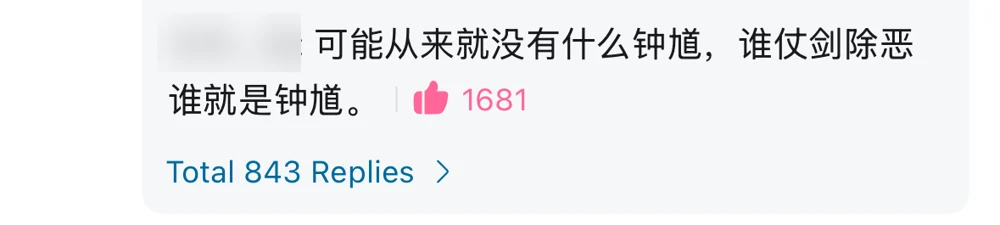
可能从来就没有什么钟馗,谁仗剑除恶谁就是钟馗。
“Perhaps there was never one Zhong Kui. Whoever takes up the sword against evil becomes Zhong Kui.”
The cleanest definition in the archive, written as a reply to an identity theory. It stops asking which biography is canonical and names the thing that has actually stayed stable: not the person, but the task. The sword, the direction of its violence and the willingness to carry it are enough to make the office legible.
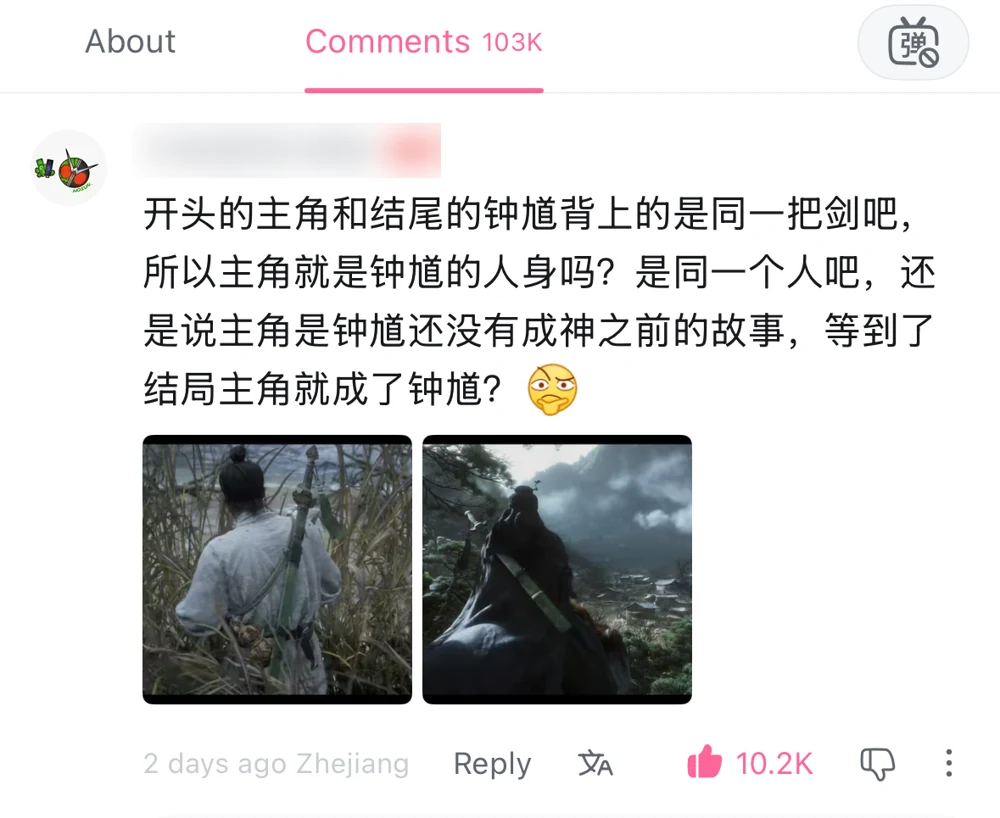
开头的主角和结尾的钟馗背上的是同一把剑吧,所以主角就是钟馗的人身吗?是同一个人吧,还是说主角是钟馗还没有成神之前的故事,等到了结局主角就成了钟馗?
“The protagonist at the beginning and Zhong Kui at the end carry the same sword. Is the protagonist Zhong Kui in human form? Are they the same person — are we playing the story before his deification, and does he become Zhong Kui at the end?”
Here Zhong Kui is the destination of a transformation: human form, deification, office. The commenter reads one repeated prop — the sword — as continuity across two bodies, which is exactly how an accumulated figure invites interpretation.
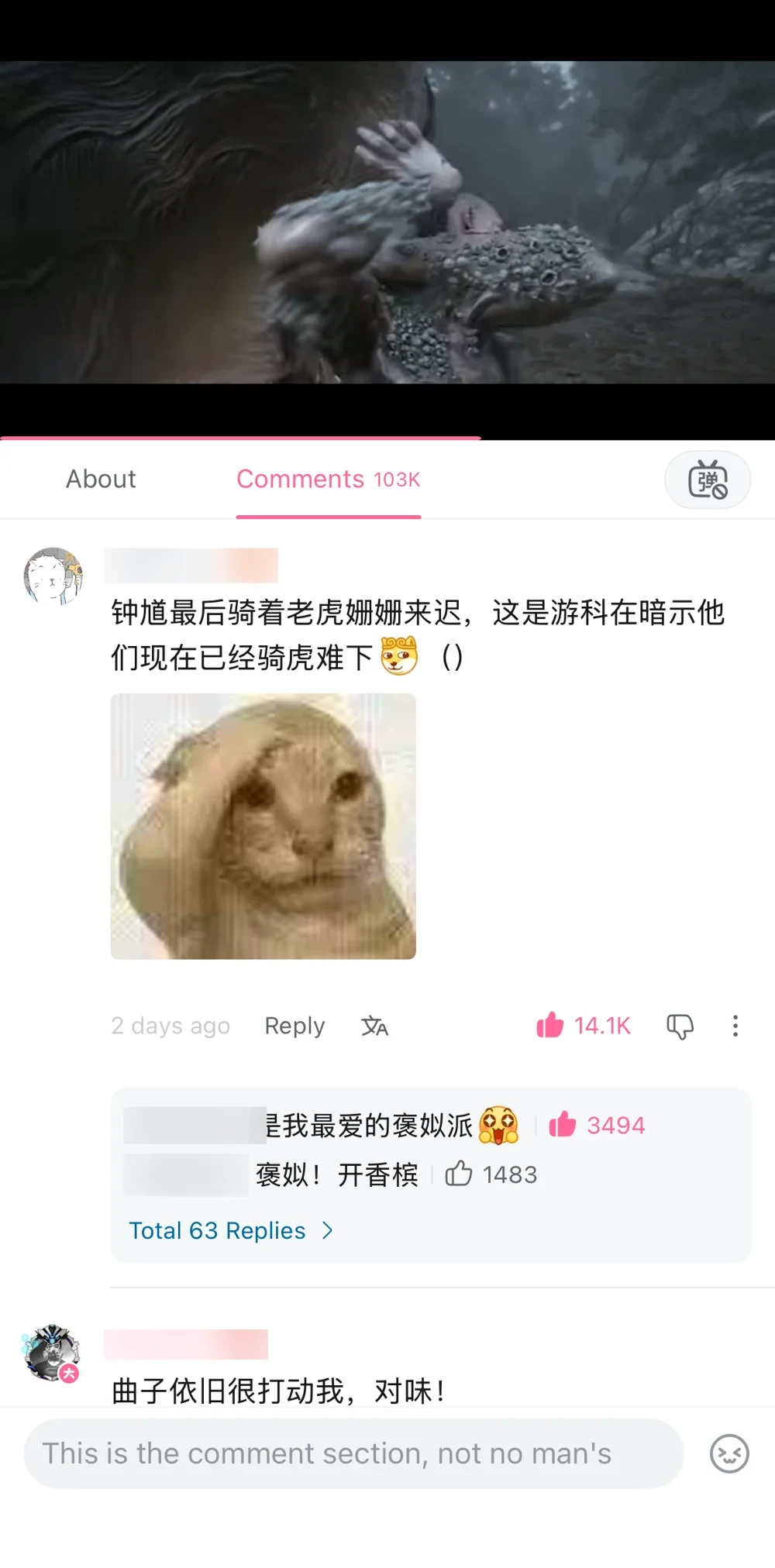
钟馗最后骑着老虎姗姗来迟,这是游科在暗示他们现在已经骑虎难下。
“Zhong Kui finally arrives late on a tiger. Game Science must be hinting that it is now riding a tiger it cannot dismount.”
Traditional-looking imagery is not kept behind museum glass. The viewer takes the tiger mount, joins it to a living idiom, and turns both toward a contemporary production problem: after Black Myth: Wukong, the studio cannot simply climb down from expectation.
The word
钟馗 is China’s demon-quelling guardian — a proper name attached to a figure whose biography, powers and public meaning have been repeatedly rebuilt by new stories, images and bodies.
Calling him a “Chinese demon hunter” gets the weapon and loses the institution. Zhong Kui can drive out ghosts, but he also guards doors and households; he can be invoked as an upright scholar wronged by worldly judgment, honoured with Daoist titles, painted as a fierce protector, staged in opera, made comic by attendant demons, or cast again by a new game. His violence is only one part of the figure. Where it points, and what it protects, are the rest.
The person changes. The office survives.
How it’s built
This is a proper name, not a compound to be solved character by character. Do not turn 钟 into “bell” and 馗 into “crossroads” and pretend the result explains him. It does not. The two characters tell you how the name is written; the archive tells you what the name can do.
That archive is layered rather than linear: the famous story of a Tang emperor dreaming of a ghost-catcher; later retellings of an upright scholar rejected for his ugly face; Daoist honour, household images, theatre, festival prints and paintings. These do not fit neatly into one authorised life. They accumulate around a recognisable job — frighten what threatens the household, defend an order that ordinary authority failed to defend.
The visual contradiction is part of the grammar. Zhong Kui looks violent enough to be mistaken for the thing at the door. He is placed there to keep worse things out. Later stories sharpen the same reversal: the face judged unworthy by a court becomes the face trusted to judge demons.
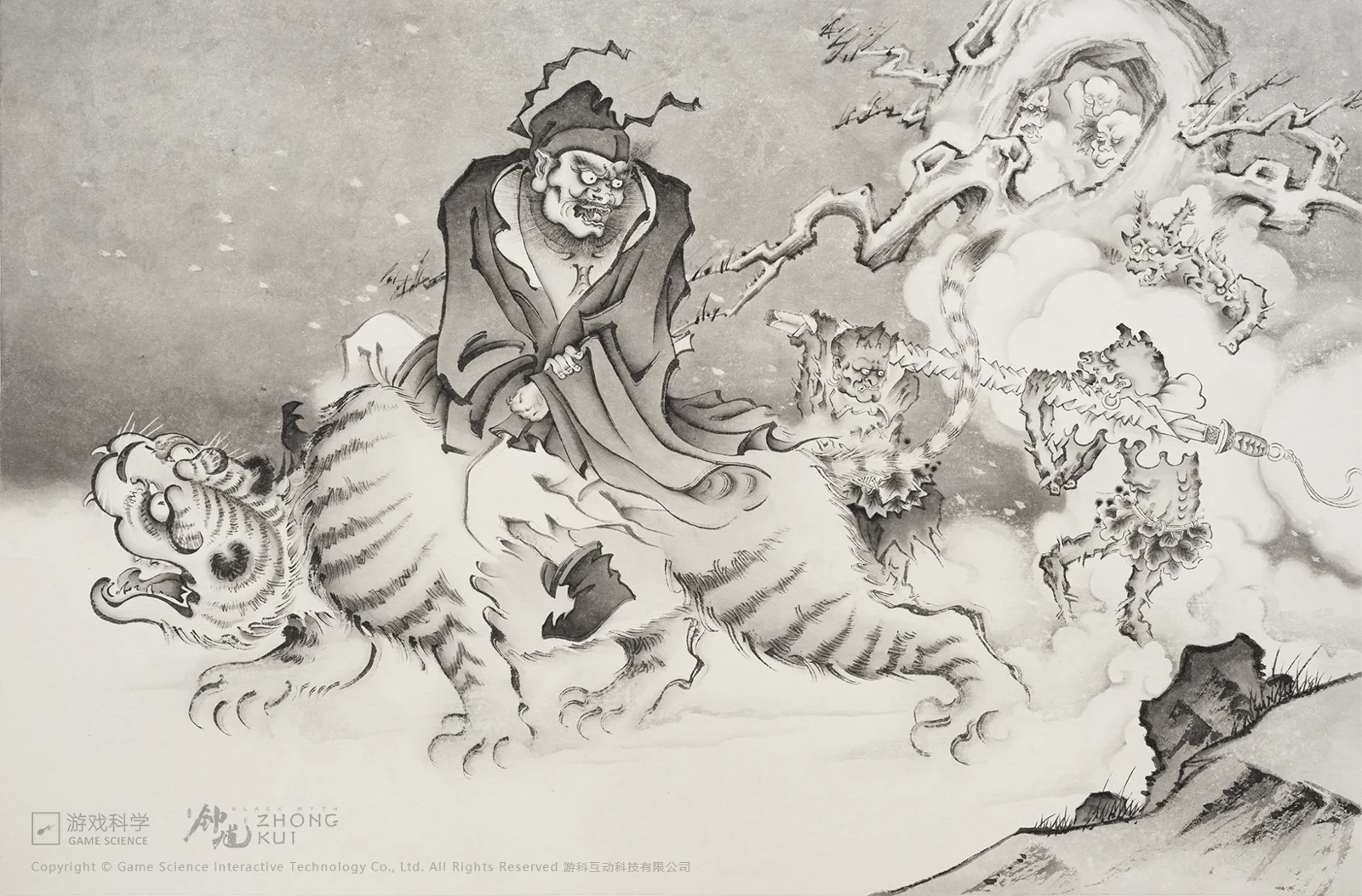
Zhong Kui riding a tiger in official concept art for Black Myth: Zhong Kui. The fierce guardian, the tiger mount and the attendant demons are all immediately legible — which is why the comment section can turn the same image into a release-date joke. Source: Game Science.
Where he accumulated
There is no single origin story to promote as the biography. Different historical layers preserve different Zhong Kuis, and later tellers often make an inherited figure look as though he had always possessed their version of his past.
One famous narrative places him in an imperial dream: a fierce ghost-catcher appears to the Tang emperor Xuanzong and subdues a smaller ghost. The British Museum notes both the dream tradition and that the surviving legends postdate the eighth century, which is why “Tang-linked” is safer than pretending we possess a single Tang biography. One familiar later version gives him the moral biography of the failed scholar — talented and upright, denied success because of his appearance, then restored after death as a judge of what respectable society failed to see. Religious titles, local worship, door images, opera and painting add further lives. None needs to cancel the others for the figure to remain legible.
The images kept changing jobs too. A Qing print could protect a household from evil; a late-Qing painting could turn Zhong Kui into a political symbol and an eccentric scholar. “The person changes. The office survives” is our reading of that accumulated archive — not a claim that traditional dictionaries literally define him as an office.
The useful question is therefore not which one is the real Zhong Kui? It is what did this century need Zhong Kui to be?
How to use it
- As a proper name: 钟馗 arrives with the demon-quelling and protective archive attached. Transliterate it as Zhong Kui; explain the role on first mention instead of replacing the name.
- As a role someone becomes: 谁仗剑除恶,谁就是钟馗 “whoever takes up the sword against evil becomes Zhong Kui”. The pattern transfers the office without claiming the person is a literal deity.
- As inherited imagery put back to work: 钟馗骑虎 “Zhong Kui riding a tiger” can remain protective iconography and become a release-date joke in the same sentence. Reuse is not evidence that the older layer disappeared; it is evidence that people still recognise it.
In English, keep the name. China’s demon-quelling guardian is a useful first handle, not a replacement definition.
When it goes wrong
Reduce Zhong Kui to a monster-killing action hero and the comments stop making sense. “Demon hunter” explains a sword fight. It does not explain the door, the household, the wronged scholar, the ugly face made morally upright, or why a viewer can treat Zhong Kui as a position another protagonist may grow into.
The opposite mistake is to freeze one popular telling into official history. Say popular tradition, one familiar version or later retellings when that is what the evidence supports. A vivid biography can be culturally real without being the one original biography from which every other layer descends.
And do not use Zhong Kui as a generic label for any Chinese supernatural fighter. The name carries a particular archive. Not every sword raised at a ghost inherits it.
Why it doesn’t translate
The difficulty is not that English lacks words for demons, hunters or guardians. It is that a one-line substitute asks one of Zhong Kui’s layers to impersonate the whole.
Chinese demon hunter chooses the modern action verb. Door god chooses placement. Exorcist chooses ritual function. Wronged scholar chooses one moral biography. Each is present somewhere; none can stand in for all the others.
So the honest translation is staged. First, keep Zhong Kui. Then give the reader a handle — China’s demon-quelling guardian — and let the surrounding sentence specify which Zhong Kui is active there: the household protector, the rejected scholar, the Daoist figure, the painted terror, the theatrical character, or the office newly filled by whoever carries the sword.
- #000 热搜 “trending, with a hand on the dial”
- #001 momo “the shared alias”
- #002 眼前一黑 “and everything went dark”
- #003 能工智人 “the working sapiens”
- #004 望周知 “please be advised”
- #005 普信男 “so ordinary, so confident”
- #006 负鼠 “the opossum”, and the philosophy that comes with it
- #008 牛马 human beasts of burden — workers calling themselves oxen and horses
- #009 牛来 Niu Lai — a homemade film title that became a quality test, a chain of puns and, briefly, a living creature
- #010 背锅 to take the fall — especially for blame that belongs elsewhere
- #011 抽象 so far outside ordinary logic that the wrongness becomes the aesthetic
- #012 来都来了 well, we're already here