热搜 “trending, with a hand on the dial” LIT. hot-search
RESOU is 热搜 in pinyin: rè sōu, the hot search. English has “trending” — a number that happens to you. 热搜 is a place. You can be put there, and you can be taken down again within the hour. Every story on this site starts with the same two questions: how did this get on the list, and who wanted it there?
Rejected translations: trending · trending topics · viral · what's buzzing · China's Twitter trends
THE RESOU DICTIONARY — SLANG THE CHINESE INTERNET USES EVERY DAY, DEFINED IN ENGLISH AND CITED FROM REAL COMMENT SECTIONS.
Attested in the wild
THE OED CITES SHAKESPEARE. WE CITE THE COMMENT SECTION. — 3 REAL SIGHTINGS, IDS BLURRED · SCREENSHOTS ARCHIVED AUG 2026
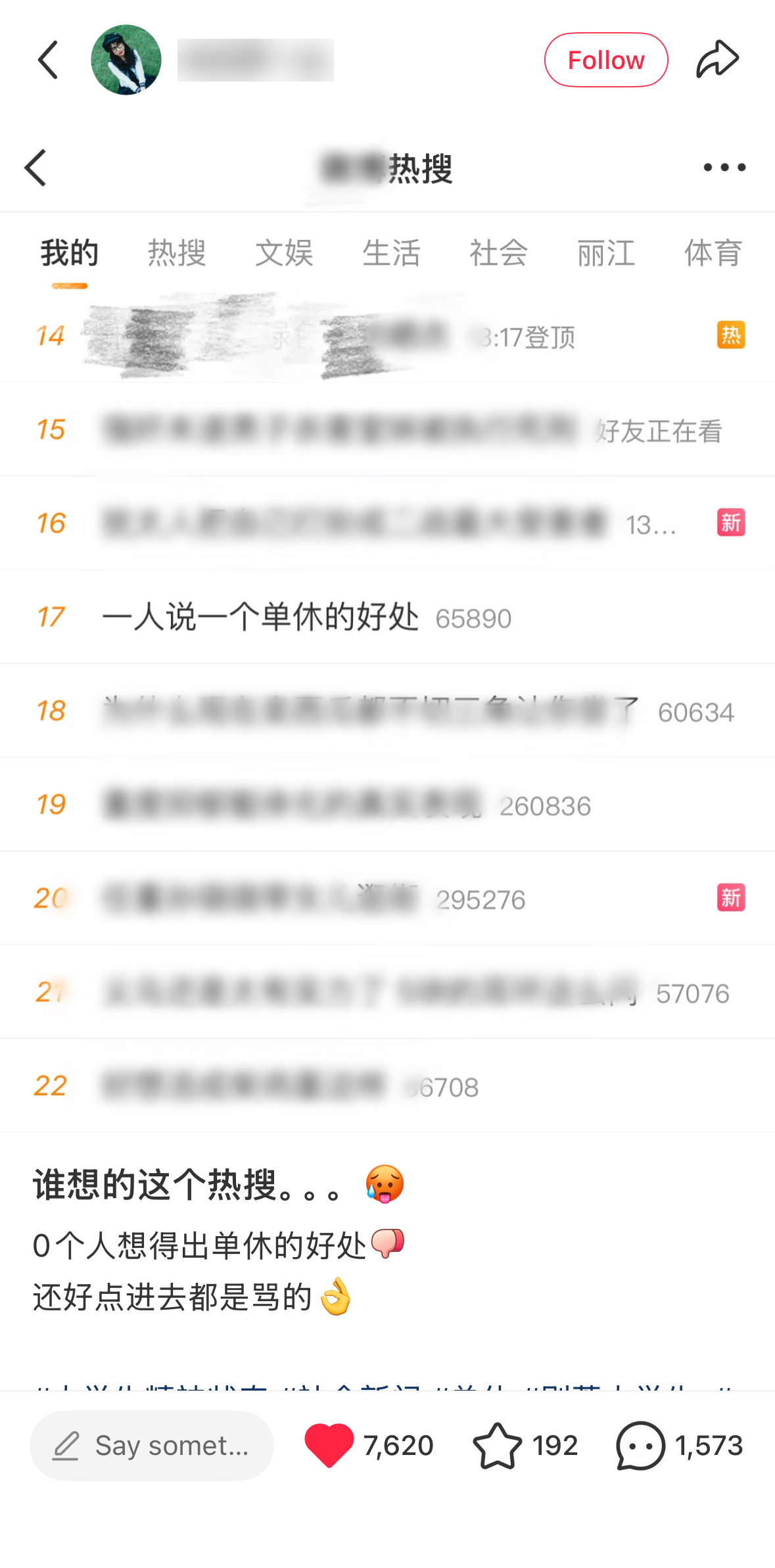
谁想的这个热搜。。。0个人想得出单休的好处,还好点进去都是骂的
“Who came up with this hot search… Zero people can think of a single upside to the six-day week. At least when you click in, it's all people cursing.”
The sentence this entry exists for. 谁想的 — “who thought this one up” — treats the list as something a person writes. English cannot ask it: nobody says who came up with this trend? The entry in question, #17, is 一人说一个单休的好处 (“everyone name one upside of the six-day week”, 65,890) — a prompt inviting praise for a labour arrangement, which the crowd answered by flooding it with abuse.
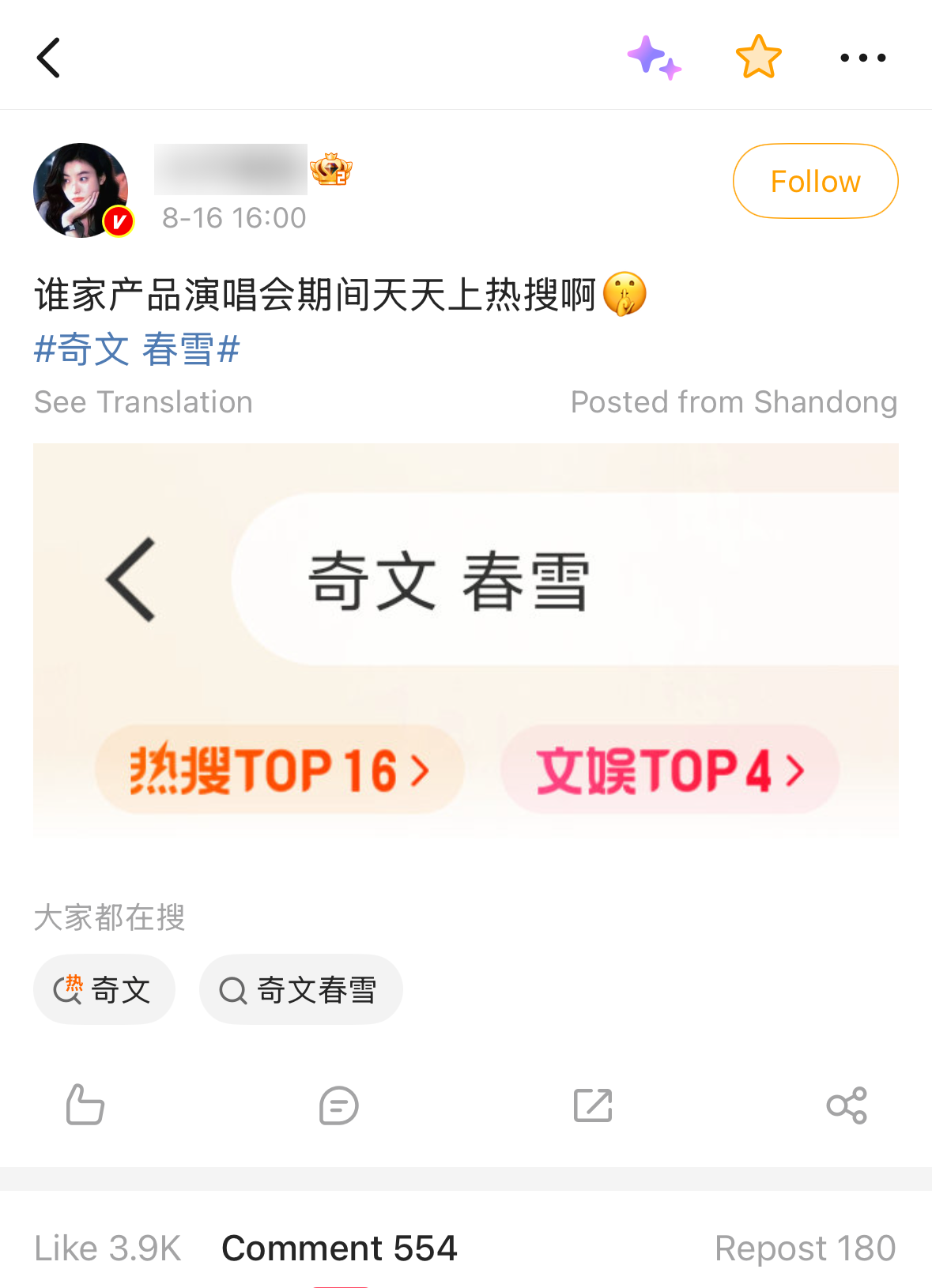
谁家产品演唱会期间天天上热搜啊🤫
“Whose product goes on the hot search every single day during a concert run 🤫”
The accusation in its polite form: no verb, no defendant, and a shushing emoji doing all the work. Note what the attached screenshot is — Weibo's own badge advertising 热搜TOP 16 · 文娱TOP 4. The platform sells rank back to you as an achievement, which is the fact the joke rests on.
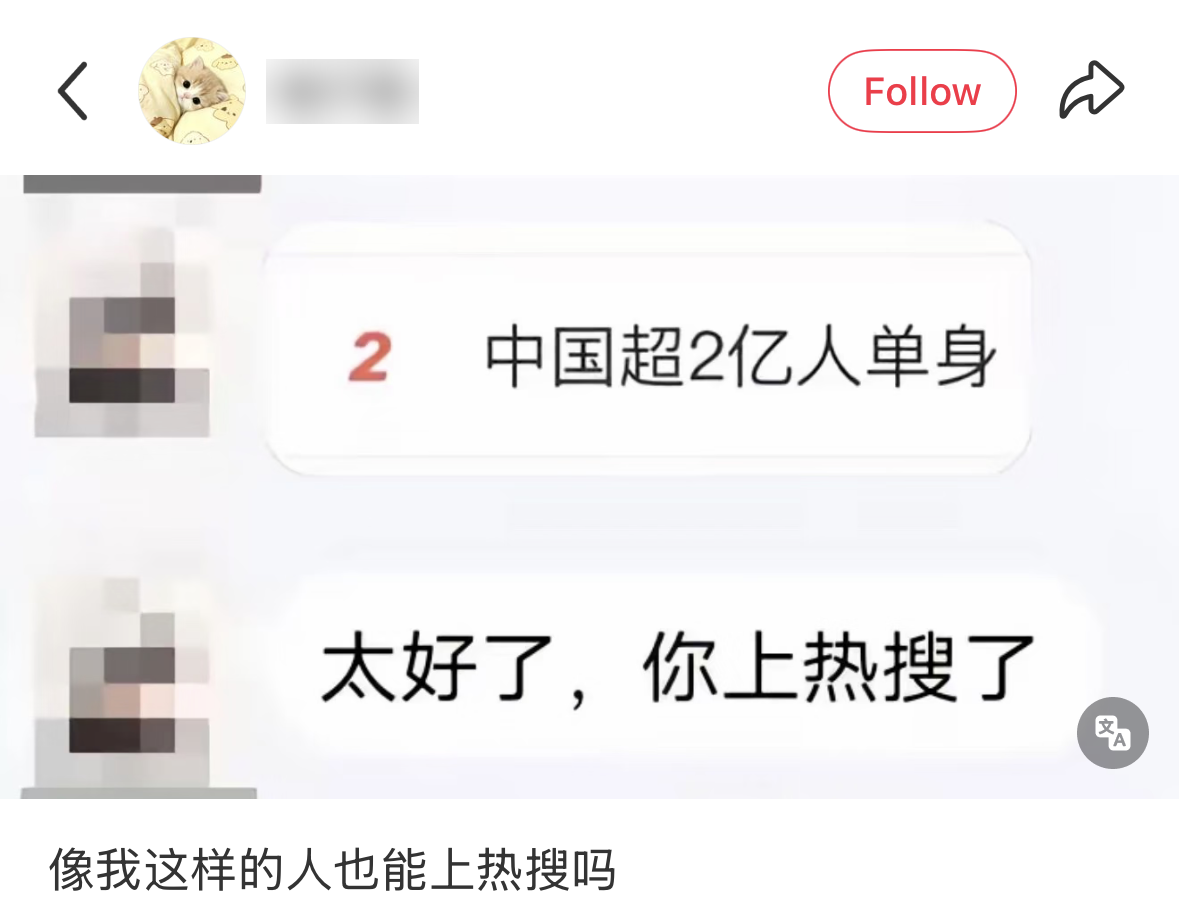
「中国超2亿人单身」——「太好了,你上热搜了」/ 像我这样的人也能上热搜吗
“#2: Over 200 million people in China are single. — Great, you made the hot search!”
The screenshot is a chat. One friend forwards the hot search list — 中国超2亿人单身 sitting at number two, the rank printed in red beside it — and adds 太好了,你上热搜了: “Great, you made the hot search!” The joke turns on a fact neither of them says out loud. The friend is single. So the entry is, technically, about him — and being counted inside a national statistic is apparently enough to put you on the list. 上热搜 is doing the work English gives to you made the papers, except that nobody here did anything at all. The poster then files the whole exchange under 像我这样的人也能上热搜吗 — “can someone like me make the hot search too?” — quietly claiming her own place among the two hundred million.
The word
A 热搜 is a ranked list of what a platform says people are searching for right now. Weibo’s is the one that matters; every other platform has since built its own, and the word has stopped belonging to any of them.
That is the dictionary definition, and it is the least interesting thing about it.
Here is the interesting thing. Under a list entry inviting people to name the upsides of a six-day working week, a user wrote four characters that no English speaker has ever needed:
谁想的这个热搜 shéi xiǎng de zhège rè sōu — “who thought up this hot search”
Try it in English. Who came up with this trend? is not a sentence anyone says, because a trend has no author — it is weather, a readout, a number that happens to you. The Chinese question is ordinary, idiomatic, and slightly annoyed, and it takes for granted that somewhere behind the list there is a person who chose.
That gap is the whole subject of this website. In English, trending is something a topic does. In Chinese, 热搜 is somewhere a topic is put — you go up onto it, and you can be taken off it.
How the list works
The list is administered. Somebody at the platform decides how many slots there are, how fast they turn over, and which entries carry one of the little coloured labels — 新 new, 热 hot, 沸 boiling. Rank is a product feature, and the platform will sell it back to you as an achievement: the badges in the third citation below, 热搜TOP16 and 文娱TOP4, are Weibo’s own.
Entries also move, and they stop being there. Nothing marks the exit: no gravestone, only a gap where the line used to be, and a list that closes over it like water. This is the part with no English equivalent — not the disappearing, which happens everywhere, but the fact that Chinese has a verb ready for it.
Readers who grew up with Twitter’s trending column tend to hear “hot search” and picture a thermometer. It is closer to a noticeboard with a keyholder.
How to use it
- 上热搜 shàng rè sōu — “to go on the hot search” is the verb you will see most. Watch its shape: things go up onto the list, and the sentence almost never says who lifted them.
- 热搜第一 rè sōu dì yī — “#1 on the hot search” is used as a measure of how bad it got, not as a compliment. Closest English: “it made the front page” — except the front page updates every few minutes.
- 撤热搜 chè rè sōu — “to pull it from the list”. English has no idiom for this because English has no button for it.
- 这也能上热搜? zhè yě néng shàng rè sōu — “this made the hot search?” is not a real question. It is the polite form of somebody paid for this.
When it goes wrong
Treating the list as a poll. It is the single most common mistake in English coverage of China: “Chinese social media users said X”, where the evidence is one hot search entry.
A hot search tells you that a topic was placed in front of several hundred million people and that they reacted. It does not tell you that the topic arrived on its own, that it stayed as long as it deserved, or that the loudest replies are the representative ones. It is a stage, and this site’s job is to describe what happened on it without pretending the stage isn’t there.
Why it doesn’t translate
“Trending” is the false friend, and it fails in the most useful way possible: it is passive where the Chinese is passive-ive. Twitter’s trends are a readout. The hot search is a placement. Translate 热搜 as trending and the reader loses the one fact that makes every story on this site make sense — that between what people are saying and what appears on the list, there is a room with a door.
“Viral” points the wrong way. Viral is bottom-up by definition; the hot search has a top.
Which leaves “hot search” — a literal rendering that is not English. Nobody in London says I saw it on the hot search. We use it anyway, and on purpose: the phrase stays visibly foreign, and a reader who trips over it is a reader who has correctly noticed that this is not their trending column.
Why we spell it RESOU
RESOU is 热搜 in pinyin — the standard system for writing Chinese sounds in the Latin alphabet, the one that turns 热搜 into rè sōu and puts the tone marks on top. Google keeps correcting it to “resource” — which we only noticed after the name was set. It is, in fact, the first five letters of resource. A coincidence we’ve decided to keep.
- #001 momo “the shared alias”
- #002 眼前一黑 “and everything went dark”
- #003 能工智人 “the working sapiens”
- #004 望周知 “please be advised”
- #005 普信男 “so ordinary, so confident”
- #006 负鼠 “the opossum”, and the philosophy that comes with it
- #007 钟馗 China's demon-quelling guardian — a role assembled across ritual, legend, religion, theatre and art
- #008 牛马 human beasts of burden — workers calling themselves oxen and horses
- #009 牛来 Niu Lai — a homemade film title that became a quality test, a chain of puns and, briefly, a living creature
- #010 背锅 to take the fall — especially for blame that belongs elsewhere
- #011 抽象 so far outside ordinary logic that the wrongness becomes the aesthetic
- #012 来都来了 well, we're already here