能工智人 “the working sapiens” LIT. able-work wise-human
Swap the first and last characters of 人工智能 — artificial intelligence — and you get 能工智人: a Homo sapiens that can work. Chinese office workers spent the summer of 2026 describing themselves as language models: finite tokens, a cheap afternoon tier, an overnight refresh.
Rejected translations: Smart Workers · artificial intelligence, reversed · working intelligence · artisanal intelligence
THE RESOU DICTIONARY — SLANG THE CHINESE INTERNET USES EVERY DAY, DEFINED IN ENGLISH AND CITED FROM REAL COMMENT SECTIONS.
Attested in the wild
THE OED CITES SHAKESPEARE. WE CITE THE COMMENT SECTION. — 3 REAL SIGHTINGS, IDS BLURRED
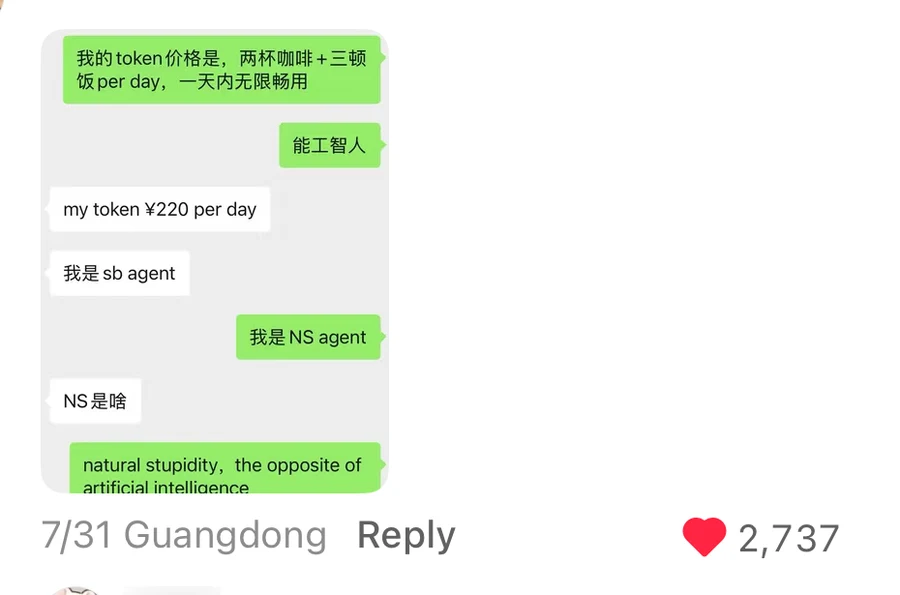
我的token价格是,两杯咖啡+三顿饭per day,一天内无限畅用 — 能工智人
““My token pricing: two coffees plus three meals per day. Unlimited use within the day.” — “能工智人.””
The word used as a one-word verdict — dropped into the chat the way you'd stamp a document CERTIFIED. The exchange then escalates: “I'm an sb agent” (sb = 傻逼 shǎbī, dumbass) is answered with “I'm an NS agent — natural stupidity, the opposite of artificial intelligence.”
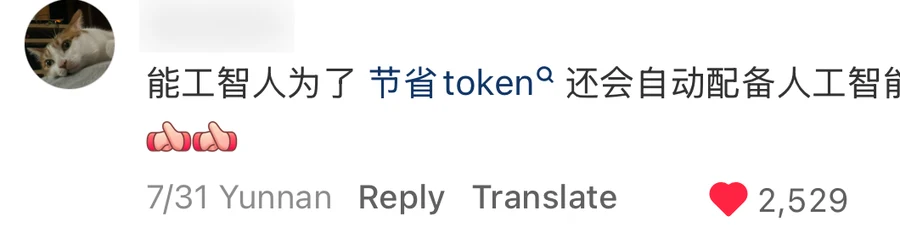
能工智人为了节省token还会自动配备人工智能
“To save tokens, the working sapiens ships with artificial intelligence built in.”
The word as the subject of a sentence, and the joke closing its own loop: the human model conserves its compute by outsourcing to the machine model. Xiaohongshu's own translation renders 能工智人 here as “Smart Workers” — the pun evaporates, which is roughly why this dictionary exists.

能工智人和人工智能都需要prompt和token才能好好干活
“Working sapiens and artificial intelligence both need prompts and tokens to work properly.”
Fifteen likes, and the most useful sentence in the thread: the word set beside the word it was made from, sharing a grammar. Whatever the machine is owed to work properly, the sentence quietly asks for too.
The word
A 能工智人 is a human being reclassified as a language model: finite tokens, a high-quality morning tier, a degraded afternoon one, and a refresh that requires sleep rather than a subscription.
It arrived as a hashtag in July 2026 and stayed because the metaphor turned out to fit far better than anyone wanted.
How it’s built
Take 人工智能 rén gōng zhì néng — artificial intelligence and swap the first character with the last. 人 (human) and 能 (able) trade places: 能工智人.
The result is not nonsense — that’s the whole trick. Read straight, it parses perfectly as a plain noun phrase: 能工 able to work + 智人 Homo sapiens. A sapiens that can work.
And that is where the joke turns quietly bleak. The speaker doesn’t demote himself from human to machine — machines are expensive. He demotes himself from 人 rén, a person to 智人 zhìrén, Homo sapiens — the species, as written on a museum label. Not someone who works. A specimen that is capable of work.
The scramble runs in the other direction too. Under the same post, a two-word comment — 智能工人 zhìnéng gōngrén, “smart worker” — collected 2,703 likes by putting the characters back in an order that sounds like something a boss would say. Neither arrangement is flattering.
There’s a third layer for the ear: 能工 is the front half of 能工巧匠 néng gōng qiǎo jiàng — “skilled craftsmen”, a compliment your grandfather would use. The praise-word and the taxonomy label arrive in the same four characters.
Where it took off
We can’t tell you who coined it — the tag was already circulating when it broke out. What we can point at is the post that put it in front of everyone: a Xiaohongshu note on 28 July 2026, captioned 人的 token 也是有限的 望周知 “Human tokens are finite too. Please be advised” — 望周知 is the sign-off of an official notice, the Chinese equivalent of stamping a memo FYI, EFFECTIVE IMMEDIATELY.
It was a screenshot of the author messaging a friend: mornings produce high-quality tokens, by afternoon she’s downgraded to the cheap model, and once those run out she just starts making things up. It refreshes overnight. Payment may trigger a surge. 16.9K likes, 2,488 comments, and a tag that people are still filing themselves under.
How to use it
- As a verdict, on its own: someone describes their own four-o’clock shutdown, and you reply with the four characters and nothing else — 能工智人. It reads as certified.
- About yourself: 我是能工智人 “I’m a working sapiens”, or simply file the post under the tag.
- In the comparison frame, which is where the word does its real work: put 能工智人 and 人工智能 in one sentence and let the symmetry do the arguing (third citation above). The frame is productive — pick anything the machine is given, and ask.
- The vocabulary that travels with the word — 我的 token 用完了 “I’m out of tokens”, said around 4pm, 睡一觉就刷新 “it refreshes after a sleep” — is not the word itself, but it is the dialect it belongs to.
- In English: the closest existing phrases are “I have no bandwidth” and “my brain is buffering” — but both stop at the metaphor. 能工智人 goes further and accepts the pricing model that comes with it.
When it goes wrong
It only works about yourself. Calling a colleague a 能工智人 hands the metaphor to management: you are now describing someone else’s throughput. The humour depends entirely on the speaker being the one who volunteers to be measured.
It is also not a complaint about AI. Nobody in the thread is afraid of being replaced by a model — they are busy comparing prices with one.
Why it doesn’t translate
The platform’s own translation says “Smart Workers”, which is not wrong so much as deaf: it renders the unscrambled version, 智能工人, and drops the scramble that was the entire point.
“Artificial intelligence, reversed” explains the mechanism and kills the timing. “Working intelligence” loses 智人 — and 智人 is where the sting lives, because the speaker is not calling himself intelligent. He is calling himself a species that happens to be employable.
- #000 热搜 “trending, with a hand on the dial”
- #001 momo “the shared alias”
- #002 眼前一黑 “and everything went dark”
- #004 望周知 “please be advised”
- #005 普信男 “so ordinary, so confident”
- #006 负鼠 “the opossum”, and the philosophy that comes with it
- #007 钟馗 China's demon-quelling guardian — a role assembled across ritual, legend, religion, theatre and art
- #008 牛马 human beasts of burden — workers calling themselves oxen and horses
- #009 牛来 Niu Lai — a homemade film title that became a quality test, a chain of puns and, briefly, a living creature
- #010 背锅 to take the fall — especially for blame that belongs elsewhere
- #011 抽象 so far outside ordinary logic that the wrongness becomes the aesthetic
- #012 来都来了 well, we're already here