来都来了 well, we're already here LIT. come — already — come — done
Four characters, the same verb twice, and no reasoning in between: we are here, so we are doing it. 来都来了 is what Chinese speakers say at the ticket booth, the trailhead, the buffet and, this August, the camera roll. The cost is already paid; the sentence converts it into a principle. English has ‘might as well,’ which forgets the cost, and ‘sunk cost fallacy,’ which is far too honest.
Rejected translations: might as well · YOLO · when in Rome · sunk cost fallacy
THE RESOU DICTIONARY — SLANG THE CHINESE INTERNET USES EVERY DAY, DEFINED IN ENGLISH AND CITED FROM REAL COMMENT SECTIONS.
Attested in the wild
THE OED CITES SHAKESPEARE. WE CITE THE COMMENT SECTION. — 3 REAL SIGHTINGS, IDS BLURRED · SCREENSHOTS ARCHIVED SEP 2026 · ONE DOUYIN COMMENT SECTION, TWO REDNOTE POSTS
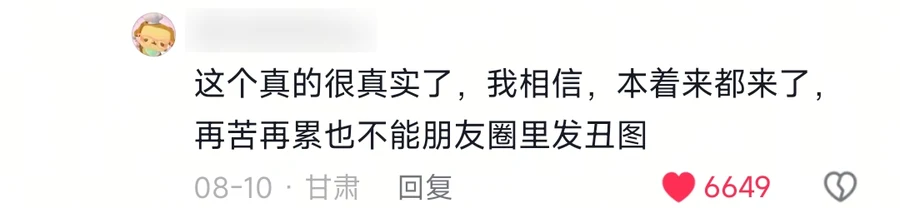
这个真的很真实了,我相信,本着来都来了,再苦再累也不能朋友圈里发丑图
“Painfully real, and I believe her. On the principle of ‘well, we're already here’ — however hard it gets, no ugly pictures allowed in Moments.”
The classic setting, travel, with one twist. 本着 means on the principle of, so the four characters are quoted as a rule the writer is obeying, not a thing she is saying. And the cost being recovered is the entire miserable trip; what it buys is not one more attraction but a photo good enough to have made the trip worth it.
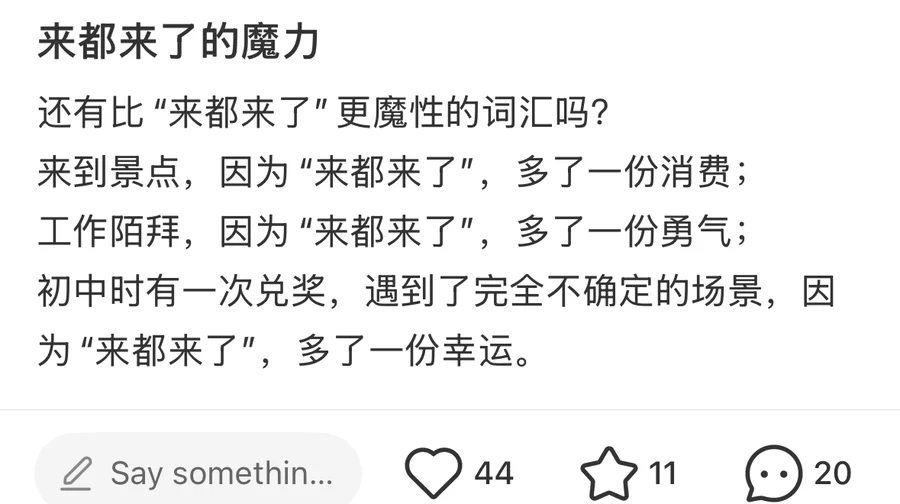
还有比“来都来了”更魔性的词汇吗?来到景点,因为“来都来了”,多了一份消费;工作陌拜,因为“来都来了”,多了一份勇气;初中时有一次兑奖,遇到了完全不确定的场景,因为“来都来了”,多了一份幸运。
“Is there a more hypnotic phrase than ‘well, we're already here’? At a tourist site, ‘we're already here’ buys one more purchase. On a cold sales call, ‘I'm already here’ buys a little more courage. Once in middle school, redeeming a prize in a situation I could not read at all, ‘I'm already here’ bought me a little luck.”
A native speaker writing the dictionary entry for us. 魔性 is the word for a tune or a phrase you cannot get out of your head. The three cases matter more than the like count: consumption, courage and luck, three different goods, all bought with the same four characters. The phrase has no content of its own. It supplies whatever the moment was missing.
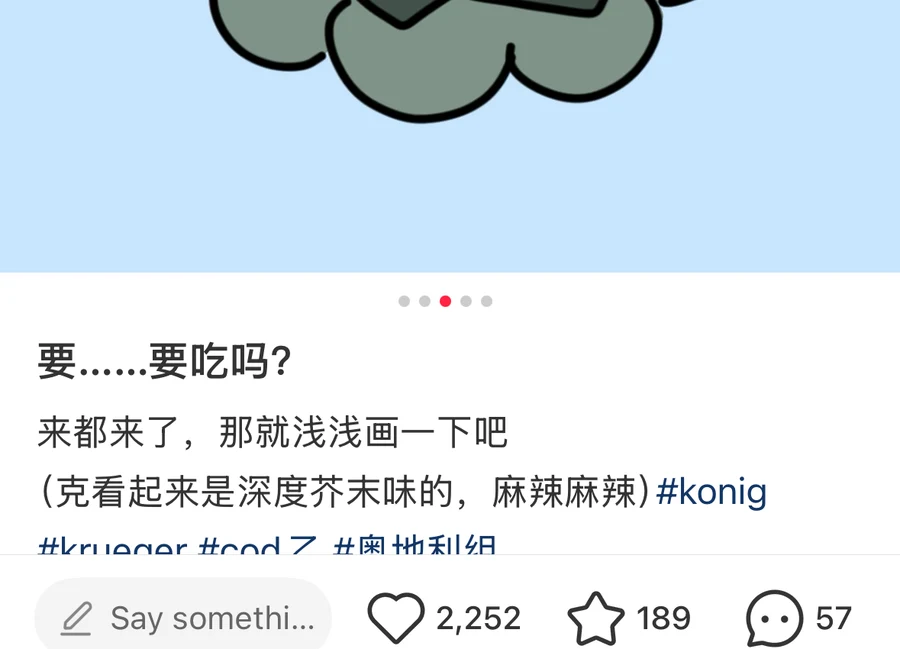
来都来了,那就浅浅画一下吧
“Well, I'm already here, so I'll do a quick little drawing.”
No trip, no ticket, no place. The post is fan art of a video-game character, and the here the writer has arrived at is a fandom. Once 来都来了 works without a location, it has stopped being a travel remark and become a principle: a cost was paid, so something must be produced. Note the frame 来都来了,那就……吧, we're here, so let's, the phrase's most common shape.
The word
来都来了 is the sentence that ends the discussion: we have already come, so we are doing the thing.
It is said at the ticket booth when the ticket is too expensive, at the trailhead when the summit is two hours further than advertised, at the buffet when nobody is hungry and, in August 2026, in front of the camera when the trip has been a disaster and the photo still has to look like heaven. The cost has already been paid. The four characters convert that cost into a reason.
Nobody argues with it, because there is nothing in it to argue with. It makes no claim about whether the thing is worth doing. It only observes that you are here.
How it’s built
来 lái is to come. 都 dōu usually means all, but here it means already or even, with a shrug built in. 了 le marks the coming as done. Literally: come, already come.
The verb appears twice. The first 来 is the topic, as for coming; the second is the fact, we have come. Chinese has a productive template here: V 都 V 了, the verb, then 都, then the verb again with 了. 买都买了 “it’s already bought”. 说都说了 “it’s already been said”. 吃都吃了 “it’s already eaten.” Every version means the same thing: the deed is done, adjust your position. 来都来了 is simply the most-used slot in the template, because arriving somewhere is the sunk cost people notice most.
There is no subject. Whoever came, the principle applies.
Where it took off
We cannot name a first speaker. 来都来了 is ordinary spoken Chinese and has been for as long as anyone has bought a ticket they regretted. What the internet did, sometime in the mid-2010s, was notice it. The phrase began turning up in much-reposted lists of the sentences with which Chinese people excuse anything, alongside 大过年的 “it’s New Year” and 还是个孩子 “they’re only a child.” A spoken reflex became a named national habit, and once a habit has a name, people start quoting it about themselves.
By 2026 the quotation marks are audible. Commenters write 本着来都来了 “on the principle of 来都来了” and 主打一个来都来了 “main feature: 来都来了”, phrasings that treat the four characters as a rule they are following rather than a thing they are saying.
How to use it
- As the whole sentence: someone points out that the cable car costs 200 yuan. You say 来都来了. That is the reply in full; the cable car is now happening.
- As the frame: 来都来了,那就 X 吧 “we’re already here, so let’s X.” X is whatever costs a little more than you wanted: one more temple, one more dish, in one attested case one more drawing.
- As a principle you are merely obeying: 本着来都来了 “on the principle of 来都来了.” The speaker did not decide anything. The four characters did.
- As a personal brand: 主打一个来都来了 “main selling point: 来都来了.” 主打 is the verb used for a product’s headline feature.
The nearest English is we’ve come this far or might as well. Both translate the mood. Neither closes a conversation the way the Chinese does.
When it goes wrong
The phrase is harmless when you say it to yourself and expensive when someone says it to you. It is how the guide sells the extra boat ride, how the relative gets you to the third banquet, how the friend who planned the trip keeps the group walking. In those mouths 来都来了 is not a shrug but a lever, and the person being levered usually knows it. Say it to a companion once, in a rueful voice, as a joke you are both in on. Say it three times in a day and you are the reason the day is long.
Do not translate it as YOLO. YOLO is about appetite; 来都来了 is about accounting. The speaker is not excited. They have simply noticed that the money is gone and would prefer it to have bought something.
And do not use it before the cost exists. 来都来了 requires that you have already come. Said at the planning stage, it is just a plan.
Why it doesn’t translate
English has all the pieces and none of the sentence. Might as well gives up the cost, which is the whole point. Sunk cost fallacy names the error precisely, which is exactly what the Chinese refuses to do; the phrase works because nobody says the word fallacy. When in Rome is about behaving like the locals. In for a penny, in for a pound is closest in logic and belongs to a different century.
What none of them has is the shape: four syllables, no subject, no verb of deciding, a finished fact presented on its own and left to do the persuading. English wants a clause with a so in it. 来都来了 leaves the so to you, and you always supply it.
- #000 热搜 “trending, with a hand on the dial”
- #001 momo “the shared alias”
- #002 眼前一黑 “and everything went dark”
- #003 能工智人 “the working sapiens”
- #004 望周知 “please be advised”
- #005 普信男 “so ordinary, so confident”
- #006 负鼠 “the opossum”, and the philosophy that comes with it
- #007 钟馗 China's demon-quelling guardian — a role assembled across ritual, legend, religion, theatre and art
- #008 牛马 human beasts of burden — workers calling themselves oxen and horses
- #009 牛来 Niu Lai — a homemade film title that became a quality test, a chain of puns and, briefly, a living creature
- #010 背锅 to take the fall — especially for blame that belongs elsewhere
- #011 抽象 so far outside ordinary logic that the wrongness becomes the aesthetic