普信男 “so ordinary, so confident” LIT. ordinary-confident-man
A compression of 普通却自信 — ordinary, yet confident. It does not mean stupid, or ugly, or even rude. It names one specific gap: the distance between what a man has actually done and the terms on which he believes he is owed your attention.
Rejected translations: confidence man · mediocre king · overconfident guy · Chad
THE RESOU DICTIONARY — SLANG THE CHINESE INTERNET USES EVERY DAY, DEFINED IN ENGLISH AND CITED FROM REAL COMMENT SECTIONS.
Attested in the wild
THE OED CITES SHAKESPEARE. WE CITE THE COMMENT SECTION. — 3 REAL SIGHTINGS, IDS BLURRED · SCREENSHOTS ARCHIVED AUG 2026
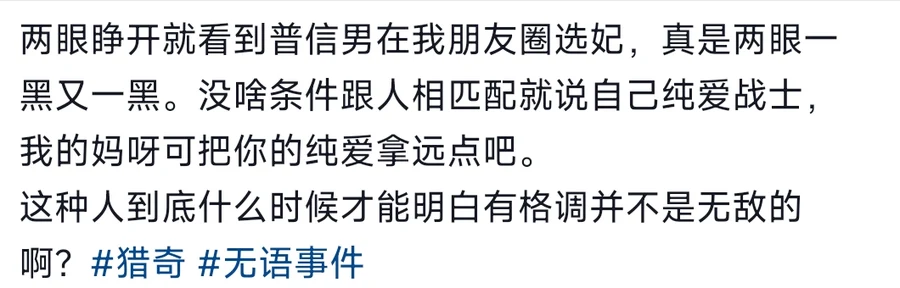
两眼睁开就看到普信男在我朋友圈选妃,真是两眼一黑又一黑
“I open my eyes and there's a 普信男 in my Moments picking out concubines. My vision goes black, then black again.”
The word doing its ordinary work: a species noun, dropped into a sentence about a Tuesday. Note the second half — 两眼一黑又一黑, black and then black again, which is #002 眼前一黑 doubled for a man who managed it twice.

打开了一本名为普信男的书
“I have opened a book entitled 普信男.”
Six thousand likes for eleven characters. The joke is the shelving: the man is not called a name, he is filed as a genre — and the speaker is merely a reader who has opened the book and is now, regrettably, reading it.
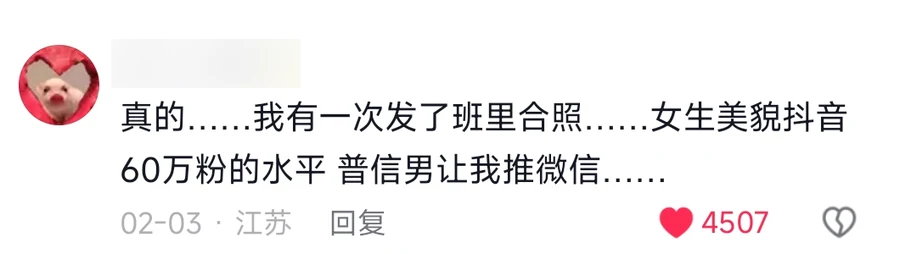
我有一次发了班里合照…女生美貌抖音60万粉的水平 普信男让我推微信
“I once posted a class group photo… the women in it were at the level of a Douyin account with 600,000 followers, and a 普信男 asked me to pass on their WeChat.”
Here the word is the subject of an anecdote, and the anecdote supplies the arithmetic the word is short for: the request was not outrageous because he wanted an introduction. It was outrageous because of the ratio he did not stop to calculate.
The word
A 普信男 is a man whose self-assessment has come unmoored from the evidence — 普通却自信 pǔtōng què zìxìn, “ordinary, yet confident”, squeezed into three characters.
Read the middle character carefully. 信 is confident, and confidence is not the charge. Plenty of ordinary men are liked for it. The charge is the 却 that got deleted in the compression: ordinary, yet confident — the little adversative that says the two halves were never reconciled.
How it’s built
普 from 普通 (ordinary) · 信 from 自信 (confident) · 男 man. Chinese builds insults this way constantly — take the two words in the accusation, keep one character each, add the category. The result sounds like a taxonomic label, which is the tone: not shouting, filing.
Where it came from
This one has an author and a date. On a 2020 comedy show, the stand-up 杨笠 Yang Li said of men: 他明明看起来那么普通,却可以那么自信 “he looks so completely ordinary, and yet he’s so confident”. The room laughed. The argument that followed ran for years, took in advertisers and boycotts, and cost her work — which is itself the best available evidence that the sentence landed on something.
The word outlived the fight. It is now used by people with no memory of the set.
How to use it
- As a species noun, third person, in a story about your week: a 普信男 commented / asked / turned up in my Moments. All three citations above do this.
- Never to his face. It is a description you give other people, the way you would name a weather system.
- In English there is no single word. Overconfident is too mild and misses the ordinariness; entitled is close but reads as an American political term; the nearest honest translation is a whole sentence — he thinks he’s the prize — which is why the entry exists.
When it goes wrong
The word is aimed at a gap, not at a man’s face or job. Use it on someone simply because he is unremarkable and it becomes what its critics always said it was: a class insult with a gender attached. The comedy only works while the target is the self-assessment.
It also cannot be flipped. There is no functioning 普信女 — attempts exist, and they land as a debating move rather than a description, because the underlying observation the word compresses is that the confidence is unequally distributed in the first place.
Why it doesn’t translate
Confidence man is a false friend: that is a con artist, someone who takes your trust deliberately. The 普信男 is entirely sincere, which is the problem. Mediocre king romanticises him. Chad is his opposite — Chad has the evidence.
English can describe this man at length and has no way to file him in three syllables, which is the difference between having a complaint and having a category.
- #000 热搜 “trending, with a hand on the dial”
- #001 momo “the shared alias”
- #002 眼前一黑 “and everything went dark”
- #003 能工智人 “the working sapiens”
- #004 望周知 “please be advised”
- #006 负鼠 “the opossum”, and the philosophy that comes with it
- #007 钟馗 China's demon-quelling guardian — a role assembled across ritual, legend, religion, theatre and art
- #008 牛马 human beasts of burden — workers calling themselves oxen and horses
- #009 牛来 Niu Lai — a homemade film title that became a quality test, a chain of puns and, briefly, a living creature
- #010 背锅 to take the fall — especially for blame that belongs elsewhere
- #011 抽象 so far outside ordinary logic that the wrongness becomes the aesthetic
- #012 来都来了 well, we're already here