眼前一黑 “and everything went dark” LIT. before-eyes-one-black
The words describe fainting — the split second when your vision goes black. Online they describe reading something so stupid, so cringeworthy, or so exhausting that your body files a formal complaint. It is the closest Chinese has to “I physically cannot.”
Rejected translations: I saw stars · blacked out · I fainted
THE RESOU DICTIONARY — SLANG THE CHINESE INTERNET USES EVERY DAY, DEFINED IN ENGLISH AND CITED FROM REAL COMMENT SECTIONS.
Attested in the wild
THE OED CITES SHAKESPEARE. WE CITE THE COMMENT SECTION. — 1 REAL SIGHTING, IDS BLURRED
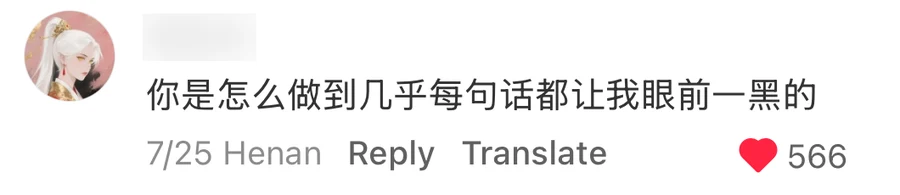
你是怎么做到几乎每句话都让我眼前一黑的
“How do you manage to make everything go dark before my eyes with almost every single sentence?”
Addressed to a blogger who had described a Fields Medal as a woman's marriage certificate. Note the construction: the writer doesn't say the post is bad — she reports her own symptoms and lets you draw the conclusion. That indirection is the whole charm of the phrase.
The word
眼前一黑 is what Chinese fiction says when a character faints: the eyes, the front of them, one blackness. Four characters, no verb, no subject — the grammar itself is the swoon.
Online, nobody has fainted. The phrase now reports the full-body reaction to reading something unbearable: a sentence so cringeworthy, an opinion so confident and so wrong, a group chat so exhausting that your vision briefly resigns.
How it’s built
Read it character by character: 眼 eye · 前 before · 一 one · 黑 black. One black before the eyes. Chinese four-character phrases work like compressed film shots, and this one is a hard cut to a black frame — which is exactly what the internet borrowed. The joke is that the body’s most dramatic possible response has been reassigned to the internet’s most trivial injury.
How to use it
- The full form is 看得我眼前一黑 “reading that made everything go dark” — the 看 marks that the damage came in through the eyes.
- Name the culprit immediately after: a sentence, a price tag, a coworker’s suggestion, your own bank balance.
- In English, the register you’re aiming for is “I need to lie down” or “that took a year off my life” — physical collapse claimed as a form of criticism. It is never “I was shocked”: too calm, and shock has no body in it.
When it goes wrong
It is about you, never about them. 你眼前一黑 — your vision went dark — isn’t an insult, it’s a diagnosis you have no business making. The phrase works precisely because the speaker files it as a personal injury report.
And it isn’t anger. Someone whose vision goes black is not fighting you; they are lying on the floor being funny about it. Reading it as an attack misses the tone by a wide margin.
Why it doesn’t translate
“I fainted” / “blacked out” are medical claims — English readers hear an ambulance. Chinese readers hear a cartoon. “I saw stars” is a punch to the head, involuntary and external. This is self-inflicted, and the cause is always something someone said. The closest honest English is “and my vision just went” — which no dictionary lists, because it isn’t an idiom in English yet. It should be.
- #000 热搜 “trending, with a hand on the dial”
- #001 momo “the shared alias”
- #003 能工智人 “the working sapiens”
- #004 望周知 “please be advised”
- #005 普信男 “so ordinary, so confident”
- #006 负鼠 “the opossum”, and the philosophy that comes with it
- #007 钟馗 China's demon-quelling guardian — a role assembled across ritual, legend, religion, theatre and art
- #008 牛马 human beasts of burden — workers calling themselves oxen and horses
- #009 牛来 Niu Lai — a homemade film title that became a quality test, a chain of puns and, briefly, a living creature
- #010 背锅 to take the fall — especially for blame that belongs elsewhere
- #011 抽象 so far outside ordinary logic that the wrongness becomes the aesthetic
- #012 来都来了 well, we're already here