负鼠 “the opossum”, and the philosophy that comes with it LIT. carrying-rodent
An opossum photographed standing at a window with its paws folded behind its back. Chinese users caption it, and every caption works the same way: take a phrase everyone already knows, break one character of it, and let the meaning drain out. What comes through is not protest. It is a small, rueful admission about yourself, made before anyone else can make it.
Rejected translations: possum · lying flat · doomer cat
THE RESOU DICTIONARY — SLANG THE CHINESE INTERNET USES EVERY DAY, DEFINED IN ENGLISH AND CITED FROM REAL COMMENT SECTIONS.
Attested in the wild
THE OED CITES SHAKESPEARE. WE CITE THE COMMENT SECTION. — 3 REAL SIGHTINGS, IDS BLURRED · SCREENSHOTS ARCHIVED AUG 2026
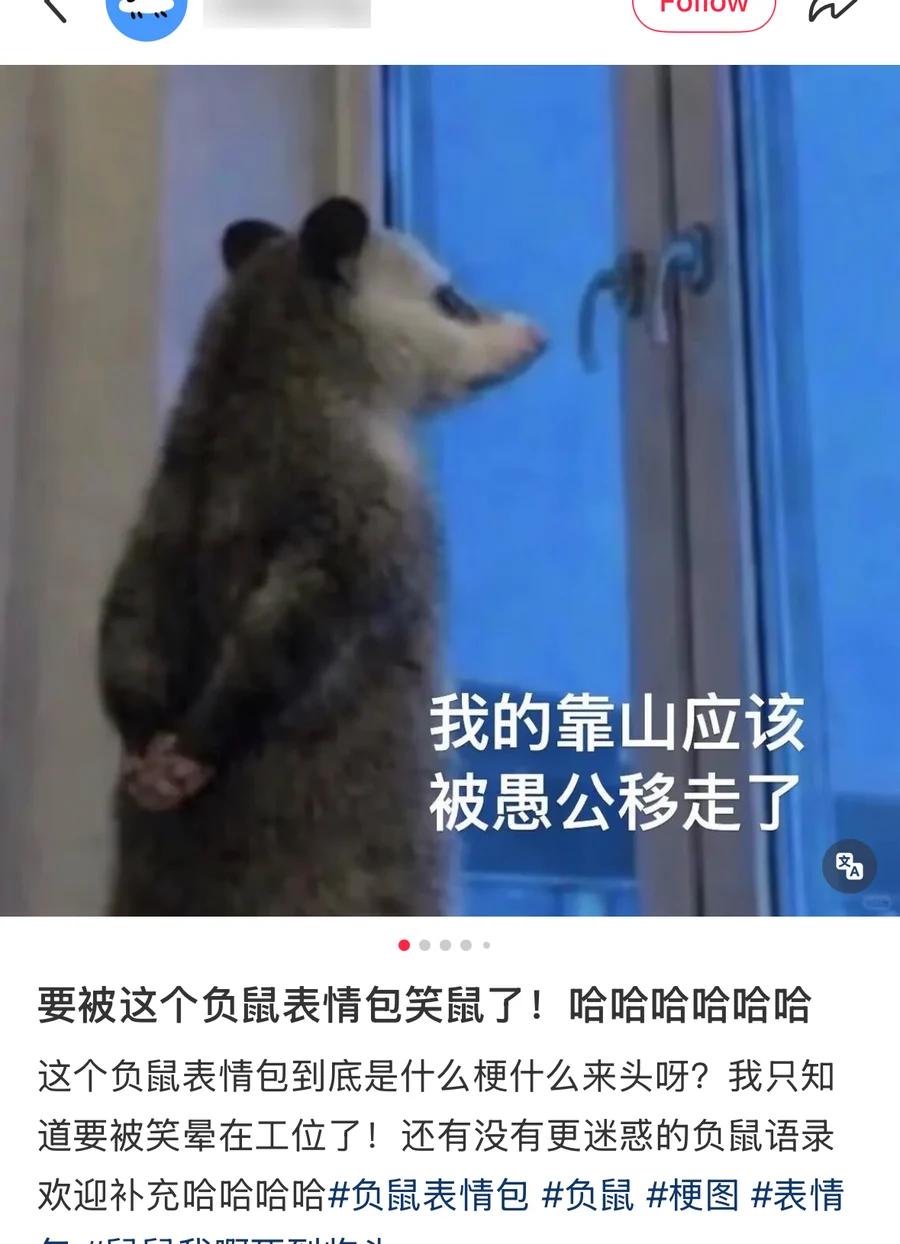
我的靠山应该被愚公移走了
“The mountain I was leaning on got moved. By an old man with a basket.”
The caption simply lets the parable happen to the protector — and note who is not blamed. Not the old man, not the mountain, and not the speaker, who merely observes that the thing he was leaning on is gone. The post text underneath is the other half of the evidence: 这个负鼠表情包到底是什么梗什么来头呀?我只知道要被笑晕在工位了 — “what even IS this possum meme, where did it come from? All I know is I'm about to pass out laughing at my desk.” Ninety-eight thousand people liked a post whose content is I don't know what this is and I can't stop.
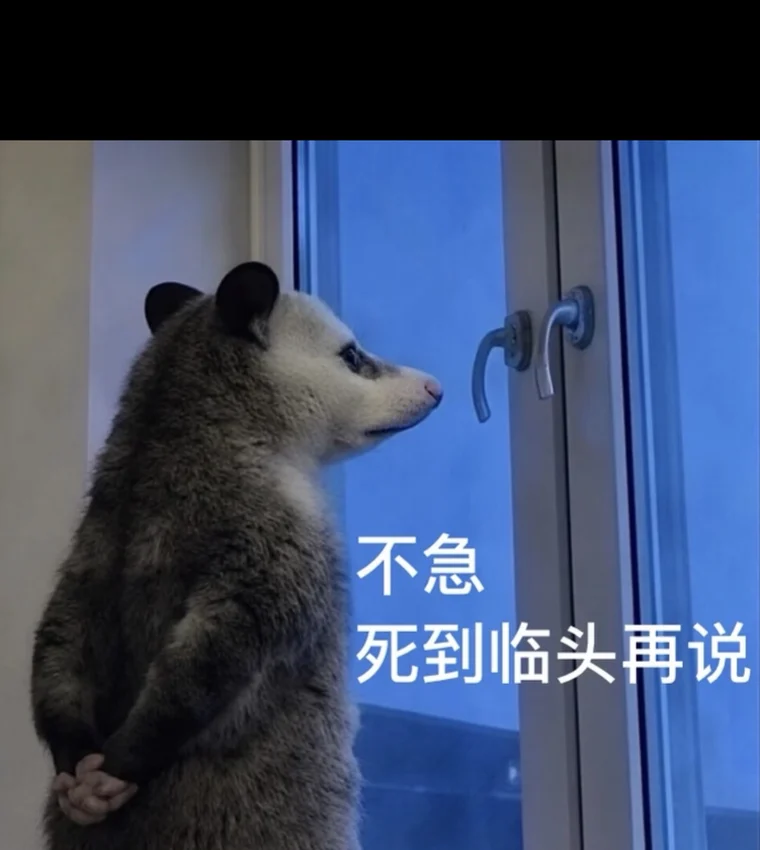
不急 / 死到临头再说
“No rush. I'll deal with it once it's fatal.”
Reassigned from accusation to calendar entry. The tone is the whole point: this is not defiance. Nobody is refusing anything. He is simply scheduling, badly, and telling you so.
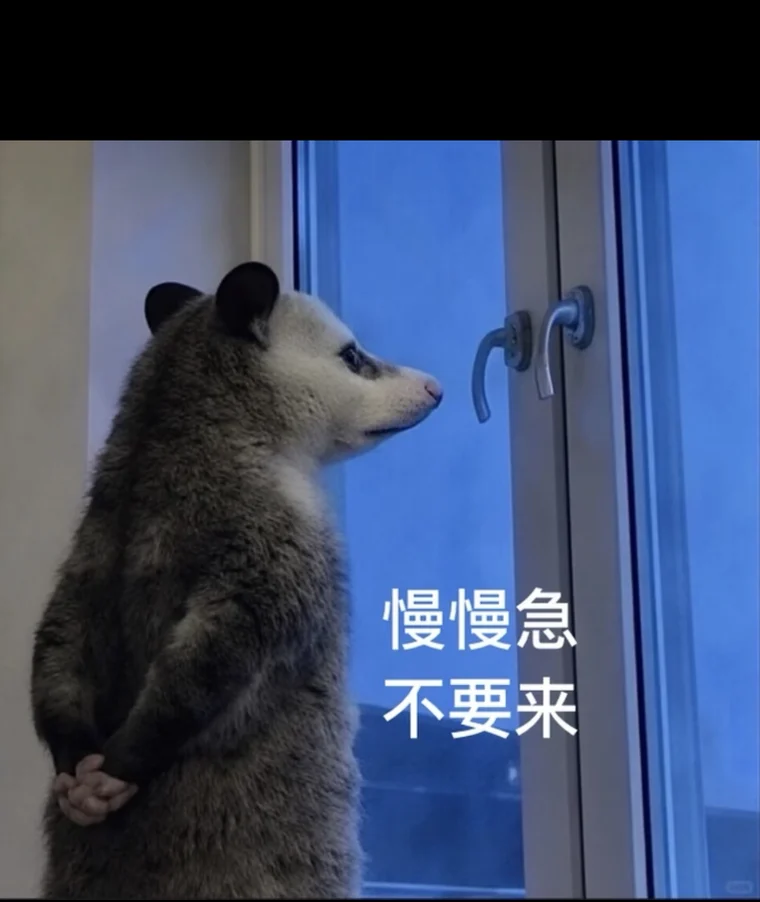
慢慢急 / 不要来
“Panic slowly. And don't come over.”
The soothing thing to say in Chinese is 慢慢来,不要急 — take your time, don't panic. Swap the last character of each half and comfort becomes two instructions nobody asked for. This is the genre's whole machinery in four characters: the phrase was already in everybody's head, and one small break drains it.
The word
负鼠 is the opossum. Since May 2026 it is also a way of handling your life.
The meme is one photograph: an opossum standing upright at a window, paws folded behind its back, looking out like a retired man surveying a courtyard. Chinese users write captions on it. The captions are the genre, and they are built to a single specification — take a phrase everyone already knows and break one character of it, so that whatever the phrase was for stops working.
The tone matters more than the mechanism, and it is easy to get wrong. These are not protest slogans. Every caption is aimed at the person writing it: I am not going to manage this, and we both know it. The pleasure is in saying it about yourself first — lightly, at your own expense, before anyone else gets there.
The first thing an English reader tends to check, reasonably, is whether there are opossums in China. There are not. The animal is American — and the face that a hundred thousand Chinese office workers recognised instantly as their own belongs to a species none of them has ever met.
How it’s built
Here is the part worth the entry. 负 fù means to carry on the back. The animal is called 负鼠 because the mother carries her young on her back once they outgrow the pouch — they cling to her fur while she forages. The name is a description of load-bearing.
When the meme broke out, so many people asked what the creature was that Chinese outlets ran explainers with zoologists, who clarified two things: it is not a rat (it is a marsupial, a relative of the kangaroo), and the 负 refers to the young on its back — not to the hands-behind-the-back pose in the photograph.
Which leaves the joke standing in a place nobody planned. Every caption in this genre is about being unable to carry anything — and the excuse offered is never a principle, it is a personal defect:
我能扛起什么责任,我是个溜肩啊 “What responsibility could I shoulder? I have sloping shoulders.”
溜肩 liū jiān is sloping shoulders — a mild physical complaint, the sort of thing people say about not suiting a certain coat. Offered as grounds for exemption from adult life, it is both a joke and a small confession, which is the register the whole genre sits in.
An animal named for carrying, famous for refusing to.
Where it took off
Two Xiaohongshu posts in May 2026 — one on the 19th, one on the 21st — between them around 200,000 likes and 8,500 comments. Neither could say where the photograph came from, which did not slow anything down. The second post’s cover caption, 有什么事明天也别说, rewrites the stock brush-off 有什么事明天再说 — tell me tomorrow — so that tomorrow is refused in advance too.
Under the tags on that post sits the detail that says most about what kind of thing this is: a group chat called 负鼠表情包 5 群, “Opossum Stickers Group 5”, holding 499 people. Four filled up first. A single funny picture does not need five rooms; a format anybody can write another line of does.
The lineage is visible in the tags. Alongside #负鼠表情包 sits #鼠鼠我啊死到临头 “rat-rat here, death at the door” — pointing back to 鼠鼠我啊 shǔ shǔ wǒ a, an earlier meme in which the speaker refers to themselves as a small sewer rat. The possum is that voice’s next tenant: same self-diminishment, better posture.
How to use it
- Write one. That is the whole form. Find a phrase that comes pre-installed in everyone’s head — a proverb, a line of managerial reassurance, a school text — and break exactly one word of it. The comment sections do this constantly: 每个成功人士背后都有一个屁股 “behind every successful person, there is an ass” (266 likes) rewrites behind every great man there is a great woman.
- As a genre name: 负鼠语录, possum quotes.
- In English you already own half of it. Play possum — to survive by lying there and refusing to participate — is the same animal doing the same trick. What English lacks is the office context: this possum is not escaping a predator, it is at work.
When it goes wrong
It is worn, not thrown. A possum quote is always about the speaker’s own uselessness — the moment you point one at a colleague it stops being self-mockery and becomes an appraisal, which is a different genre entirely and not a funny one.
And it is not 躺平 tǎng píng, lying flat, which is a position you take. Lying flat argues. The possum apologises, faintly, and does nothing — it is still standing at the window, still at the desk, still going to answer the message. Tomorrow. Possibly.
Why it doesn’t translate
Possum on its own is just the animal. What is missing in English is that 负 means carry — so the Chinese name quietly does half the work of the joke, and a reader who knows only “opossum” gets a picture where a Chinese reader gets a picture and an argument about responsibility.
Lying flat is the wrong scale and doomer is the wrong mood: nobody here is despairing. English tends to reach for defiance (quiet quitting) or for gloom (doomer), and this is neither. It is the register of someone taking the blame cheerfully and inaccurately, to get the moment over with — declining, politely, with their hands behind their back.
- #000 热搜 “trending, with a hand on the dial”
- #001 momo “the shared alias”
- #002 眼前一黑 “and everything went dark”
- #003 能工智人 “the working sapiens”
- #004 望周知 “please be advised”
- #005 普信男 “so ordinary, so confident”
- #007 钟馗 China's demon-quelling guardian — a role assembled across ritual, legend, religion, theatre and art
- #008 牛马 human beasts of burden — workers calling themselves oxen and horses
- #009 牛来 Niu Lai — a homemade film title that became a quality test, a chain of puns and, briefly, a living creature
- #010 背锅 to take the fall — especially for blame that belongs elsewhere
- #011 抽象 so far outside ordinary logic that the wrongness becomes the aesthetic
- #012 来都来了 well, we're already here