望周知 “please be advised” LIT. hoping-all-round-know
Three characters that close a real official notice, the way an English memo ends PLEASE BE ADVISED. Online they get stapled to things no institution would ever announce — your own depleted attention span, a discount at a scenic spot — and the joke is always the same: the voice of an authority, arriving on behalf of nobody.
Rejected translations: FYI · just so you know · spread the word
THE RESOU DICTIONARY — SLANG THE CHINESE INTERNET USES EVERY DAY, DEFINED IN ENGLISH AND CITED FROM REAL COMMENT SECTIONS.
Attested in the wild
THE OED CITES SHAKESPEARE. WE CITE THE COMMENT SECTION. — 3 REAL SIGHTINGS, IDS BLURRED · SCREENSHOTS ARCHIVED AUG 2026

本人于2026年5月种出了番茄,望周知
“The undersigned produced a tomato in May 2026. Please be advised.”
The best specimen in this entry, because the notice voice is not just the sign-off — it runs the whole length of the sentence: undersigned, formal preposition, dated to the month, sealed with 望周知. What is being placed on the public record is one cherry tomato, photographed on a tissue for scale, next to a caption clarifying that it is not a goji berry. 43,800 people agreed this was worth knowing.
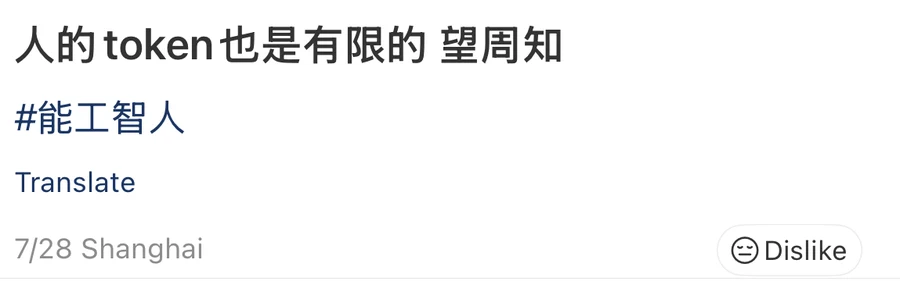
人的token也是有限的 望周知
“Human tokens are finite too. Please be advised.”
The caption of the post that started #003 能工智人. What is being announced, in the voice of a workplace circular, is that the author personally runs out of good sentences by mid-afternoon. Nobody appointed her to announce this. That is the form working exactly as intended.

新疆的景区领证,可以终生免门票,望周知
“Register at a scenic spot in Xinjiang and you get free admission for life. Please be advised.”
Read alone it looks like a travel tip. Read in its thread it is one more bid in that competition — marriage registration pitched as a loyalty perk, complete with the lifetime benefit and the official sign-off. The bureaucratic voice is not decoration here; it is the punchline, because the absurdity being described is itself bureaucratic.
The word
望周知 is how an official notice ends in Chinese — the line after the announcement, telling you the announcement was for everybody. Online it does the same job for announcements that concern nobody.
It is worth being precise about what the joke is, because it is easy to get backwards. 望周知 does not mean “this is genuine information.” It means I am saying this in the voice of an institution. The comedy is the gap between that voice and whatever has just been announced.
How it’s built
Three characters, and each is doing bureaucratic work: 望 wàng — to hope, in the formal register a person never uses about lunch; 周 zhōu — all round, on every side; 知 zhī — to know. It is hoped this is known all round. No subject, no addressee, no verb anyone could be held to. The grammar of a notice is that nobody in particular is speaking, and that is precisely what the borrower is borrowing.
The seal often brings the rest of the document with it. In the first citation below, the sentence opens 本人于2026年5月 “the undersigned, in May 2026” — 本人 is the self-reference of affidavits, 于 the written “on/at”, and the date is given to the month, and only then closes with 望周知. Filing language at both ends, and a tomato in the middle.
Where it took off
There is no origin to point at. The formula has closed government circulars, school announcements and HR emails for as long as those have existed — which is what makes it available: everyone has read it a hundred times without ever saying it.
What changed is who uses it. A form that only institutions could speak is now something you can put at the end of a sentence about your own afternoon.
How to use it
- Put it last. The statement arrives, then the seal: 人的 token 也是有限的,望周知. Nothing follows it.
- Announce something too small to announce. The device does not add weight to your news; it exposes how little weight the news has. Both citations above work this way — a personal energy shortage, a ticket discount.
- In English the closest move is genuinely available: Please be advised, Be advised, or the passive-aggressive corporate As a reminder. An English speaker reaching for the same joke would write “Please be advised.” and full stop.
When it goes wrong
Attach it to something that actually matters and it curdles — you sound like you believe you have the authority you are borrowing. The form only works when the mismatch is obvious to everyone, including you.
It is also not 转发周知 zhuǎnfā zhōu zhī, “forward this so everyone knows”, which is a real request to spread real news. 望周知 asks nothing of you. It just files the sentence.
Why it doesn’t translate
Unusually for this dictionary: it does. Please be advised is a close, honest match, and an English reader will get the joke on the first try.
What does not survive is the frequency. In English, borrowing the memo voice is a move you make occasionally, and it reads as sarcasm aimed at an employer. In Chinese it has become an ordinary sentence-ending — a way of announcing your own small absurdities in a voice that was built for announcing other people’s rules. The distance between those two things is the entry.
- #000 热搜 “trending, with a hand on the dial”
- #001 momo “the shared alias”
- #002 眼前一黑 “and everything went dark”
- #003 能工智人 “the working sapiens”
- #005 普信男 “so ordinary, so confident”
- #006 负鼠 “the opossum”, and the philosophy that comes with it
- #007 钟馗 China's demon-quelling guardian — a role assembled across ritual, legend, religion, theatre and art
- #008 牛马 human beasts of burden — workers calling themselves oxen and horses
- #009 牛来 Niu Lai — a homemade film title that became a quality test, a chain of puns and, briefly, a living creature
- #010 背锅 to take the fall — especially for blame that belongs elsewhere
- #011 抽象 so far outside ordinary logic that the wrongness becomes the aesthetic
- #012 来都来了 well, we're already here