Game Science Couldn't Reveal More About Zhong Kui. The Comment Section Had Already Finished the Game.
Game Science released fifteen minutes from an early build of Black Myth: Zhong Kui, then admitted that players were already reading the footage more closely than the developers could keep up with. By morning, the comment section had designed the combat system, reconstructed the plot, cast the actors, found the folk archive behind it — and demanded a release date.
What happened
On August 20, Game Science released fifteen minutes of in-development footage from Black Myth: Zhong Kui, the second game in its Black Myth series. The studio’s Weibo post was careful: this was an early build, and the final release might look different.
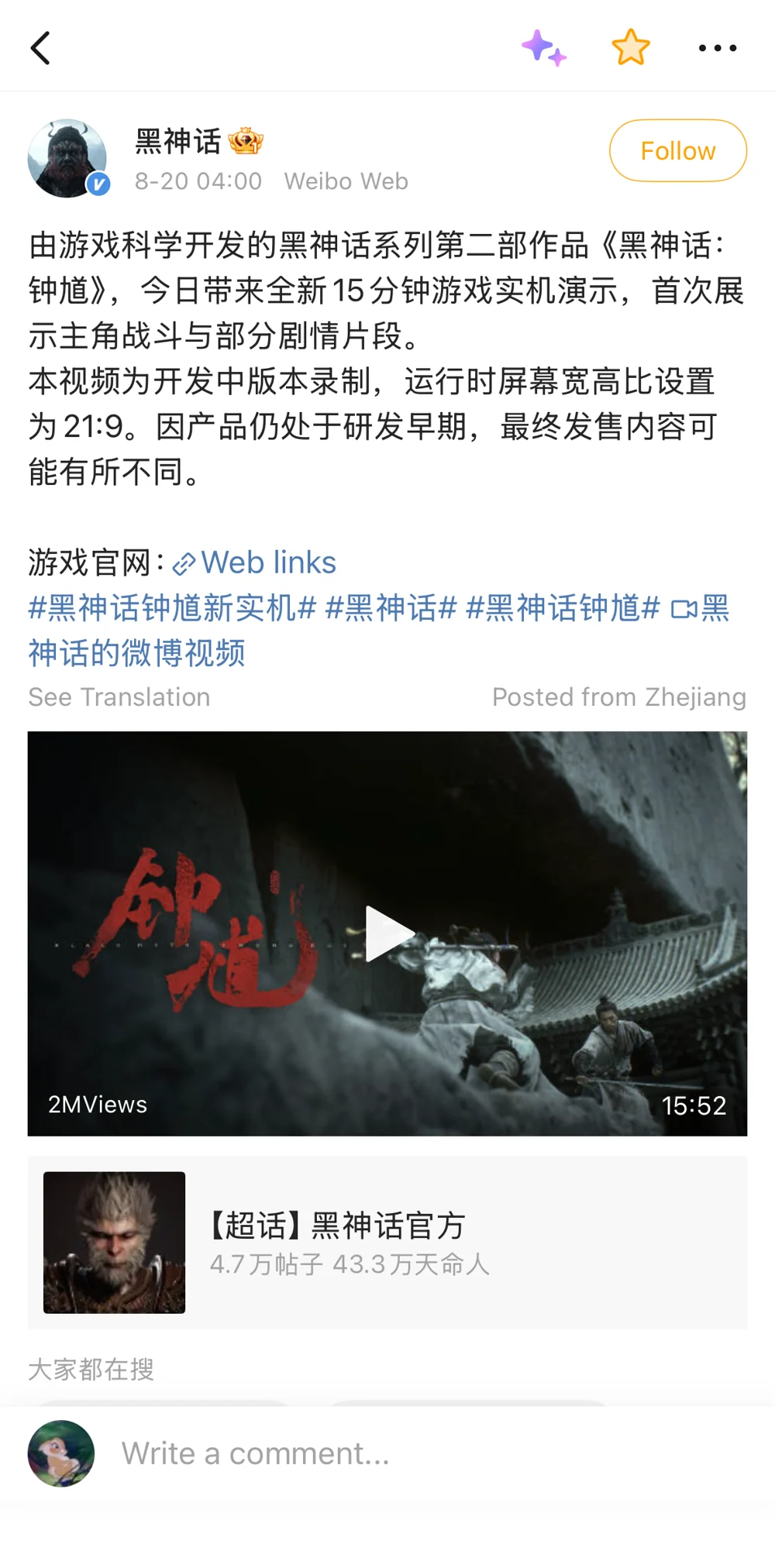
由游戏科学开发的黑神话系列第二部作品《黑神话:钟馗》,今日带来全新 15 分钟游戏实机演示,首次展示主角战斗与部分剧情片段。本视频为开发中版本录制,最终发售内容可能有所不同。 “Game Science’s second Black Myth title, Black Myth: Zhong Kui, presents fifteen minutes of new gameplay, showing the protagonist in combat and parts of the story for the first time. This footage was captured from a build in development; final release content may differ.”
The numbers were less careful. The Bilibili upload shown in these screenshots passed 9.6 million views, 103,000 comments, 813,600 likes, 650,900 coins, 200,700 saves and 468,400 shares.
Someone asked the studio whether it could reveal anything more about the plot and gameplay. The official answer was unusually honest:
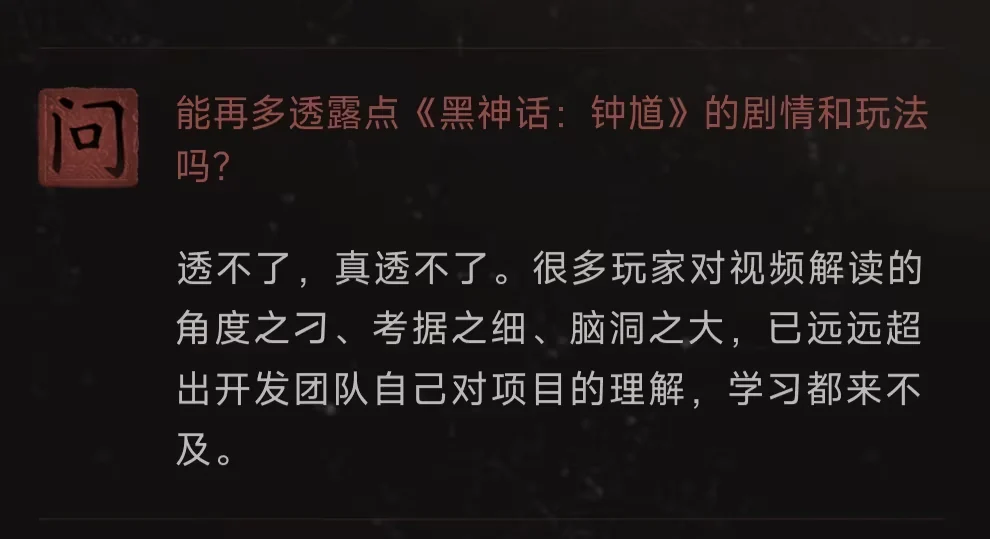
透不了,真透不了。很多玩家对视频解读的角度之刁、考据之细、脑洞之大,已远远超出开发团队自己对项目的理解,学习都来不及。 “We can’t reveal it. We really can’t. The angles players have found, the fineness of their textual detective work, the size of the theories — they have already gone far beyond the development team’s own understanding of the project. We’re still trying to learn from them.”
This was not modesty for long. The comment section took it as a job opening.
What they’re saying
Fifteen minutes in, the co-developers arrive
The first wave was praise, but even the praise came with a production schedule attached.
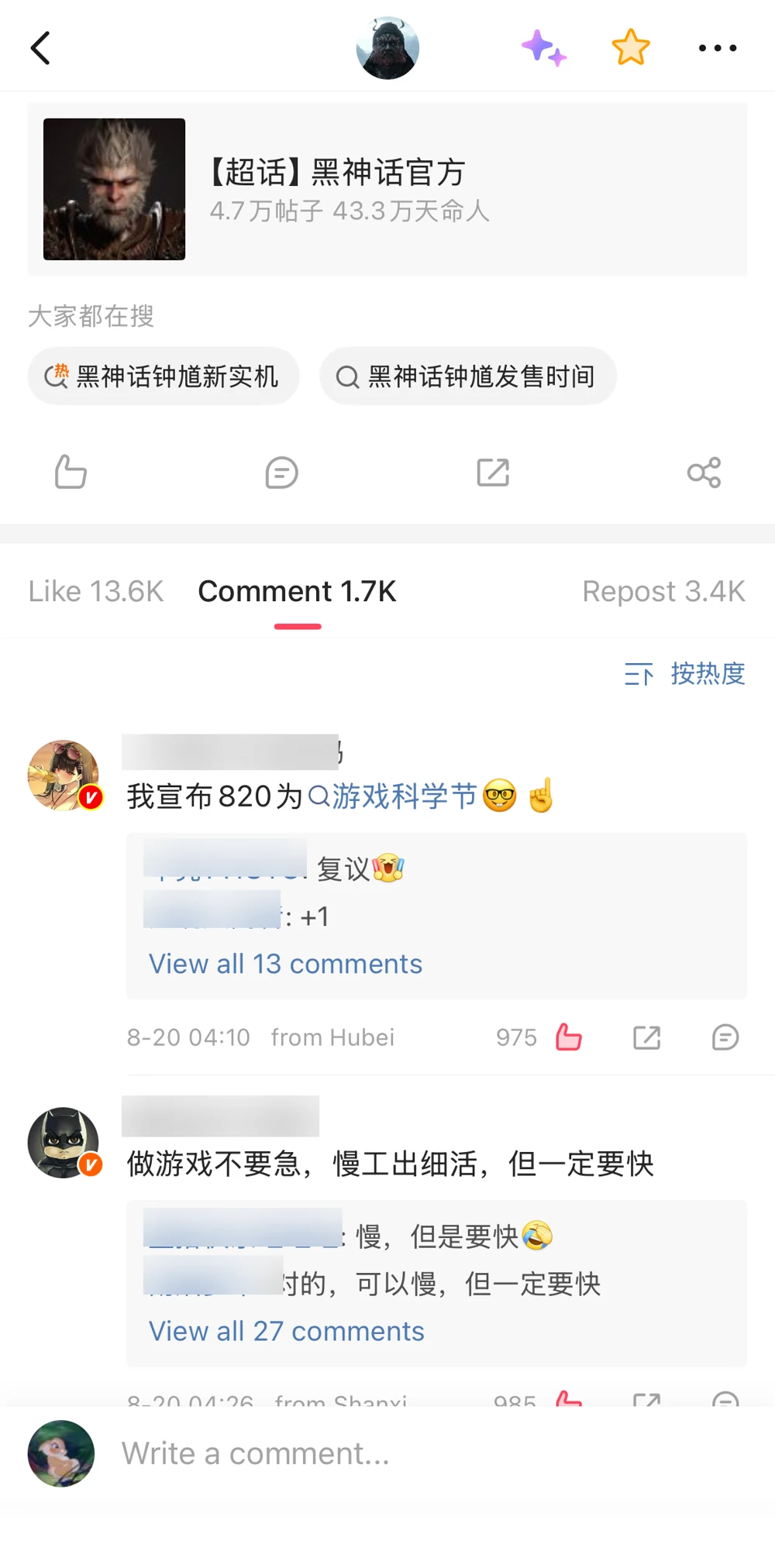
我宣布 820 为游戏科学节 “I hereby declare August 20 Game Science Day.” — 975 likes, Hubei
做游戏不要急,慢工出细活,但一定要快 “Don’t rush a game. Fine work takes time. But you absolutely do need to hurry.” — Shaanxi
Another viewer compared the damp terrain and almost documentary texture to the opening of Death Stranding. One called August 20 the studio’s annual “exam day” and hoped the fifteen minutes would be enough to keep everyone fed. A third had already placed the title’s demon-quelling hero in transit:
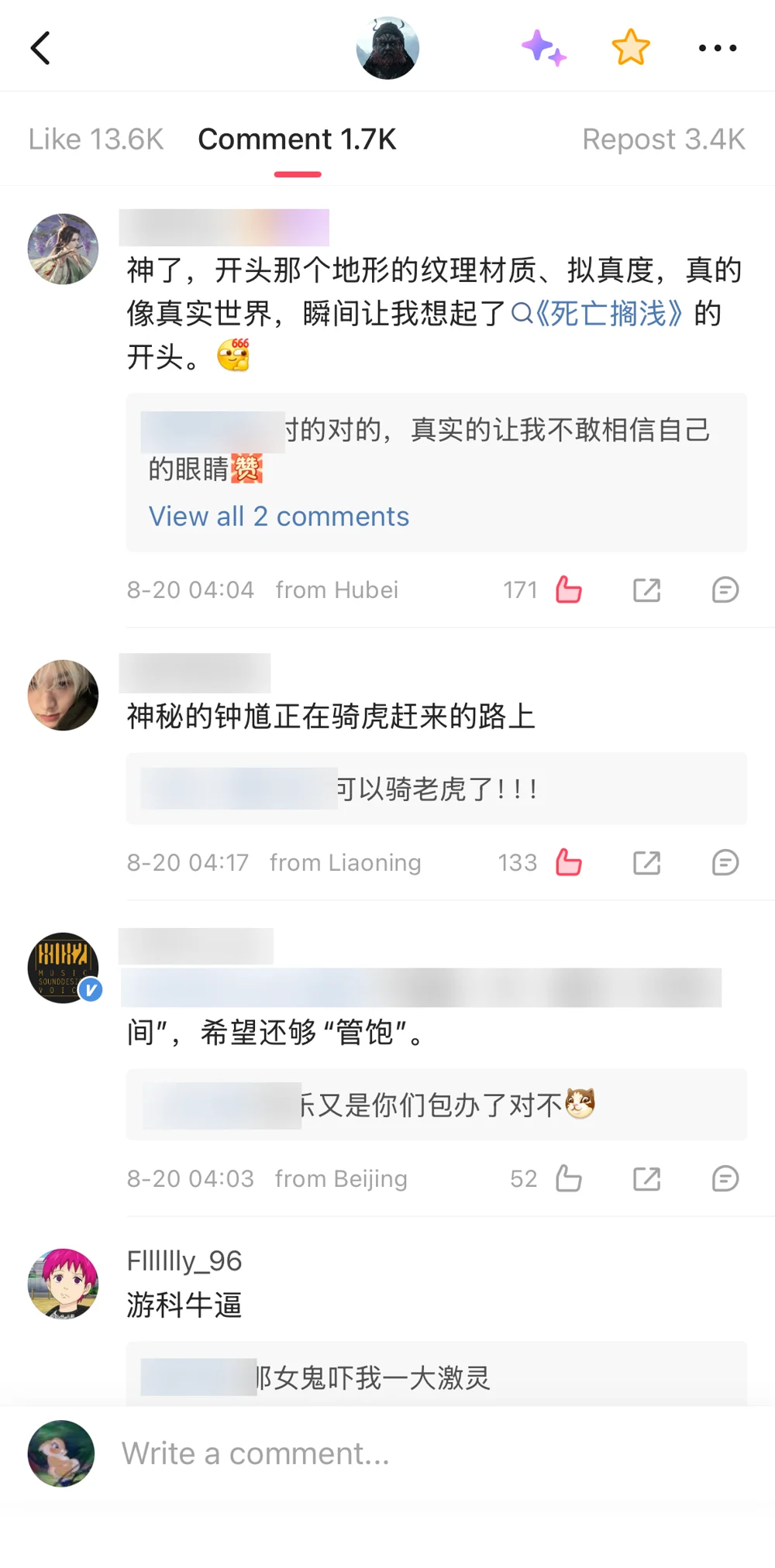
神了,开头那个地形的纹理材质、拟真度,真的像真实世界,瞬间让我想起了《死亡搁浅》的开头。 “That opening terrain — the texture work, the realism — looks like the physical world. It took me straight back to Death Stranding’s opening.” — 171 likes, Hubei
神秘的钟馗正在骑虎赶来的路上 “The mysterious Zhong Kui is on his way over. By tiger.” — 133 likes, Liaoning
可谓是一年一度的“大考时间”,希望还够“管饱” “The annual exam day has arrived. Hopefully this is enough to keep us fed.” — 52 likes, Beijing
That tiger matters twice. In popular images, Zhong Kui is a fierce, bearded demon-queller: red-robed or dark-faced, sword in hand, sometimes accompanied by bats, ghosts or a tiger. He is hung on doors and painted into homes as protection. He is also a figure whose story has never stopped accumulating. An old exorcistic name, a Tang emperor’s dream, the later tale of an upright scholar rejected for his ugly face, Daoist honorifics, opera, New Year prints and centuries of paintings have all left material on him. A game does not receive one canonical Zhong Kui. It receives an archive with a pulse.
The comments immediately began searching that archive for mechanics.
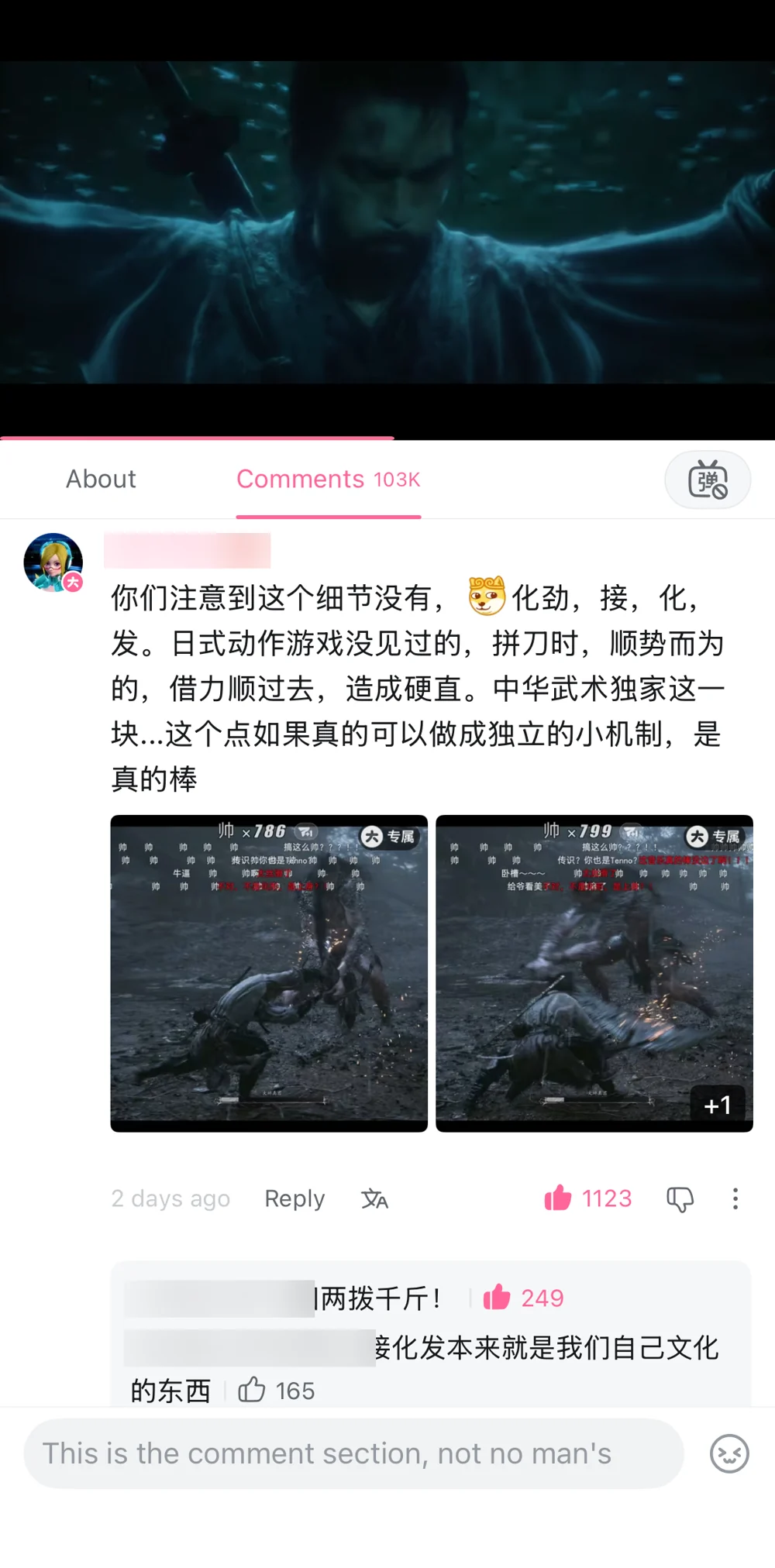
你们注意到这个细节没有,化劲,接,化,发。日式动作游戏没见过的,拼刀时,顺势而为,借力顺过去,造成硬直。中华武术独家这一块……这个点如果真的可以做成独立的小机制,是真的棒 “Did you catch this? Neutralise the force: receive, redirect, issue. You don’t usually see this in Japanese action games. When the blades meet, he follows the incoming force, borrows it and sends it through, creating a stagger. This is a distinctly Chinese martial idea. If it becomes a proper mechanic, it could be brilliant.” — 1,123 likes
四两拨千斤! “Four ounces moving a thousand pounds.” — 249 likes
接化发本来就是我们自己文化的东西 “Receive, neutralise, issue — that was ours to begin with.” — 165 likes
接化发 jiē, huà, fā — receive, transform, release now arrives online with two histories attached. It names a real family of martial principles: do not meet force with force; take it, alter its path, return it. It is also meme language, made comic by years of dubious online martial-arts demonstrations. The footage gives the phrase its dignity back for a moment. The reply supplies the classical shorthand: a tiny force redirecting a huge one.
The next creature is a giant clam. One player sees a shield system before the studio has announced one:
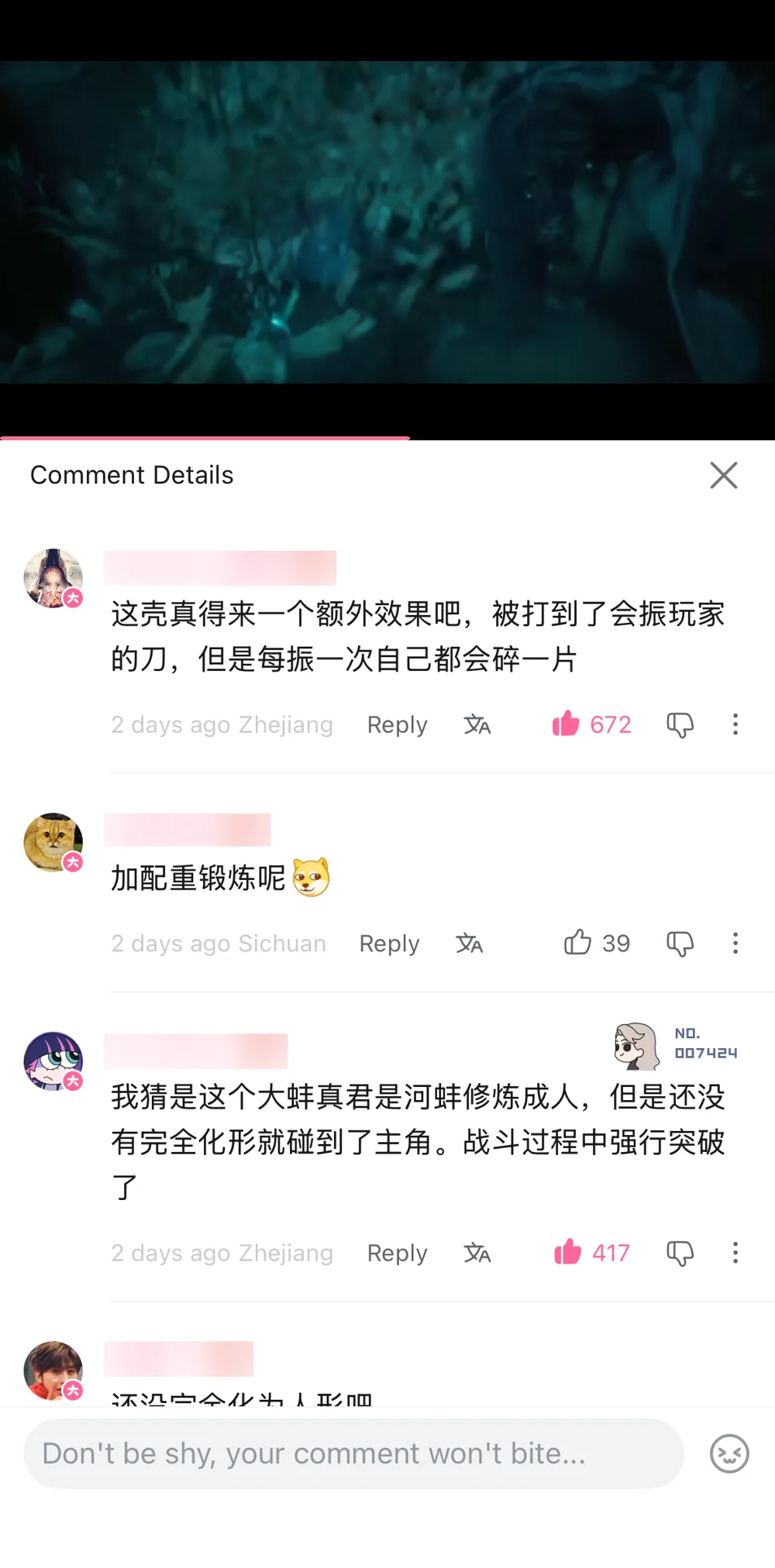
这壳真得来一个额外效果吧,被打到了会震玩家的刀,但是每震一次自己都会碎一片 “That shell needs an extra effect: it jolts the player’s blade on contact, but every jolt chips off one piece of the shell.” — 672 likes, Zhejiang
加配重锻炼呢 “Resistance training.” — 39 likes, Sichuan
我猜这个大蚌真君是河蚌修炼成人,但是还没有完全化形就碰到了主角,战斗过程中强行突破了 “My guess: Lord Giant Clam cultivated itself toward human form, ran into the protagonist before the transformation was complete, and forced a breakthrough mid-fight.” — 417 likes, Zhejiang
真君 zhēn jūn, “Perfected Lord” — a Daoist title for an immortal or realised being. Giving it to a clam monster is both grand and funny, but perfectly at home in a world where animals, objects and landscape spirits may cultivate into new forms. The commenter does not need a cutscene. The unfinished body is already a biography.
One 26,400-like comment compresses the whole video into five patch notes:
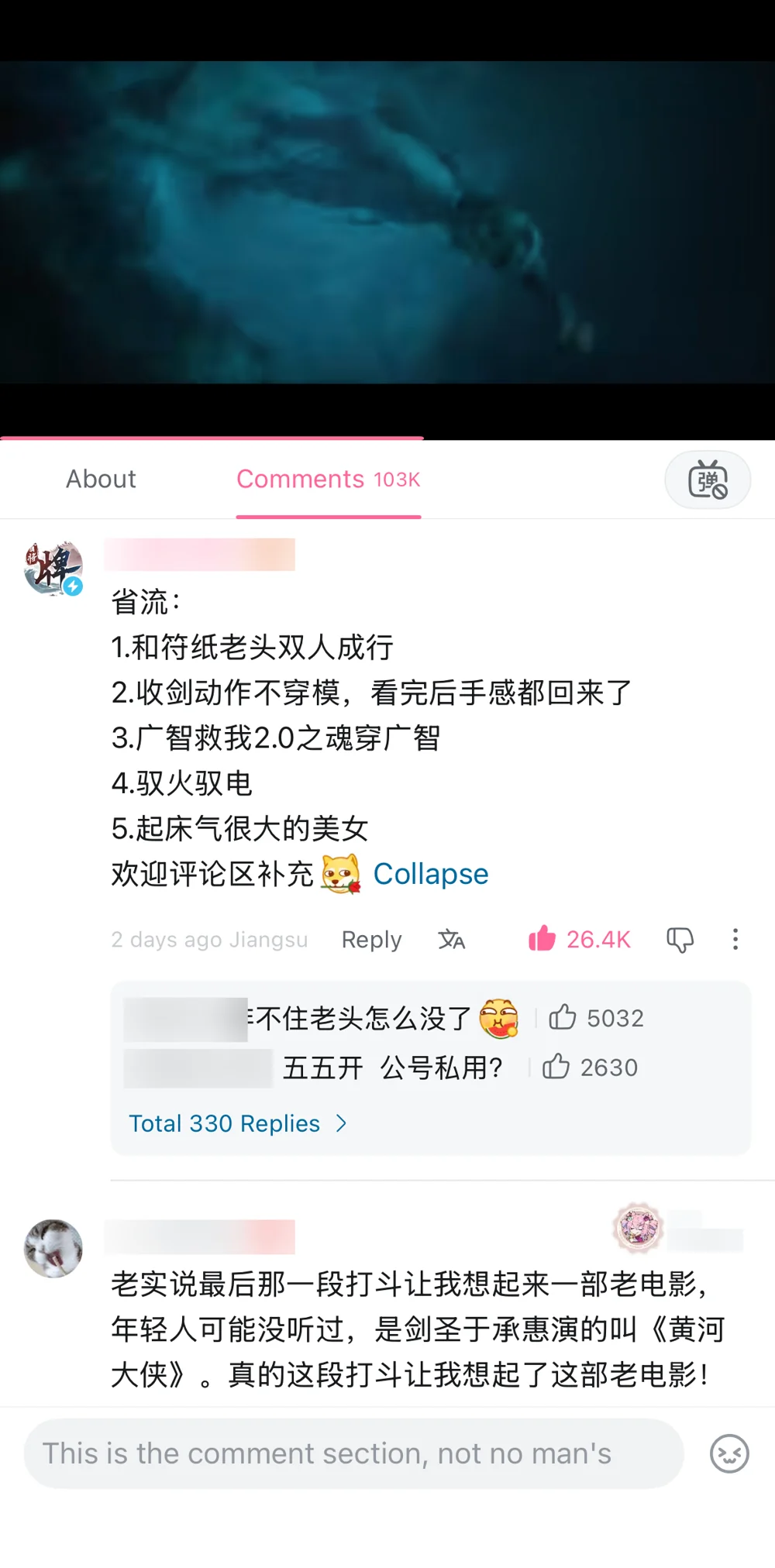
省流:1. 和符纸老头双人成行;2. 收剑动作不穿模,看完后手感都回来了;3. 广智救我 2.0 之魂穿广智;4. 驭火驭电;5. 起床气很大的美女。欢迎评论区补充 “The short version: 1. It Takes Two with the old talisman man. 2. The sheathing animation doesn’t clip — I could feel the controls coming back just watching it. 3. ‘Guangzhi, save me’ 2.0: possess Guangzhi. 4. Command fire, command lightning. 5. A beautiful woman with catastrophic morning temper. Add your findings below.” — 26,400 likes, Jiangsu
The 符纸 fú zhǐ — paper talisman is not fantasy wallpaper. Yellow talisman paper covered with ritual writing is one of the most recognisable tools in Chinese vernacular images of Daoist priests, ghost-catching and household protection. To a viewer raised on those images, an old man carrying one enters the scene with a profession already attached.
Two replies underneath show how quickly the room changes register:
蚌不住,老头怎么没了 “I can’t keep my shell together — where did the old man go?” — 5,032 likes
五五开,公号私用? “A fifty-fifty match-up? Is someone using the brand account for personal posting?” — 2,630 likes
The first is 绷不住 “I can’t hold it together” with 蚌 clam swapped in for the matching sound. When the monster is a clam, even losing composure has to stay on theme.
The last duel sent another viewer back to a 1988 wuxia film:
老实说最后那一段打斗让我想起来一部老电影,年轻人可能没听过,是剑圣于承惠演的《黄河大侠》。 “Honestly, that final fight took me back to an old film younger viewers may not know: Yellow River Fighter, starring the sword master Yu Chenghui.”
Later comments compared the protagonist’s face directly with Yu’s. The resemblance had become another clue in the collaborative reconstruction.
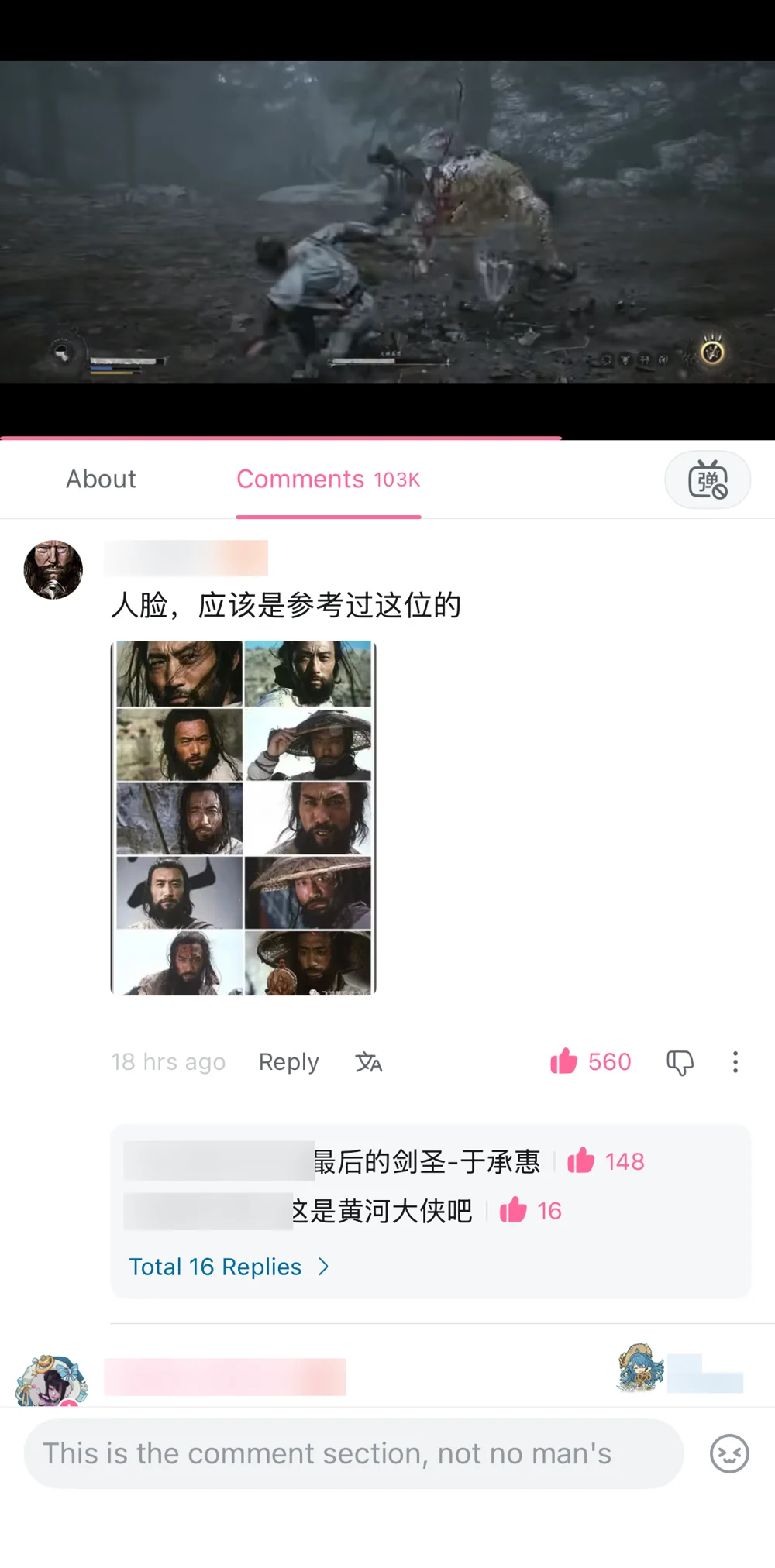
人脸,应该是参考过这位的 “The face seems to have been modelled after this man.” — 560 likes
最后的剑圣——于承惠 “The last sword master: Yu Chenghui.” — 148 likes
这是《黄河大侠》吧 “This is Yellow River Fighter, isn’t it?” — 16 likes
The skeleton has backbone
The footage includes skeleton musicians. Chinese makes the required pun almost without assistance:
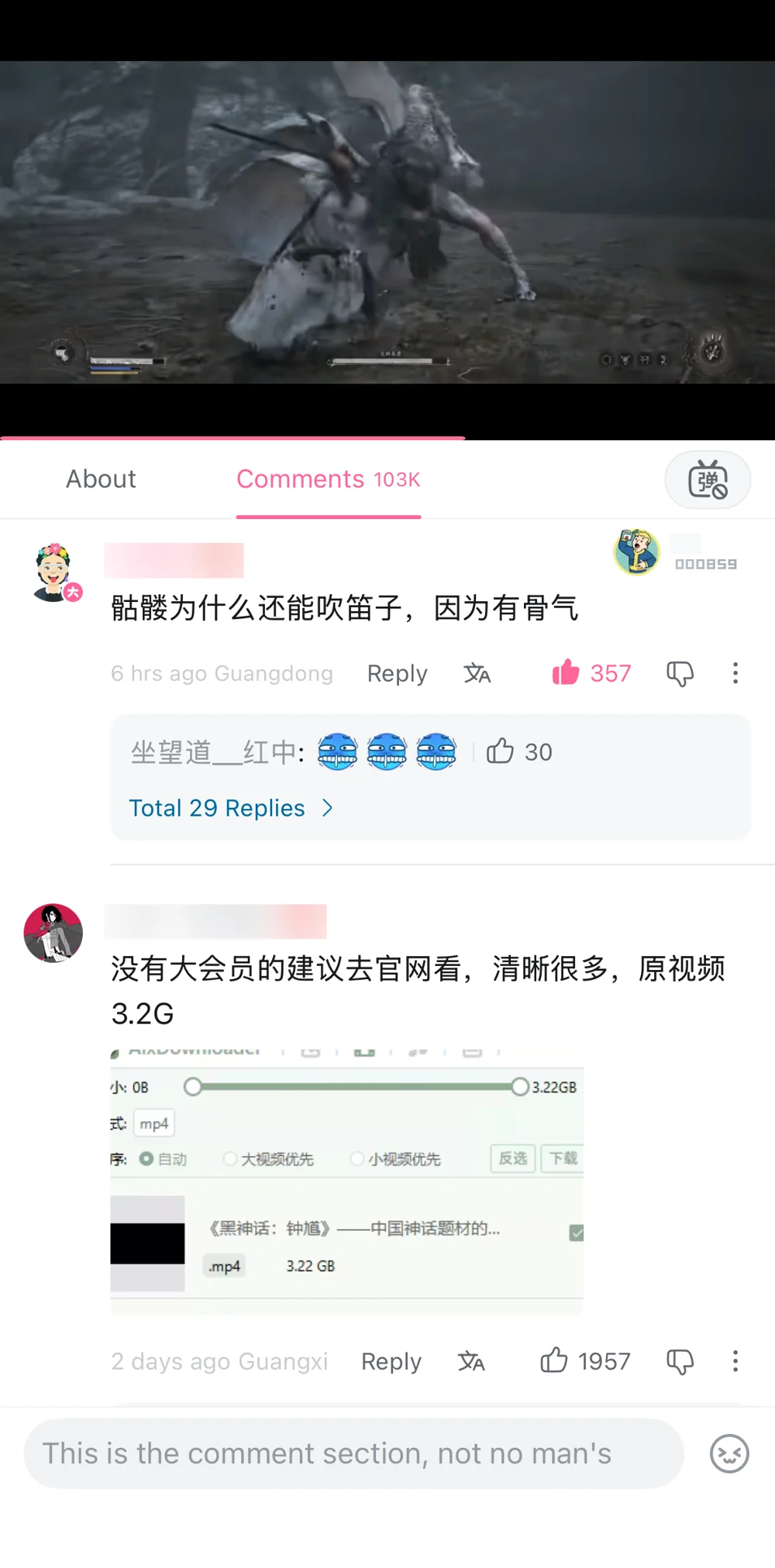
骷髅为什么还能吹笛子,因为有骨气 “How can a skeleton still play the flute? Because it has backbone.” — 357 likes, Guangdong
没有大会员的建议去官网看,清晰很多,原视频 3.2G “If you don’t have Bilibili Premium, watch it on the official site. Much clearer. The original video is 3.2GB.” — 1,957 likes, Guangxi
骨气 gǔ qì — literally “bone spirit”; figuratively backbone, moral fibre. The joke is not that the skeleton has bones. It is that Chinese already stores courage inside them.
Another comment calls the group a 古典乐队 classical ensemble. The reply changes one character: 骨典乐队 a bone-classical ensemble. Three thousand people approved the orchestra. One hundred and forty-nine more supplied its new genre.
One viewer added: 曲子依旧很打动我,对味! “The music still gets me. Exactly the right flavour.”
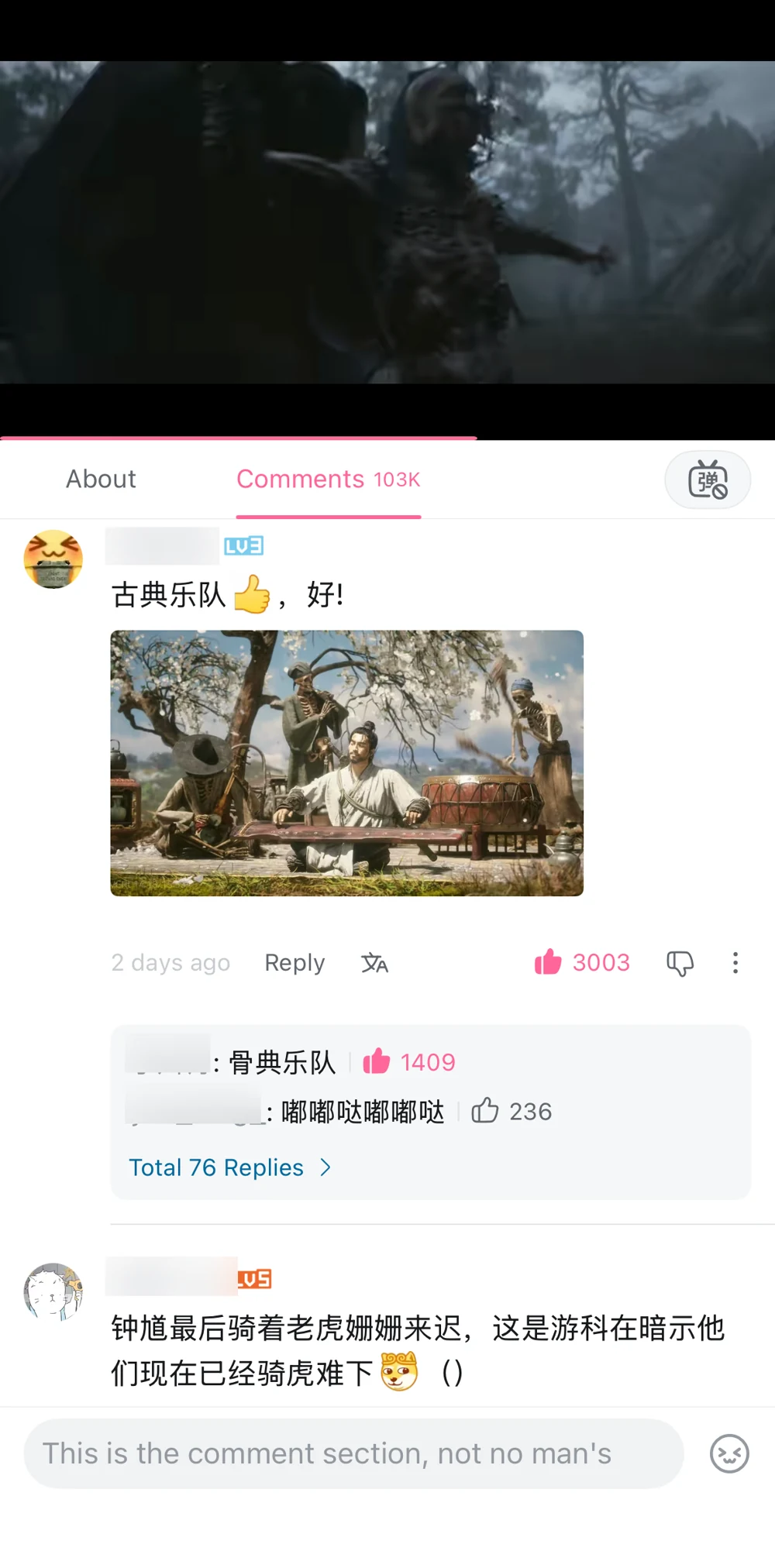
古典乐队,👍,好! “Classical ensemble. Good.” — 3,003 likes
骨典乐队 “Bone-classical ensemble.” — 1,409 likes
Someone else simply wrote that the score still moved them: “Exactly the right flavour.” And then came the image most likely to escape the original thread:
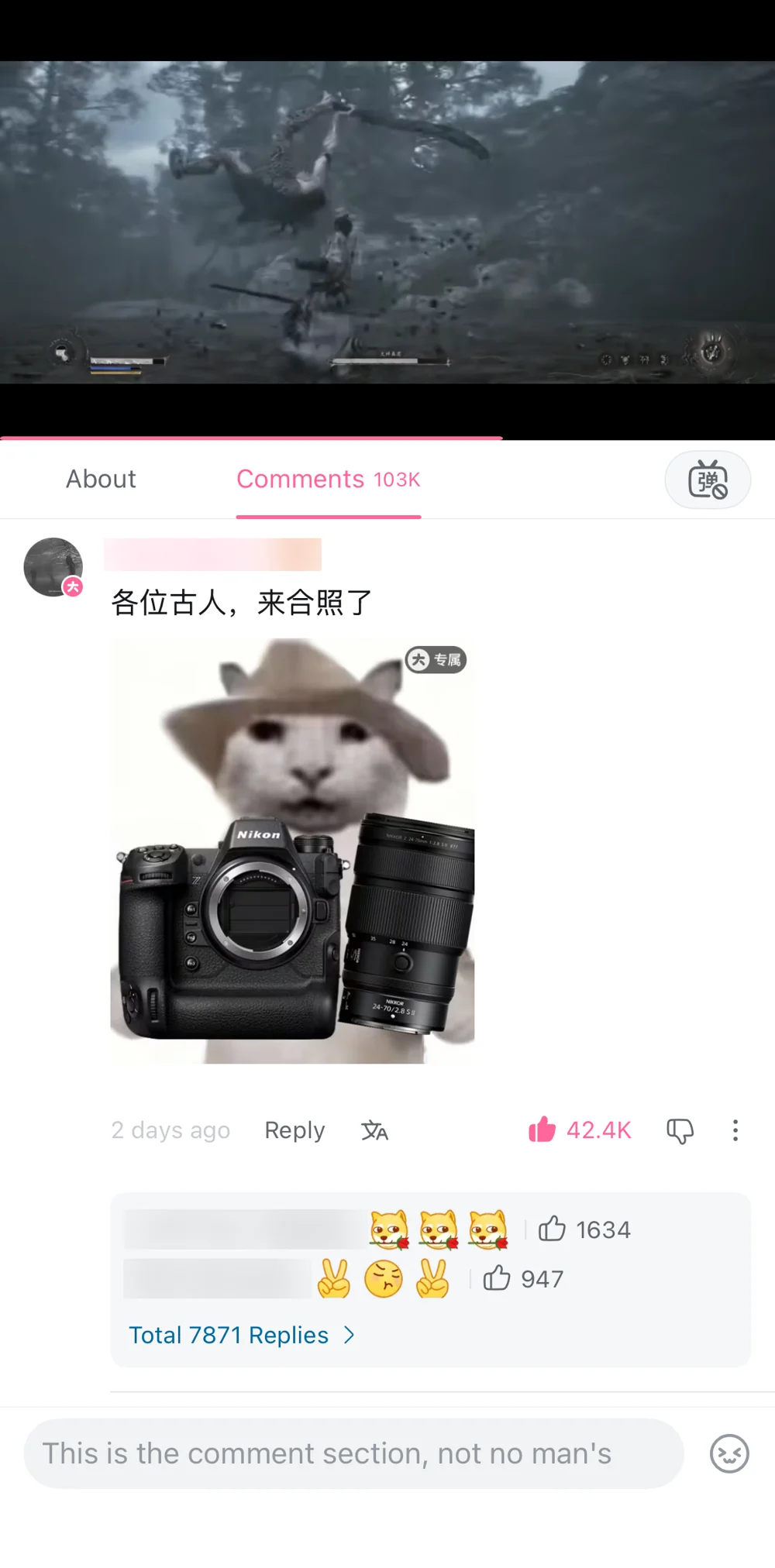
各位古人,来合照了 “All ancient persons, group photo.” — 42,400 likes
The game is being admired as technology and recognised as memory at the same time. One viewer said its ultrawide footage felt so cinematic that some shots no longer looked like gameplay. Replies wondered what new rendering technique could feel more real than a CG trailer, and said the landscape looked like a live-action short before the character walked in.
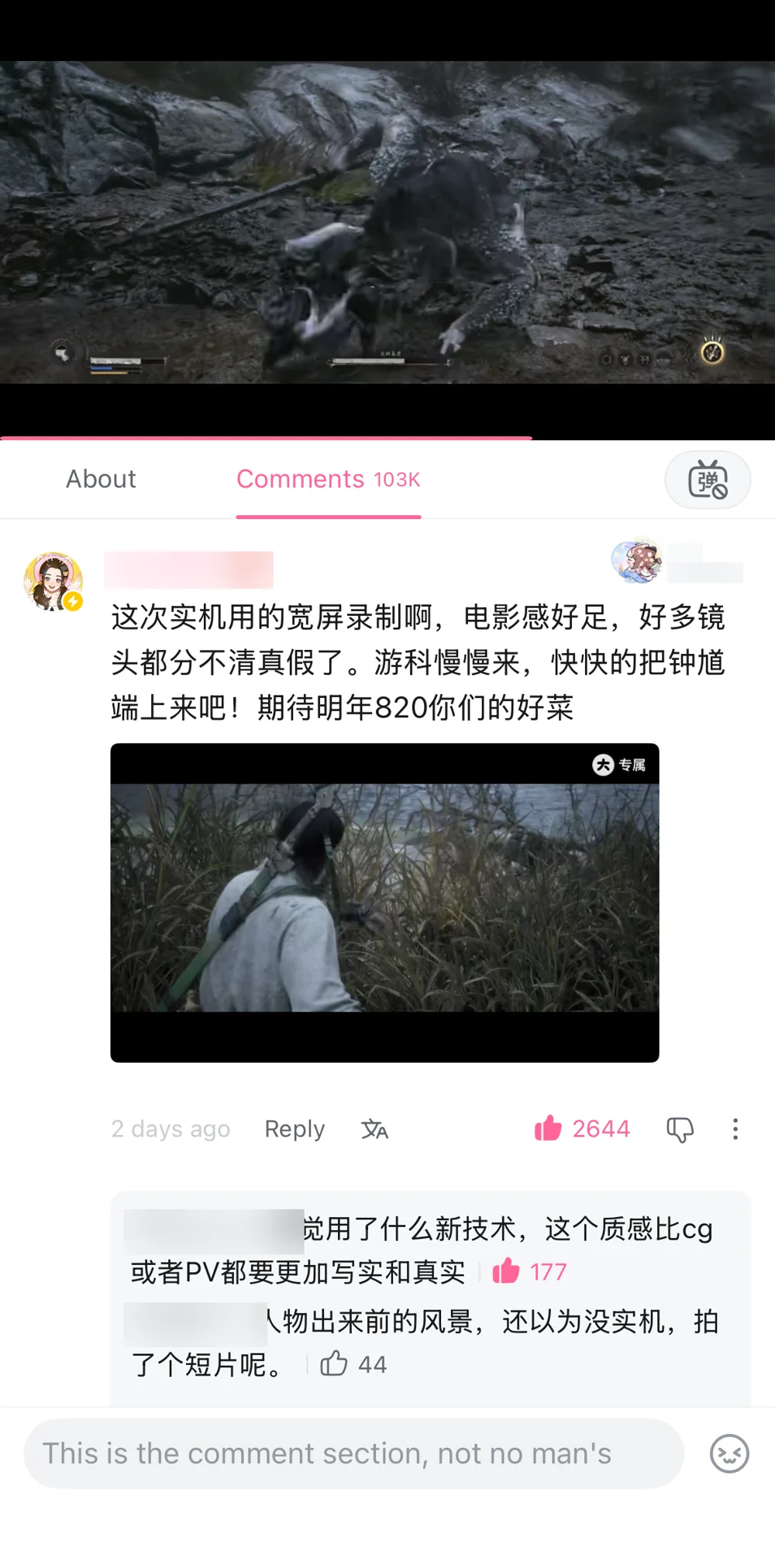
这次实机用的宽屏录制啊,电影感好足,好多镜头都分不清真假了。游科慢慢来,快快地把钟馗端上来吧!期待明年 820 你们的好菜 “The ultrawide capture gives this such a cinematic feel — half the shots are hard to separate from reality. Take your time, Game Science. Now hurry up and serve us Zhong Kui. Looking forward to next August 20’s special.” — 2,644 likes
They found the fishing system too
A single screenshot of the protagonist sitting beside water was enough:
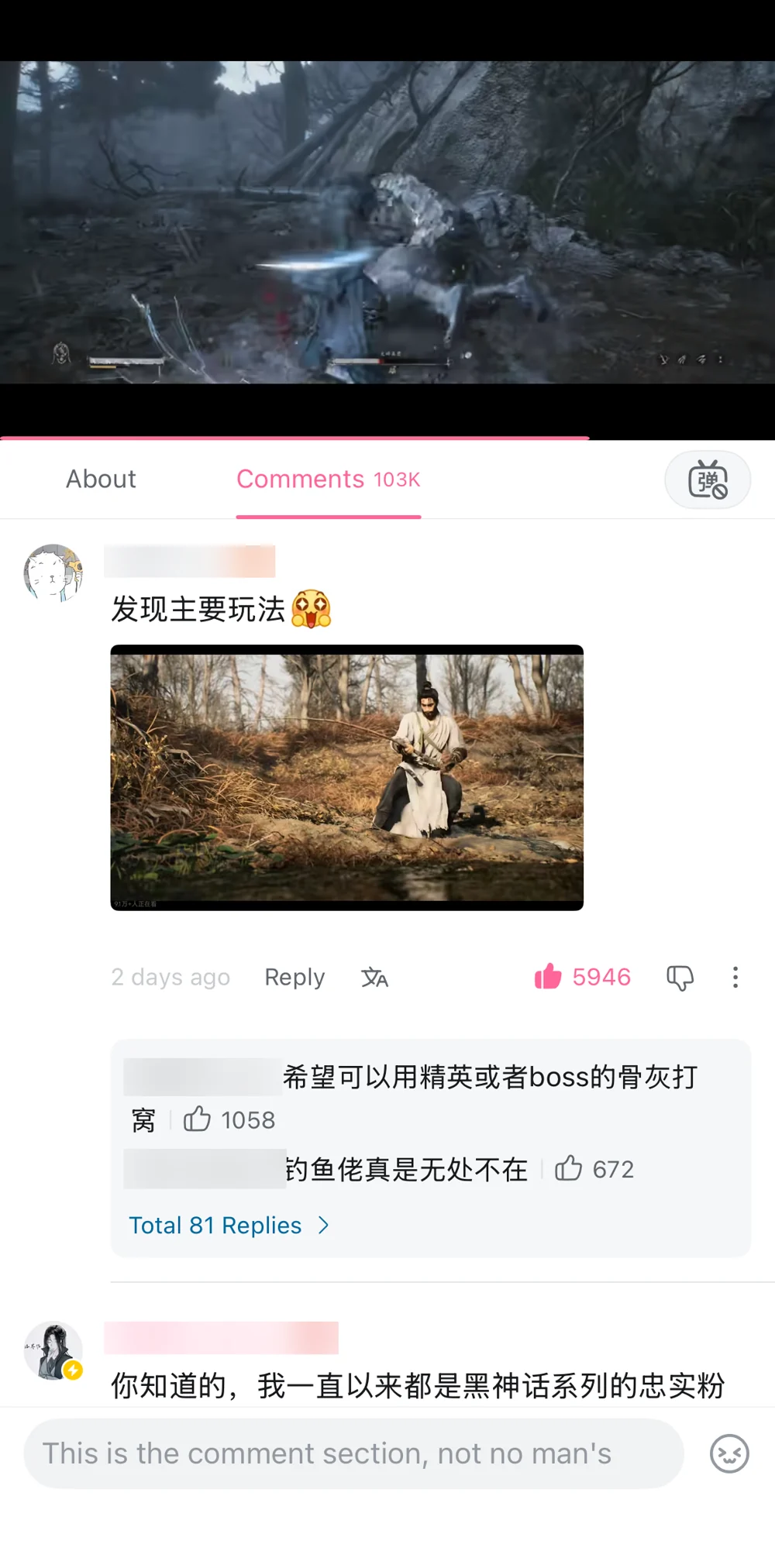
发现主要玩法 “Main gameplay loop discovered.” — 5,946 likes
希望可以用精英或者 boss 的骨灰打窝 “I hope we can chum the fishing spot with elite-enemy or boss ashes.” — 1,058 likes
钓鱼佬真是无处不在 “Fishing guys are truly everywhere.” — 672 likes
打窝 dǎ wō — throwing bait into one spot before fishing so fish gather there. Games train players to collect enemy ashes; anglers train themselves to see any loose organic matter as potential chum. The comment simply merges the inventories.
Please take all the time you need by yesterday
At 45,200 likes, the most popular comment is a complete relationship with a studio in one sentence:
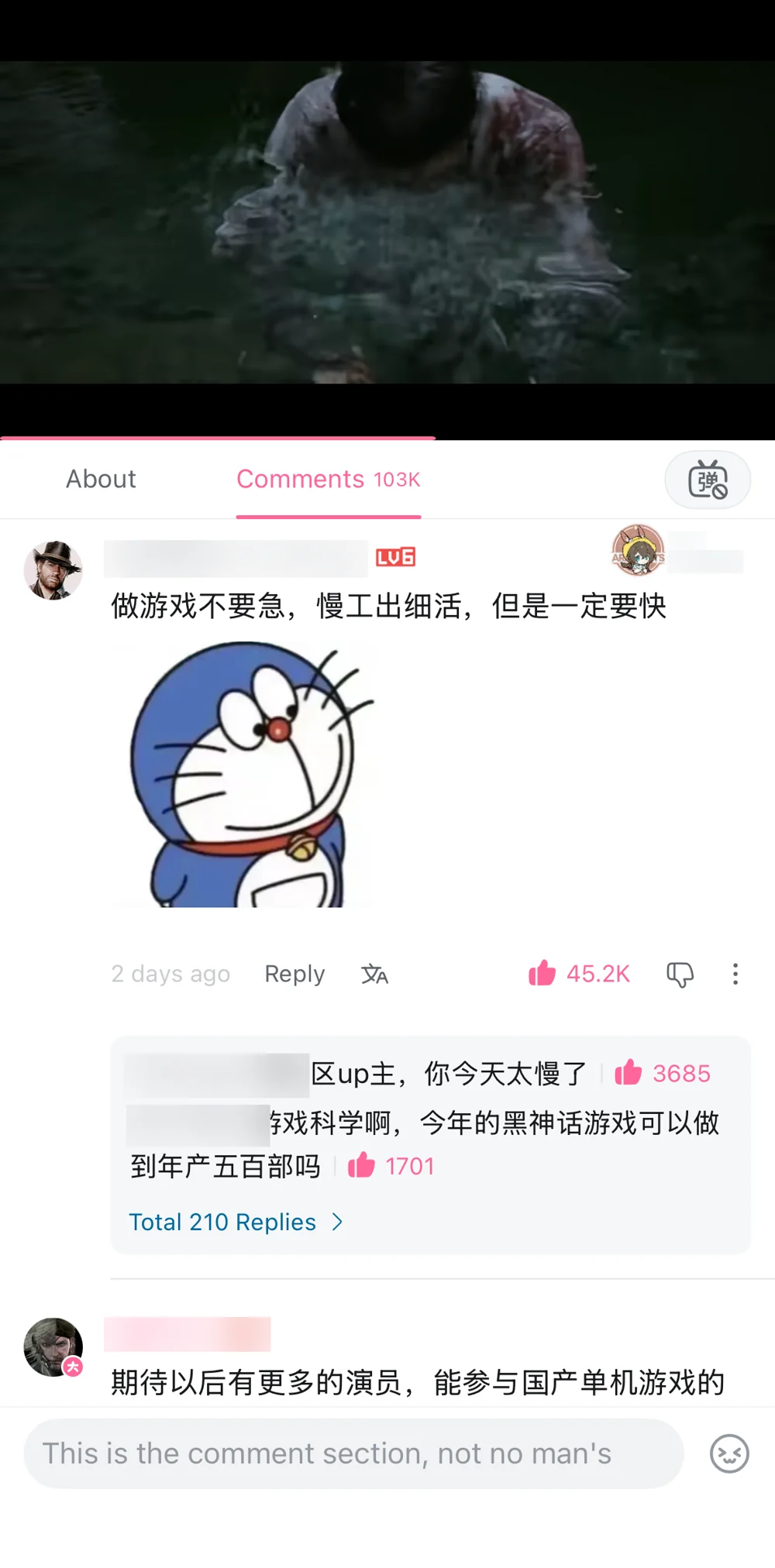
做游戏不要急,慢工出细活,但是一定要快 “Don’t rush a game. Fine work takes time. But you do need to hurry.” — 45,200 likes
评论区 UP 主,你今天太慢了 “Comment-section creator, you’re moving too slowly today.” — 3,685 likes
游戏科学啊,今年的黑神话游戏可以做到年产五百部吗 “Game Science, could we get annual production up to five hundred Black Myth games this year?” — 1,701 likes
Then Zhong Kui finally appears on his tiger, and the tiger turns into an idiom:
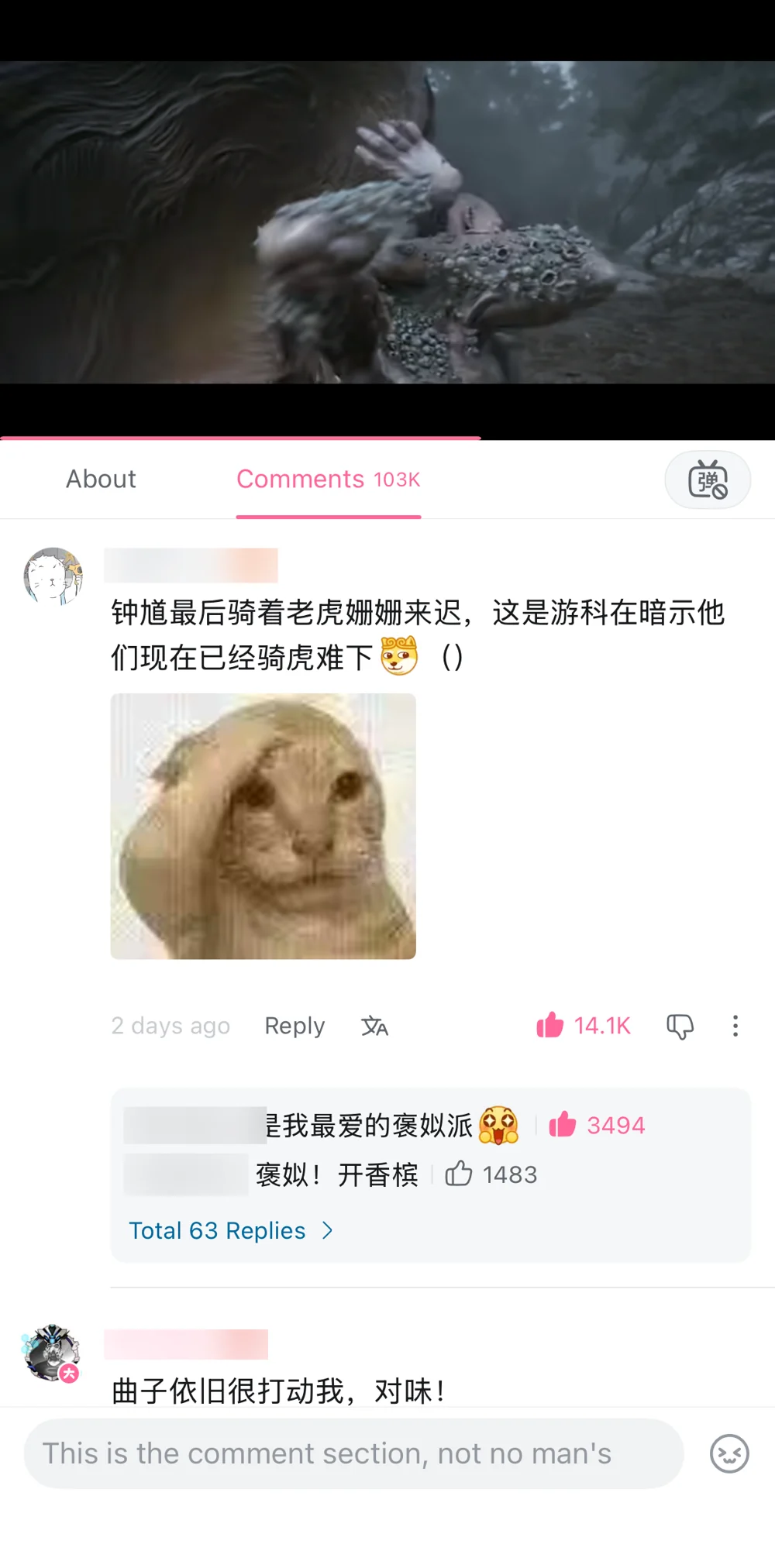
钟馗最后骑着老虎姗姗来迟,这是游科在暗示他们现在已经骑虎难下 “Zhong Kui finally turns up late, riding a tiger. Game Science is telling us it is now riding a tiger it cannot dismount.” — 14,100 likes
骑虎难下 qí hǔ nán xià — once you are riding the tiger, getting off is harder than staying on. The English “tiger by the tail” is close. The screenshot is closer.
The deadline bargaining continues all the way into absurdity:
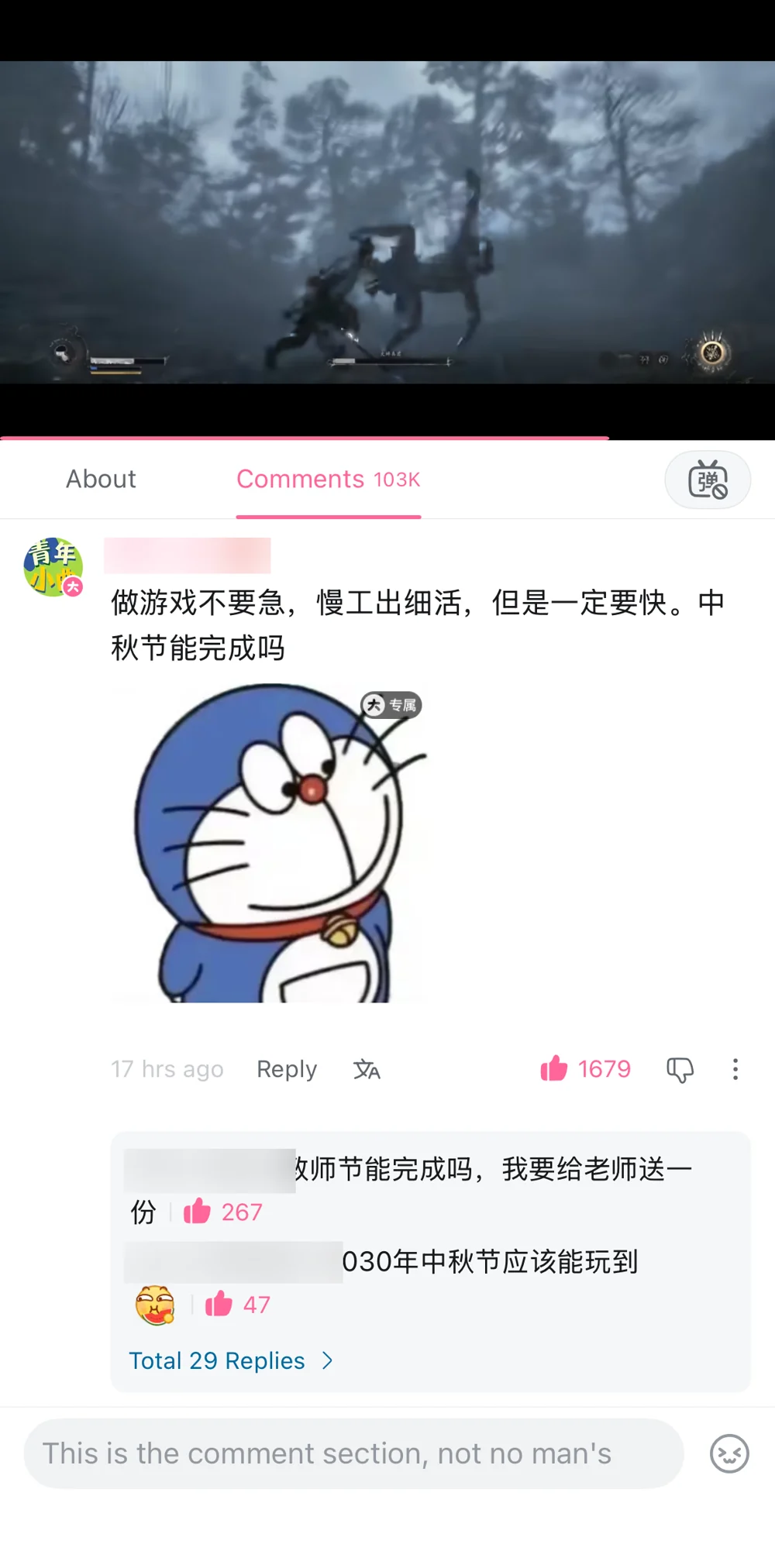
做游戏不要急,慢工出细活,但是一定要快。中秋节能完成吗 “Don’t rush. Fine work takes time. But you do need to hurry. Could it be finished by Mid-Autumn Festival?” — 1,679 likes
教师节能完成吗,我要给老师送一份 “Could you finish by Teachers’ Day? I want to give my teacher a copy.” — 267 likes
2030 年中秋节应该能玩到 “Mid-Autumn Festival 2030 should be realistic.” — 47 likes
Who is speaking, and who becomes Zhong Kui?
The footage also revealed two performance models. Model Dai Zhili identified himself as the protagonist’s face and called the result 赛博永生 “cyber-immortality”. Veteran actor Li Guangfu supplied the elder’s face. One comment hoped more actors would join Chinese single-player game production — 1,407 people agreed.
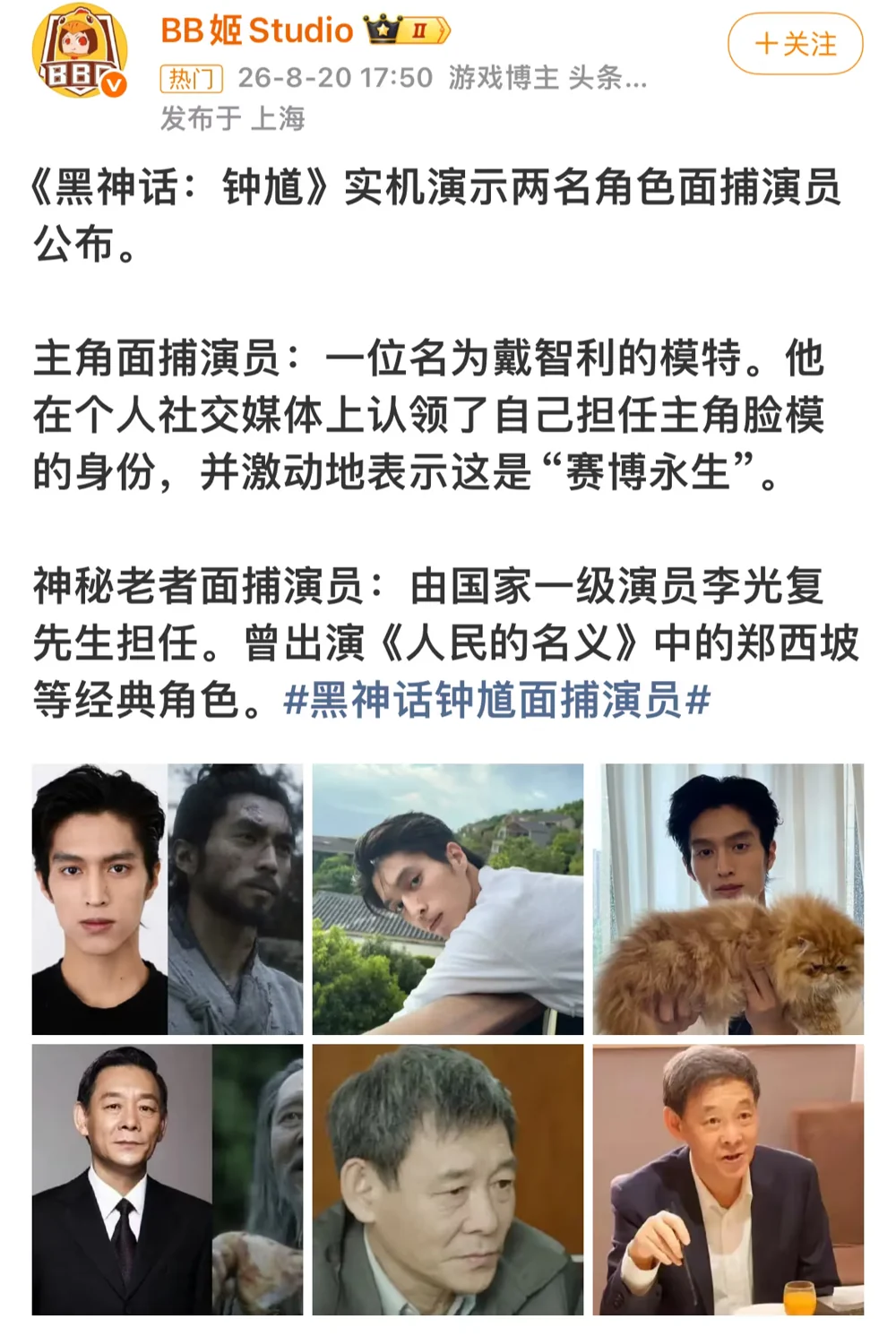
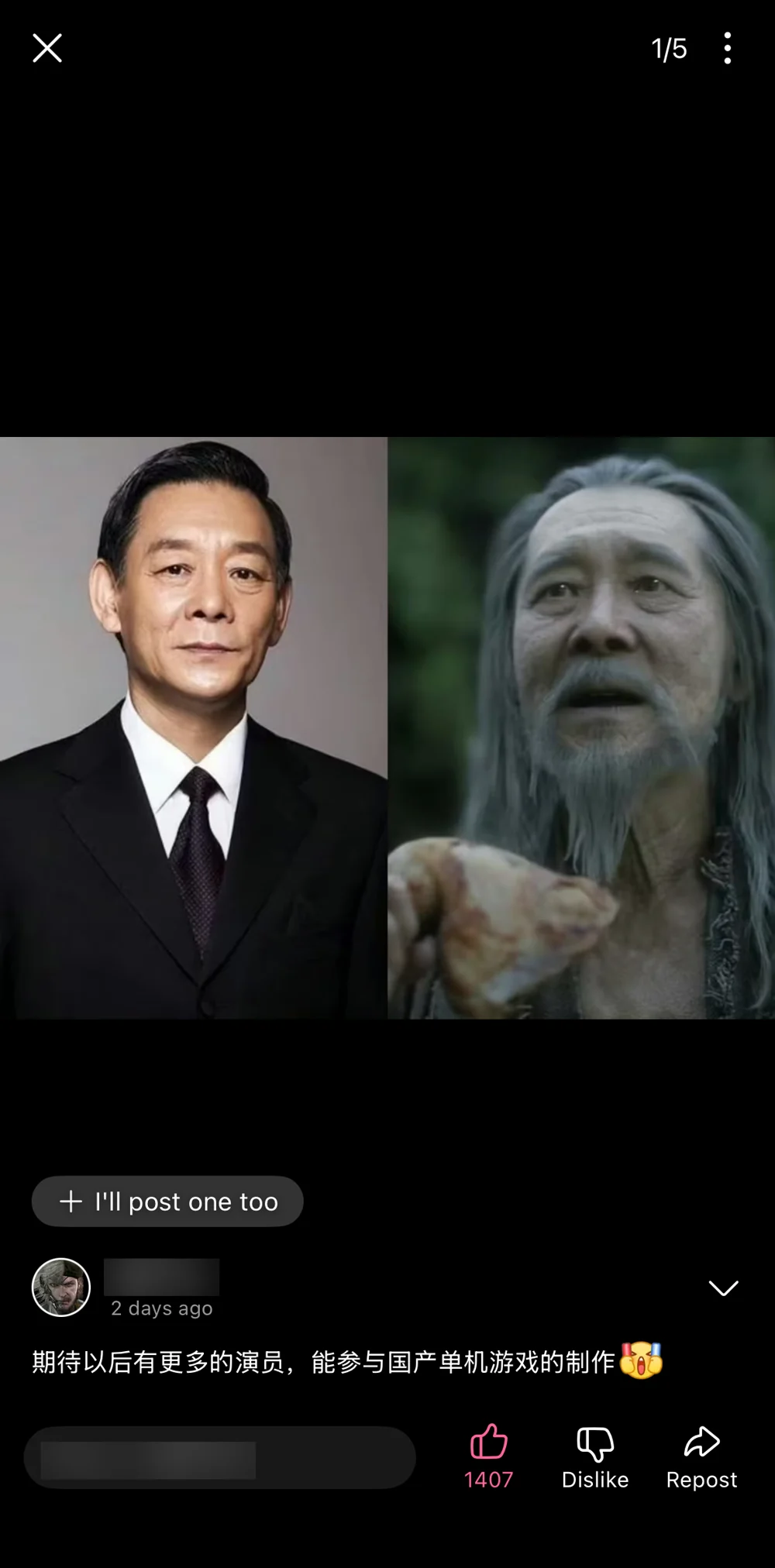
期待以后有更多的演员,能参与国产单机游戏的制作 “I hope more actors get to take part in making Chinese single-player games.” — 1,407 likes
The lack of dialogue became evidence too:
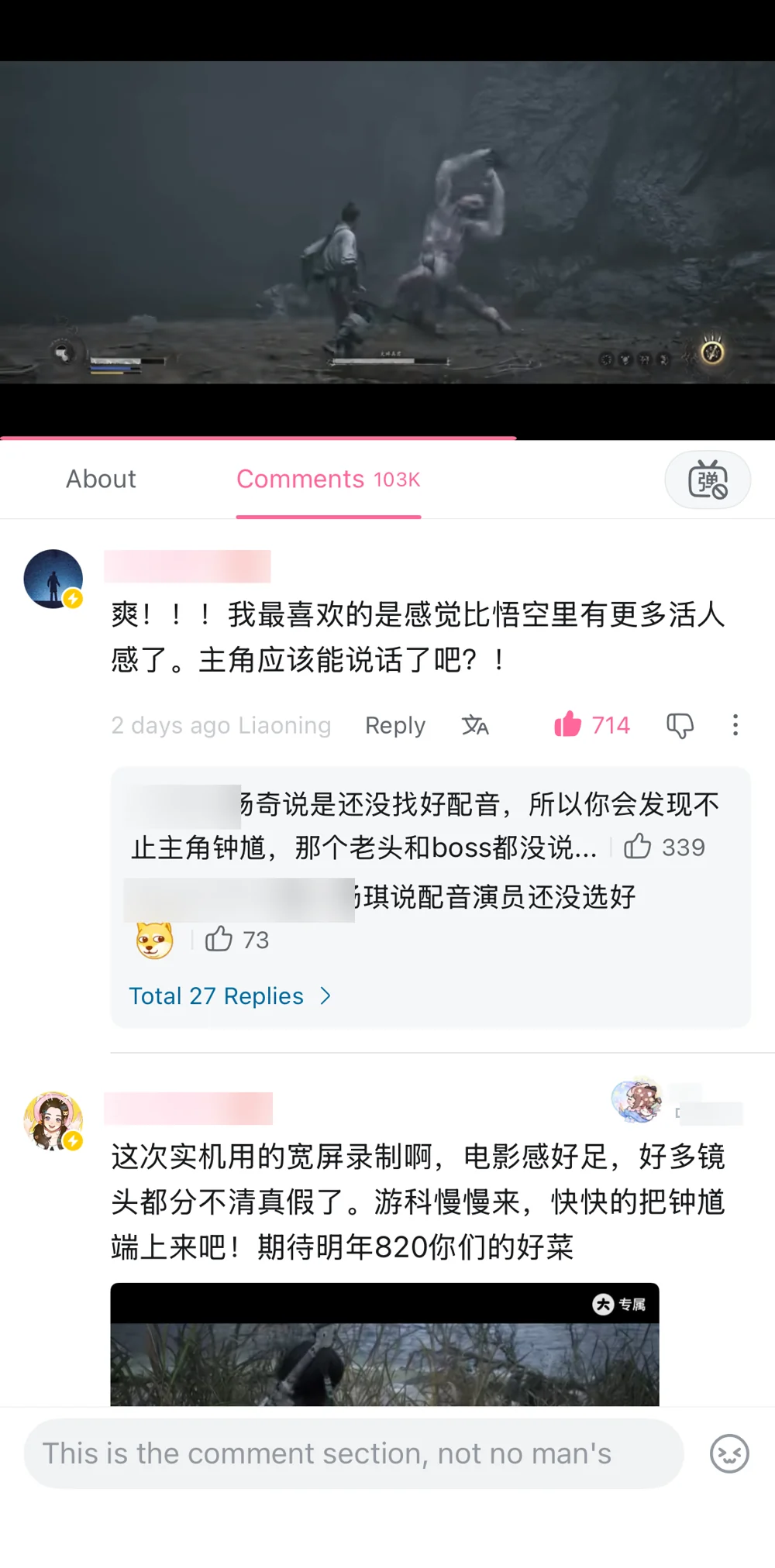
爽!!!我最喜欢的是感觉比悟空里有更多活人感了。主角应该能说话了吧?! “YES. What I like most is that this feels more inhabited than Wukong. The protagonist will be able to talk this time, right?” — 714 likes, Liaoning
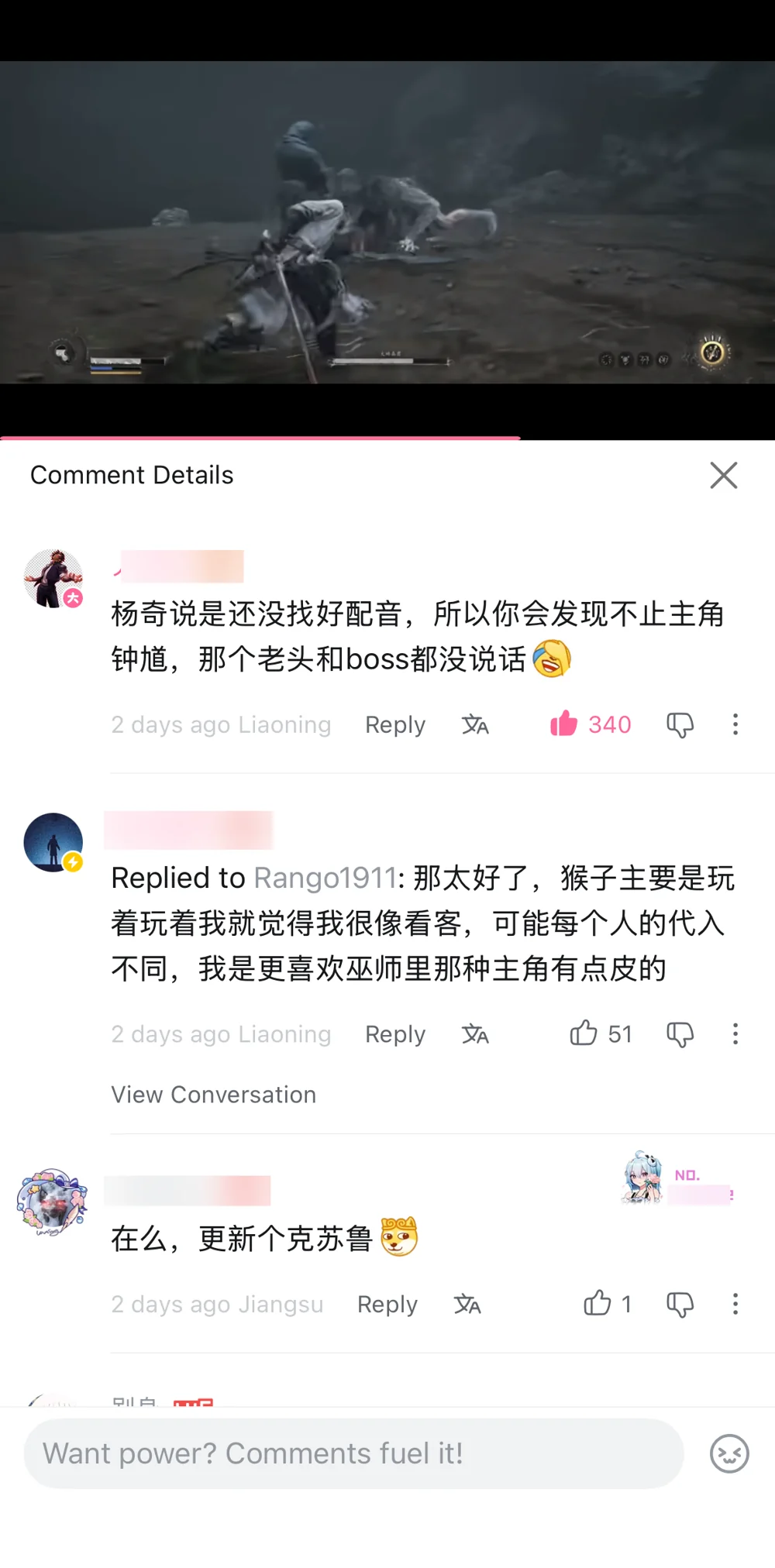
杨奇说是还没找好配音,所以你会发现不止主角钟馗,那个老头和 boss 都没说话 “Yang Qi said they haven’t settled on the voice cast. That’s why it isn’t just Zhong Kui — the old man and the boss don’t speak either.” — 340 likes
那太好了,猴子主要是玩着玩着我就觉得自己很像看客。可能每个人代入不同,我是更喜欢巫师里那种主角有点皮的 “That’s great. Playing the Monkey, I sometimes felt more like a spectator. Different people inhabit a character differently; I prefer a protagonist with a little of The Witcher’s cheek.” — 51 likes
The largest theory starts with a sword visible on two backs:
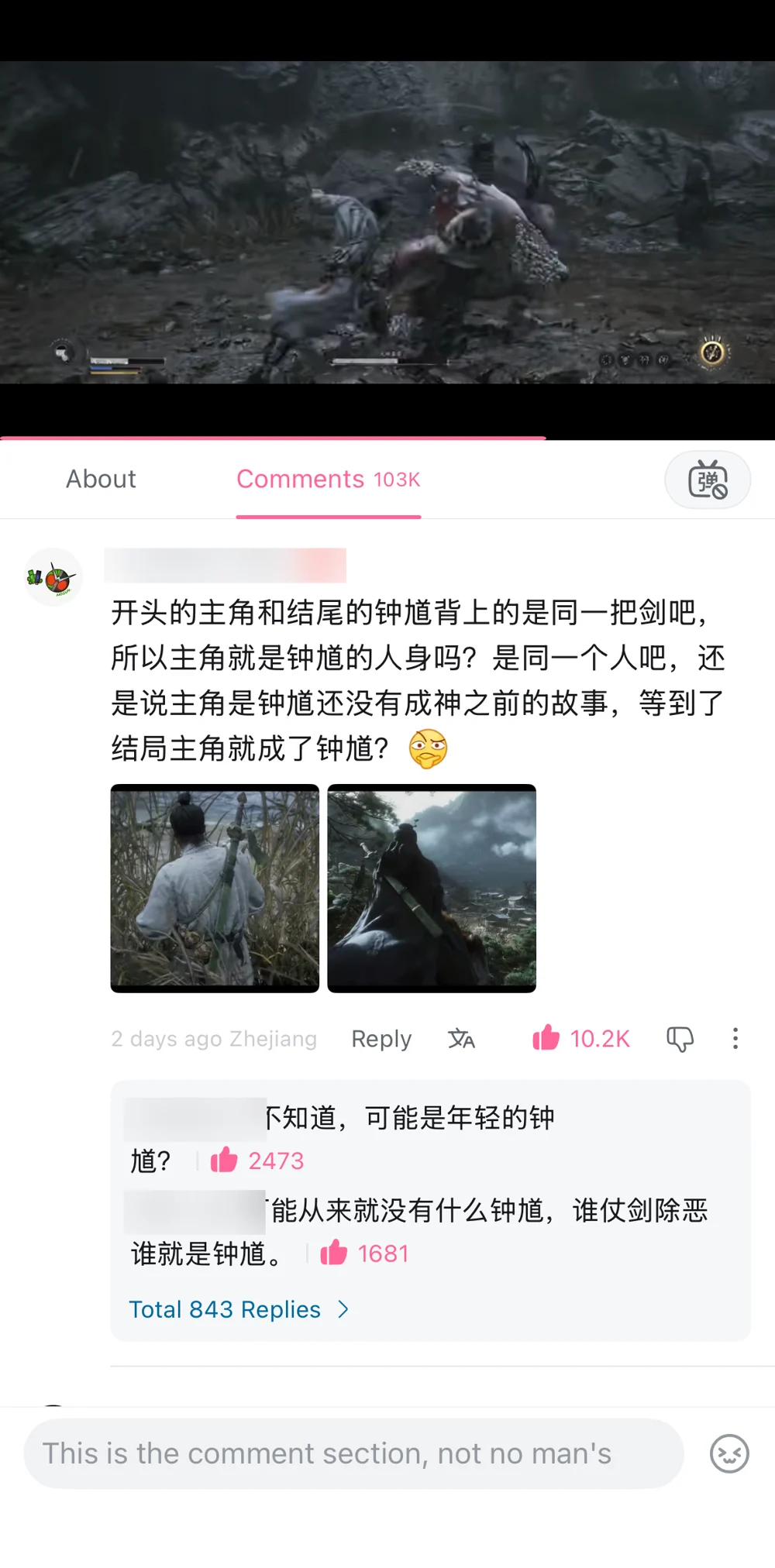
开头的主角和结尾的钟馗背上的是同一把剑吧,所以主角就是钟馗的人身吗?是同一个人吧,还是说主角是钟馗还没有成神之前的故事,等到了结局主角就成了钟馗? “The protagonist at the beginning and Zhong Kui at the end carry the same sword. Is the protagonist Zhong Kui in human form? Are they the same person — are we playing the story before his deification, and does he become Zhong Kui at the end?” — 10,200 likes, Zhejiang
不知道,可能是年轻的钟馗? “No idea. A young Zhong Kui, perhaps?” — 2,473 likes
可能从来就没有什么钟馗,谁仗剑除恶谁就是钟馗。 “Perhaps there was never one Zhong Kui. Whoever takes up the sword against evil becomes Zhong Kui.” — 1,681 likes
That last reply accidentally understands the archive. Zhong Kui has never depended on a single biography as much as on a function: the ugly face that frightens ugliness, the upright scholar whom the court misjudges, the violent-looking guardian whose violence is directed at what enters the house. The person changes. The office survives.
The archive the genre forgot
The word the comments keep circling is 志怪 zhì guài — “records of the strange”. It is less a modern genre label than an old writing habit: brief accounts of ghosts, transformations, impossible animals, uncanny places and events worth recording precisely because ordinary explanation failed. Much of it sits in classical Chinese, compressed enough that a monster may receive three lines and an entire cosmology.
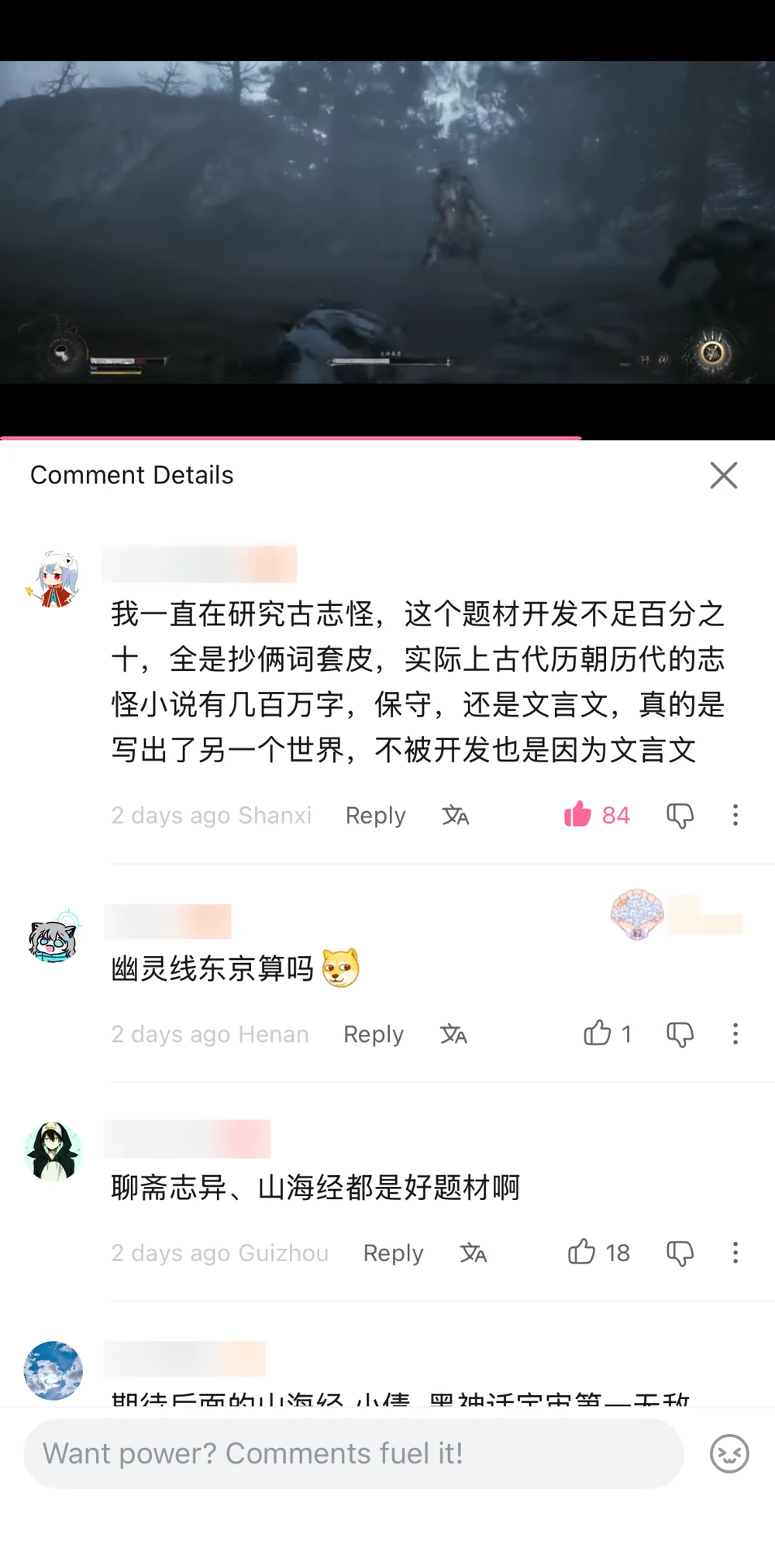
我一直在研究古志怪,这个题材开发不足百分之十,全是抄俩词套皮。实际上古代历朝历代的志怪小说有几百万字,保守,还是文言文,真的是写出了另一个世界;不被开发也是因为文言文 “I’ve spent years studying old zhiguai. Not even ten percent of the material has been developed; most adaptations borrow two words and reskin something else. Across the dynasties there are, conservatively, millions of characters of these stories — and they are in classical Chinese. They wrote another world. The classical language is also why it remains unopened.” — 84 likes, Shanxi
聊斋志异、山海经都是好题材啊 “Strange Tales from a Chinese Studio and the Classic of Mountains and Seas are both incredible source worlds.” — 18 likes, Guizhou
Another viewer said the strange-tale material attracted them even more than the Monkey King, and another answered that they had grown up loving exactly this world: Daoist talismans, priests catching ghosts, the grammar of an uncanny China that domestic games had rarely made navigable.
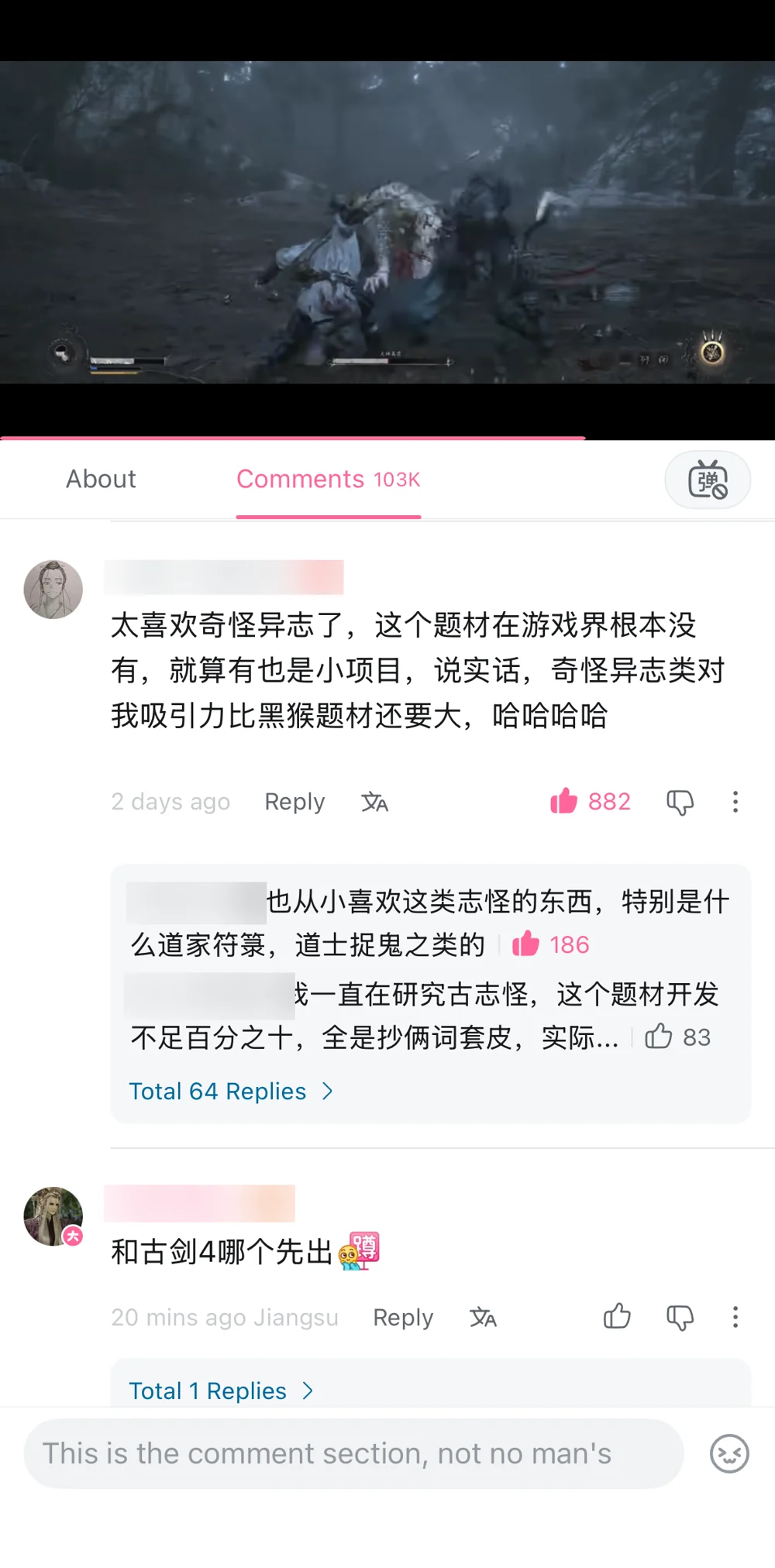
太喜欢奇怪异志了,这个题材在游戏界根本没有,就算有也是小项目。说实话,奇怪异志类对我吸引力比黑猴题材还要大,哈哈哈哈 “I love records of the uncanny. Games have barely touched this material, and when they do it is usually a small project. Honestly, it pulls me even harder than the Monkey King did. HAHAHAHA.” — 882 likes
我也从小喜欢这类志怪的东西,特别是什么道家符箓,道士捉鬼之类的 “I’ve loved this kind of zhiguai since childhood — especially Daoist talismans, priests catching ghosts, all of that.” — 186 likes
和古剑 4 哪个先出 “Which comes out first, this or Gujian 4?” — Jiangsu
It may be the comment section’s most pessimistic release forecast.
Then a viewer wrote the missing plot in full:
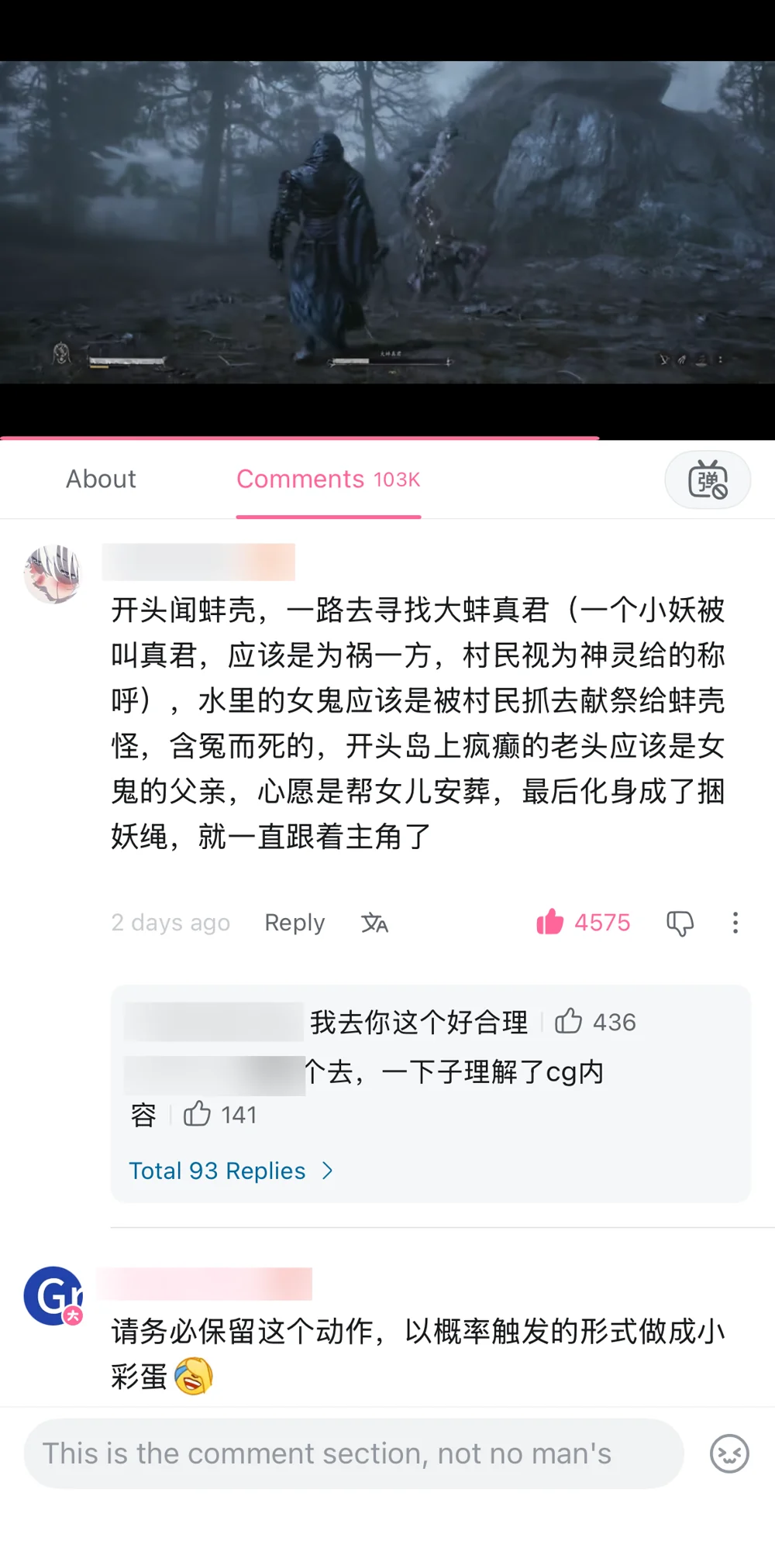
开头闻蚌壳,一路去寻找大蚌真君(一个小妖被叫真君,应该是为祸一方,村民视为神灵给的称呼),水里的女鬼应该是被村民抓去献祭给蚌壳怪,含冤而死的,开头岛上疯癫的老头应该是女鬼的父亲,心愿是帮女儿安葬,最后化身成了捆妖绳,就一直跟着主角了 “At the beginning we hear about the clam shell and set out to find Lord Giant Clam. Calling a minor monster ‘Perfected Lord’ suggests it has terrorised the area long enough for villagers to treat it as a god. The woman in the water was probably seized and sacrificed to it, dying wronged. The mad old man on the island is likely her father; his wish is to bury his daughter. In the end he becomes the demon-binding rope and follows the protagonist.” — 4,575 likes
我去你这个好合理 “Oh hell, this is completely plausible.” — 436 likes
我勒个去,一下子理解了 CG 内容 “Good lord. I suddenly understand the entire cinematic.” — 141 likes
The studio had revealed almost nothing. A viewer supplied sacrifice, local religion, grief, transformation, quest companion and ending. The replies did not ask whether it was canon. They thanked the volunteer writer for making the footage legible.
What I see
The easy story here is that Chinese players are excited about a Chinese game. That is true and not very interesting.
What these comments show is a different kind of literacy. A paper talisman enters the frame and brings ritual practice with it. A monster receives the title “Perfected Lord” and viewers infer the village that learned to worship it. A sword changes backs and ten thousand people begin debating whether a mortal is becoming a god. A skeleton lifts a flute and the language itself supplies the joke. None of this requires agreement. It requires a sufficiently shared archive for disagreement to become productive.
The comment section is not outside the work, waiting to rate it. It is already behaving like a writers’ room, mechanics meeting, casting desk, folklore seminar and delivery manager. That is why the studio’s “we’re still learning from them” lands as more than a joke. The audience does not merely want cultural recognition. It wants edit access.
And yet the best reply in the entire thread may be the one that loosens Zhong Kui from the question of identity: perhaps whoever carries the sword against evil becomes Zhong Kui. That is how a cultural figure survives this long. Not by staying pure, but by remaining a role that another century can cast.
The developers asked for time to build a game from the archive. The comment section used the same fifteen minutes to move into the archive, rearrange the furniture, and ask why the build was late.
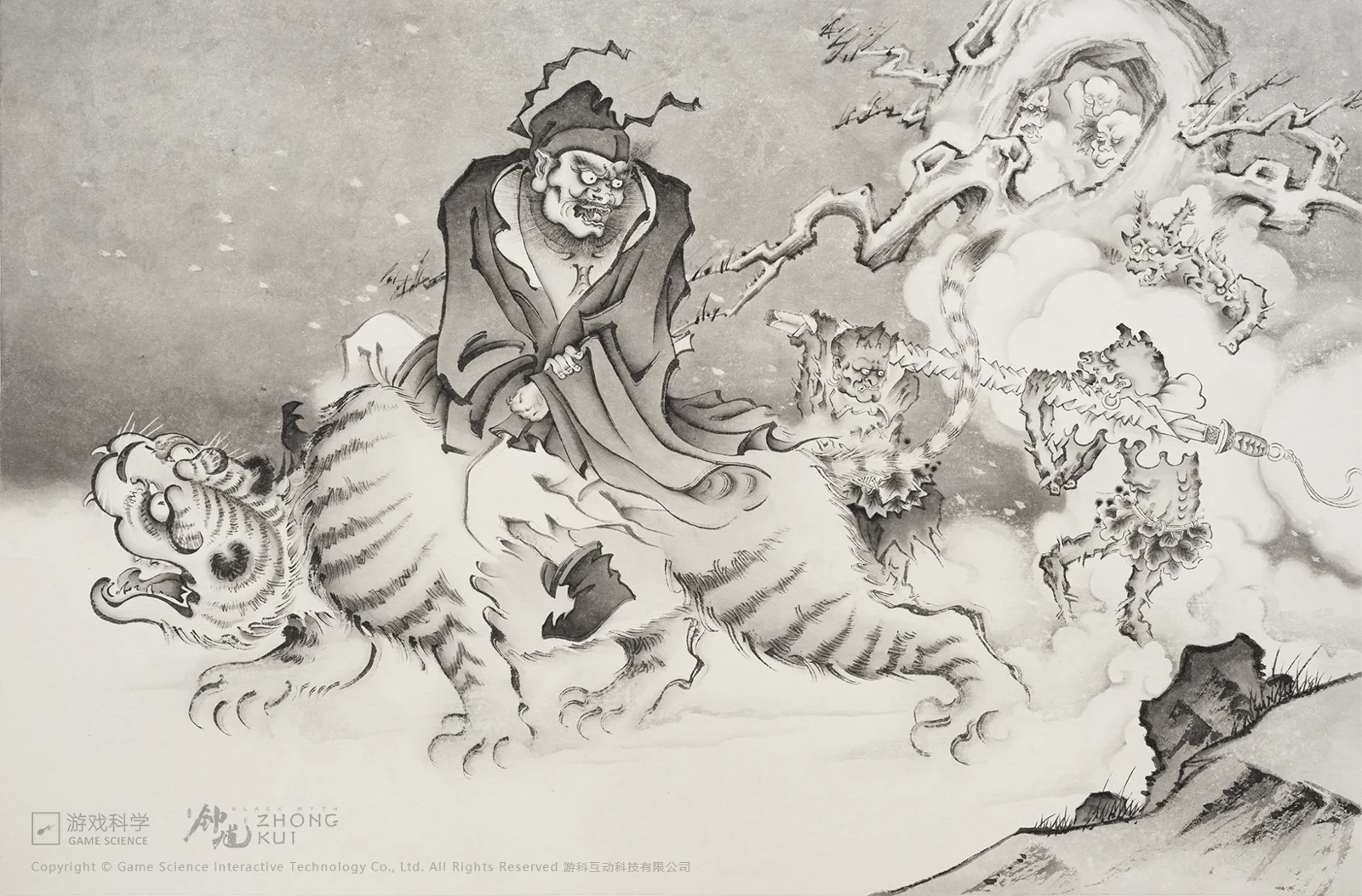
Zhong Kui riding a tiger in official concept art for Black Myth: Zhong Kui. Source: Game Science.
The studio released an early build. The comment section returned it with complete lore, patch notes, casting notes, and one unresolved bug: the release date.
下次热搜见 — see you at the next hot search