"Like a tsunami on land." The comment section watched Gyirong disappear.
On August 26, a glacier collapse on the Nepal side buried Gyirong Port on the Tibet–Nepal border in minutes. The comment sections spent the next day doing the only things left to do: amateur glaciology, watching the numbers climb, and praying.
What happened
Around 10:30 in the morning on August 26, part of a glacier and the mountainside under it collapsed on the Nepal side of the Himalayas. The mass came down as an ice-rock debris flow. Minutes later — commenters watching the surveillance footage counted seven — it reached Gyirong Port, 15 to 20 kilometers downstream.
CONTEXT · A “port,” here, with no sea anywhere in sight: 口岸 kǒu’àn — a land border crossing. Gyirong Port is China’s main overland gateway to Nepal, a checkpoint town wedged into a Himalayan gorge in Shigatse, Tibet.
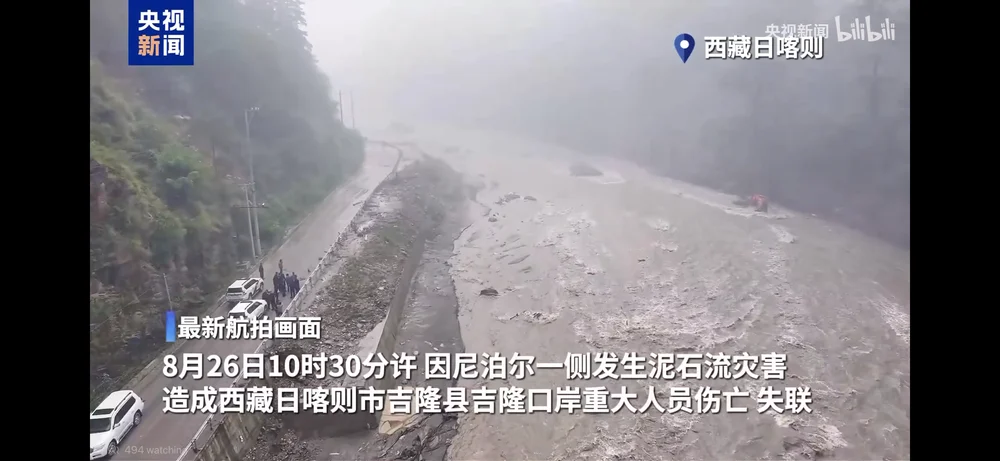
The state broadcaster’s caption reads: 8月26日10时30分许 因尼泊尔一侧发生泥石流灾害 造成西藏日喀则市吉隆县吉隆口岸重大人员伤亡 失联 “Around 10:30 a.m. on Aug 26, a mudslide disaster originating on the Nepali side caused major casualties and left people missing at Gyirong Port, Gyirong County, Shigatse, Tibet.”
No official toll had settled by the time we archived these threads on August 27, and none of the numbers below should be read as final. What follows is not a news report. It is what 6,485 comments across four bilibili threads did with a disaster in real time — which turned out to be three things in sequence: they tried to understand it, they tried to count it, and then they prayed.
What they’re saying
First, the physics lesson
The top comment under Xinhua’s livestream of the aftermath is not grief. It is a measurement, because the grief needed a denominator first.
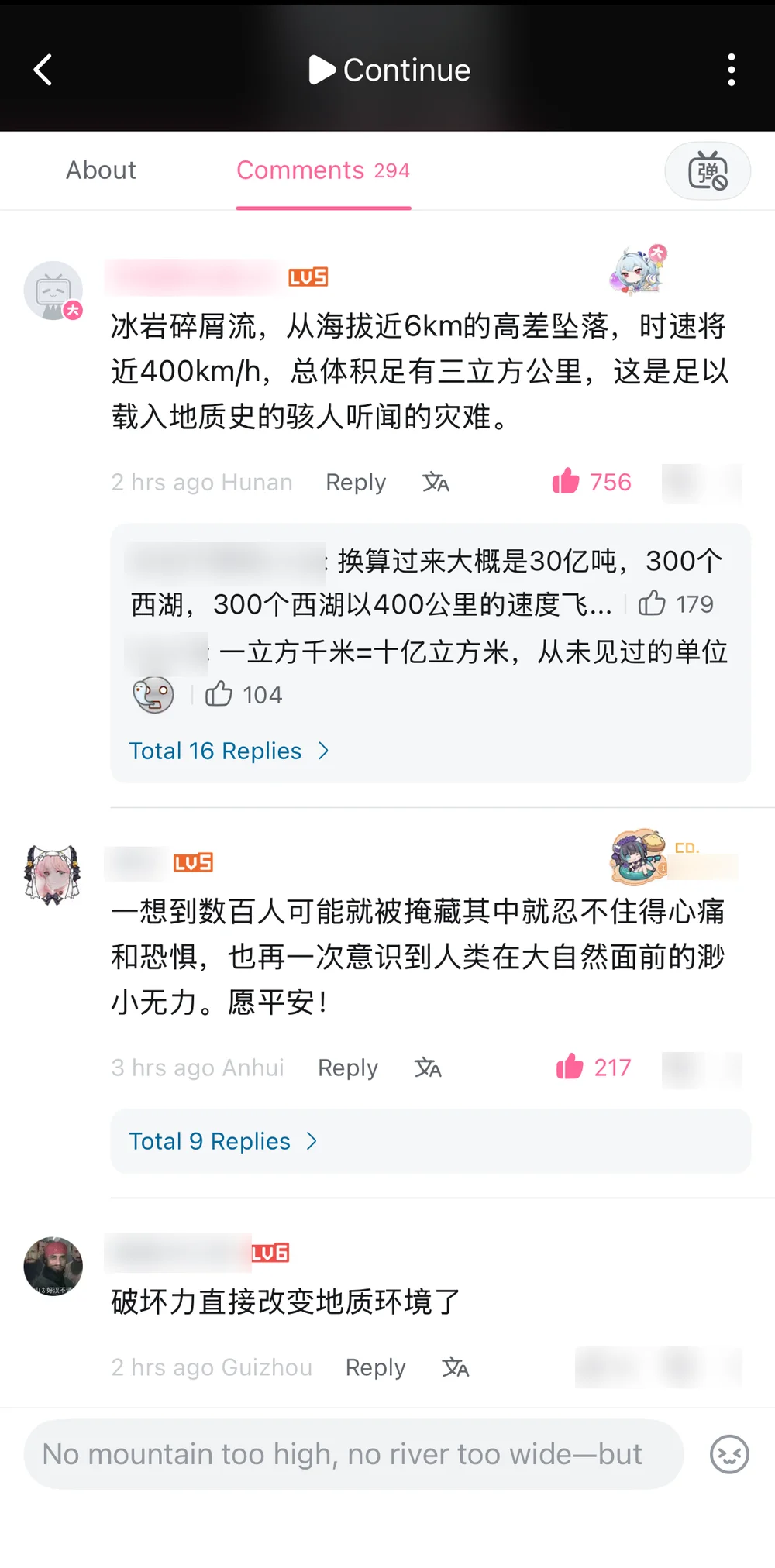
冰岩碎屑流,从海拔近6km的高差坠落,时速将近400km/h,总体积足有三立方公里,这是足以载入地质史的骇人听闻的灾难。 “An ice-rock avalanche, falling nearly 6 kilometers of elevation, closing in on 400 km/h, three cubic kilometers of it in total. This is the kind of disaster that gets written into the geological record — the horrifying kind.” — 756 likes, Hunan
一想到数百人可能就被掩藏其中就忍不住得心痛和恐惧,也再一次意识到人类在大自然面前的渺小无力。愿平安! “The thought that hundreds of people may be hidden under all this — I can’t help the heartache and the fear. Once again I understand how small and powerless humans are in front of nature. Please be safe!” — 217 likes, Anhui
The replies took the numbers and tried to make them mean something.

一立方千米=十亿立方米,从未见过的单位😵 “One cubic kilometer = one billion cubic meters. A unit I have never seen used before 😵” — Shanghai
冰岩碎屑流 从右边山体冲下来,冲上左边至少近200多米高的山体上。。。。再加上空气效应 。。。。 “The ice-rock flow came down the mountainside on the right and surged at least 200 meters UP the mountain on the left…… and then there’s the air blast on top of that……” — 17 likes, Sichuan
换算过来大概是30亿吨,300个西湖,300个西湖以400公里的速度飞过来 “Do the math and that’s roughly 3 billion tons. Three hundred West Lakes. Three hundred West Lakes flying at you at 400 kilometers an hour.” — 181 likes, Hainan
CONTEXT · 西湖 Xīhú, West Lake — Hangzhou’s most famous body of water, and the Chinese internet’s favorite unit for volumes too big to imagine. One West Lake is roughly 5,800 Olympic pools. Three hundred of them is about 40% of Loch Ness — emptied down a mountainside at highway-times-three speed.
Two more replies finished the arithmetic:
西湖还只是水,这玩意是巨石裹挟着泥沙 “West Lake is just water. This thing is boulders wrapped in mud.”
石头泥沙的密度比水大多了,重量更大,比单纯洪水危害更大 “Rock and sediment are far denser than water — more mass, far deadlier than a flood.”
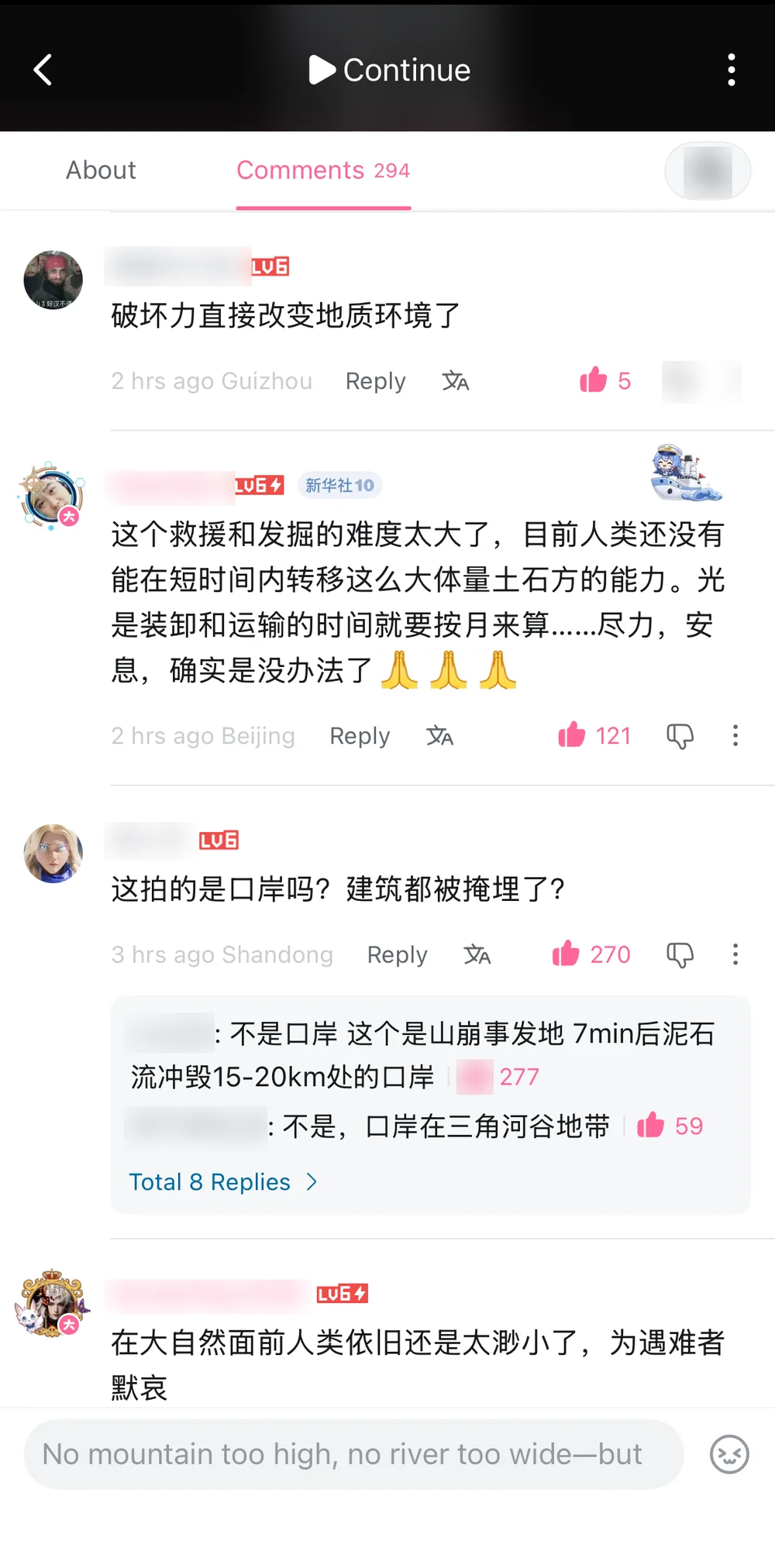
破坏力直接改变地质环境了 “The destructive force literally rewrote the local geology.” — 5 likes, Guizhou
这个救援和发掘的难度太大了,目前人类还没有能在短时间内转移这么大体量土石方的能力。光是装卸和运输的时间就要按月来算……尽力,安息,确实是没办法了🙏🙏🙏 “The rescue and recovery here is almost impossibly hard. Humanity simply doesn’t have the ability to move earth on this scale in a short time — the loading and hauling alone would be measured in months…… Do what can be done. Rest in peace. There truly is no way. 🙏🙏🙏” — 121 likes, Beijing
这拍的是口岸吗?建筑都被掩埋了? “Is this footage of the border port? The buildings are all buried?” — 270 likes, Shandong
不是口岸 这个是山崩事发地 7min后泥石流冲毁15-20km处的口岸 “No — this is the landslide site. Seven minutes after this, the debris flow destroyed the border port 15–20 km away.” — the reply, 277 likes
在大自然面前人类依旧还是太渺小了,为遇难者默哀 “In front of nature, humans are still just too small. Mourning the dead.” — the comment below
Even the geography had to be crowdsourced. The thread corrected itself in public, reply by reply:

不是,口岸在三角河谷地带 “No, the port sits in a delta at the valley mouth.” — 59 likes, Guangdong
拍的是形成的堰塞湖 “What’s filmed here is the barrier lake it formed.” — 28 likes, Inner Mongolia
更正下是20多米😭 “Correction: it’s twenty-something meters 😭” — the reply
口岸那边很宽的,不是这里 “The port area is much wider than this — this isn’t it.” — 15 likes, Sichuan
A barrier lake — a lake dammed up by the debris itself — is a second disaster on layaway; a reporter on the ground noted more of them upstream. And for scale, one commenter reached for the biggest thing China has ever built:

当年做三峡也就挖过1.87亿立方米的土,这泥石流好像是冲了三四十亿方土下来 “The entire Three Gorges project excavated 187 million cubic meters of earth. This debris flow reportedly brought down three or four BILLION.” — 98 likes, Hubei
山体崩塌引发5.2级地震,半个山头都没了,带着50亿立方米的土石水从数千米高山上冲下。逆流而上冲了数公里,几十米高的泥石流… “The collapse set off a magnitude-5.2 quake. Half the mountaintop is gone — 5 billion cubic meters of rock, earth and water charging down from a several-thousand-meter mountain, surging kilometers upstream, a debris flow dozens of meters high…” — 48 likes, Guangdong
The volume estimates in the thread disagree with each other by an order of magnitude — three cubic kilometers, three or four billion cubic meters, five billion. Nobody knew yet. That was part of the horror: on day one, even the amateurs’ numbers could only agree on unprecedented.

尼泊尔此次山体滑坡灾害破坏力极大,并非想象中普通的滑坡灾害。事发区域位于尼泊尔境内海拔7000余米的北坡,巨型山体发生崩塌滑坡,大量巨石、山体岩土与冰雪裹挟在一起倾泻而下,冲击力极强,破坏力呈指数级放大,山下所有构筑物都难以抵御,都将不复存在,人员更是毫无避险空间🙏🙏🙏 “This Nepal landslide is devastating on a scale far beyond an ordinary slide. It started on a north slope above 7,000 meters inside Nepal: a giant mountainside collapsed, and boulders, rock, soil and glacial ice all came down together. The impact force multiplies exponentially. Nothing built below the mountain could withstand it — none of it will have survived — and for the people there was no space to escape to at all 🙏🙏🙏” — 24 likes, Beijing
太可怕了,仿佛从从未有过人类的痕迹 “Terrifying. As if there had never been any trace of humans here at all.” — 75 likes, Beijing
逝者安息,这天灾太恐怖了,希望还有幸存者🙏 “Rest in peace. This disaster is horrifying. I hope there are still survivors 🙏” — 1 like, Inner Mongolia
这是冰川崩塌冲下河谷的位置,叫得汀,口岸还在下游。 “This is where the glacier collapse came down into the river valley — a place the commenter calls ‘Deting’ — the border port is further downstream.” — Anhui
Someone in New Zealand added the comparison that would organize the whole day, and someone in Jiangsu typed the sentence the thread kept arriving at from every direction:
比地震后的海啸还难预警,那种至少还有好几个小时才到岸上。 “Even harder to warn against than a post-earthquake tsunami. A tsunami at least gives you hours before it reaches shore.” — New Zealand
在大自然面前人类依旧还是太渺小了,希望西藏人民平安🙏 “In front of nature, humans are still just too small. Praying the people of Tibet are safe 🙏” — Jiangsu
Then, the witnesses
Under the video of the event itself, the register changed. Nobody was measuring anymore.

看一眼录像回放你就知道有多绝望了,跟2012里的海啸一样😵😵 “Watch the replay once and you’ll understand the hopelessness. It’s the tsunami from the movie 2012. 😵😵” — 3,527 likes, Zhejiang
很难了,自然之力太大强了 “It’s beyond saving. The force of nature is just too much.” — 769 likes
绝望啊😮💨 “The despair 😮💨” — 74 likes, Guangxi

泥石流那边城市也是大洪水房子被冲垮了,我们这边口岸监控看口岸被冲差不多了 “On the far side the debris flow flooded a whole town, houses swept away. On our side, the port surveillance shows the border port is basically gone.” — 326 likes, Zhejiang
这个水量有点大啊,没看到尼方那边有明显冰湖,难道是冰川垮塌过程中融化了? “That is a LOT of water. I don’t see an obvious glacial lake on the Nepali side — did the glacier melt as it collapsed?” — 193 likes, Sichuan
And then the counting began — not by any newsroom, but inside a single reply thread, over the course of a day:

第一次看到因为直接说出现重大伤亡,那肯定伤亡不小了 “First time I’ve ever seen an official report just say ‘major casualties’ outright. The toll must not be small.” — 79 likes, Jiangsu
目前通报200多失联 “Current bulletin: 200+ missing.” — Yunnan
现在的数字是558了 “The number is 558 now.” — Hunan
太惨了 “It’s just tragic.” — the same commenter, returning
CONTEXT · 重大伤亡 zhòngdà shāngwáng, “major casualties” — official Chinese bulletins rarely lead with this phrase; they usually let the counted numbers speak. When a bulletin says it before any number lands, readers understand: the counting isn’t done, and it is already bad.
The most-liked factual comment in the thread compiled what the two governments had said — numbers that were already moving as they were typed (all figures as of Aug 26–27, since revised):
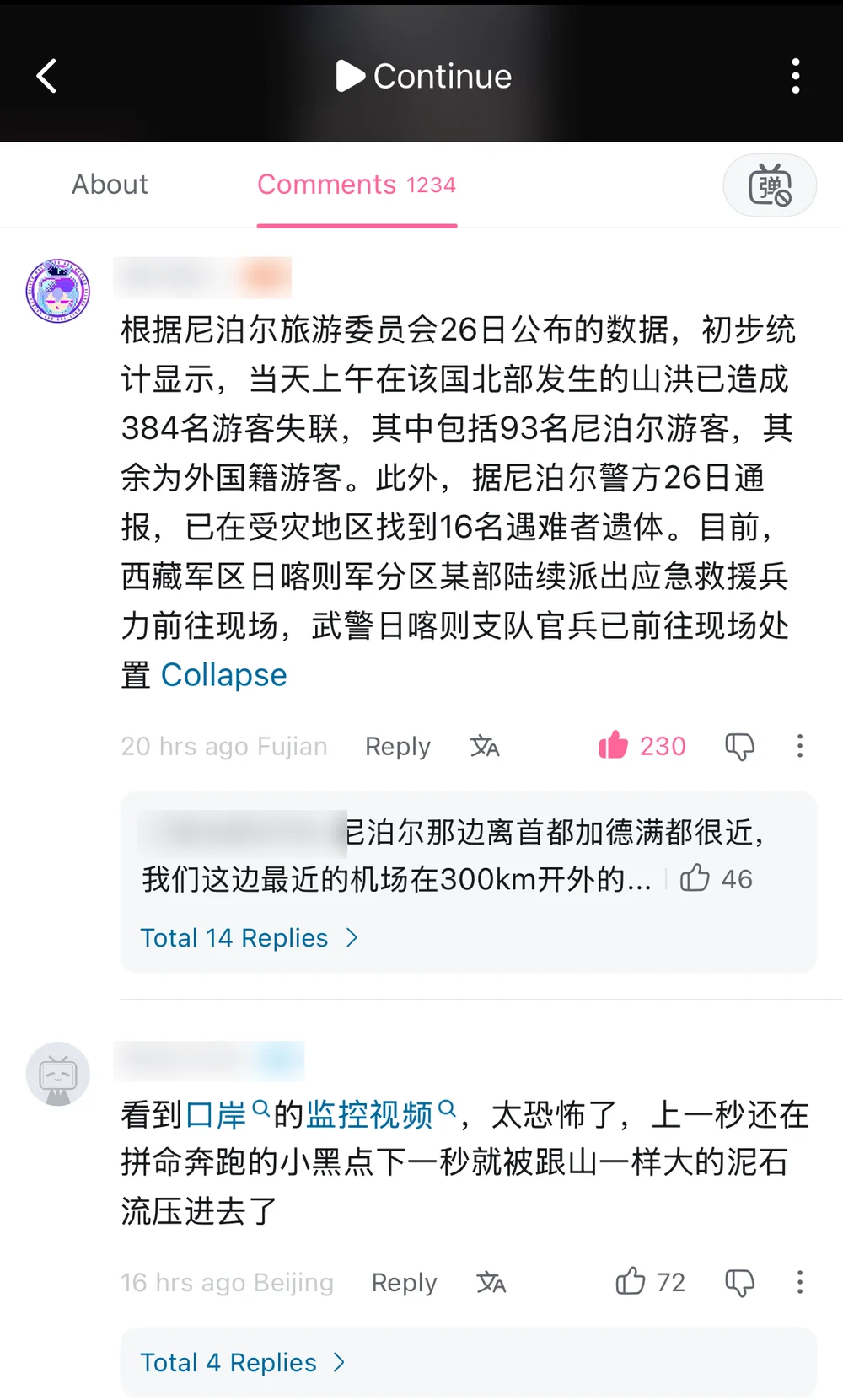
根据尼泊尔旅游委员会26日公布的数据,初步统计显示,当天上午在该国北部发生的山洪已造成384名游客失联,其中包括93名尼泊尔游客,其余为外国籍游客。此外,据尼泊尔警方26日通报,已在受灾地区找到16名遇难者遗体。目前,西藏军区日喀则军分区某部陆续派出应急救援兵力前往现场,武警日喀则支队官兵已前往现场处置 “Per the Nepal Tourism Board’s Aug 26 figures, preliminary counts put 384 tourists missing from the morning’s flash flood in the country’s north — 93 of them Nepali, the rest foreign nationals. Nepali police additionally reported 16 bodies recovered in the disaster area. Meanwhile the PLA’s Shigatse garrison has been dispatching emergency rescue forces to the site, and armed police from the Shigatse detachment are already there.” — 230 likes, Fujian
看到口岸的监控视频,太恐怖了,上一秒还在拼命奔跑的小黑点下一秒就被跟山一样大的泥石流压进去了 “I saw the port surveillance video. One second the little black dots are running for their lives; the next second a debris flow the size of a mountain presses them under. Terrifying.” — 72 likes, Beijing
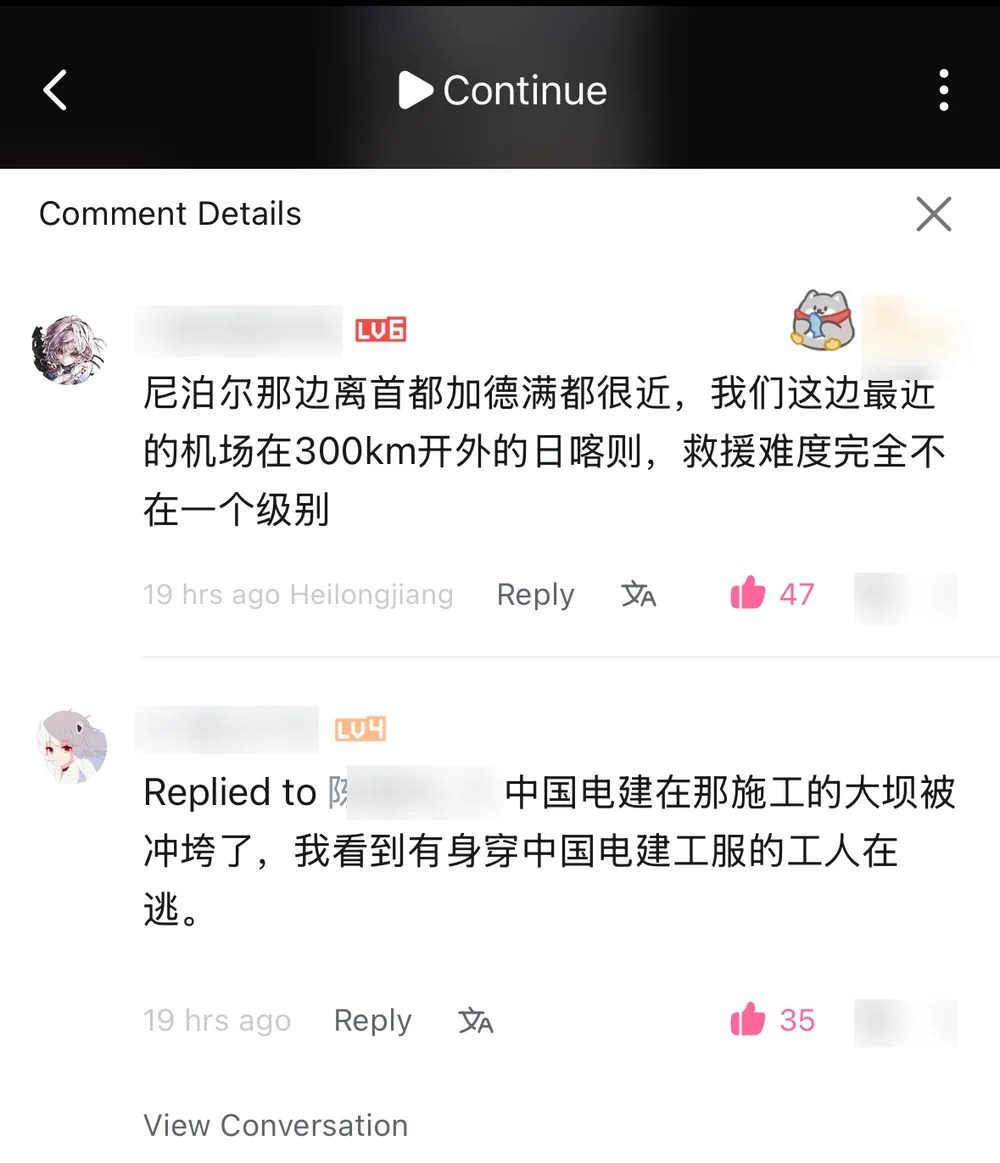
尼泊尔那边离首都加德满都很近,我们这边最近的机场在300km开外的日喀则,救援难度完全不在一个级别 “The Nepali side is close to Kathmandu. Our nearest airport is in Shigatse, 300 km away. The rescue difficulty is not remotely comparable.” — 47 likes, Heilongjiang
中国电建在那施工的大坝被冲垮了,我看到有身穿中国电建工服的工人在逃。 “The dam PowerChina was building there was destroyed — I saw workers in PowerChina uniforms running for it.” — 35 likes
PowerChina — 中国电建 Zhōngguó diànjiàn — is the state-owned giant behind much of the world’s biggest hydropower: its subsidiary Sinohydro was a principal builder of the Three Gorges Dam, it built Baihetan, the world’s second-largest hydropower station, and its dams run from Pakistan’s Karot to Ecuador’s Coca Codo Sinclair. Its crews were on the Nepali side when the flow came.
Under the evening news broadcast, the two national tallies met:

尼泊尔和国内分别通报的失联人数加起来都要上千了… “Add up the missing reported by Nepal and by China separately and it’s already heading past a thousand…” — 68 likes, Shanghai
天啊 两边加起来上千人了 “God. Both sides together — over a thousand people.” — 37 likes
Then, the map, and the people on it
One commenter answered the question nobody had asked out loud — why was the port there at all? — with a homemade satellite annotation:
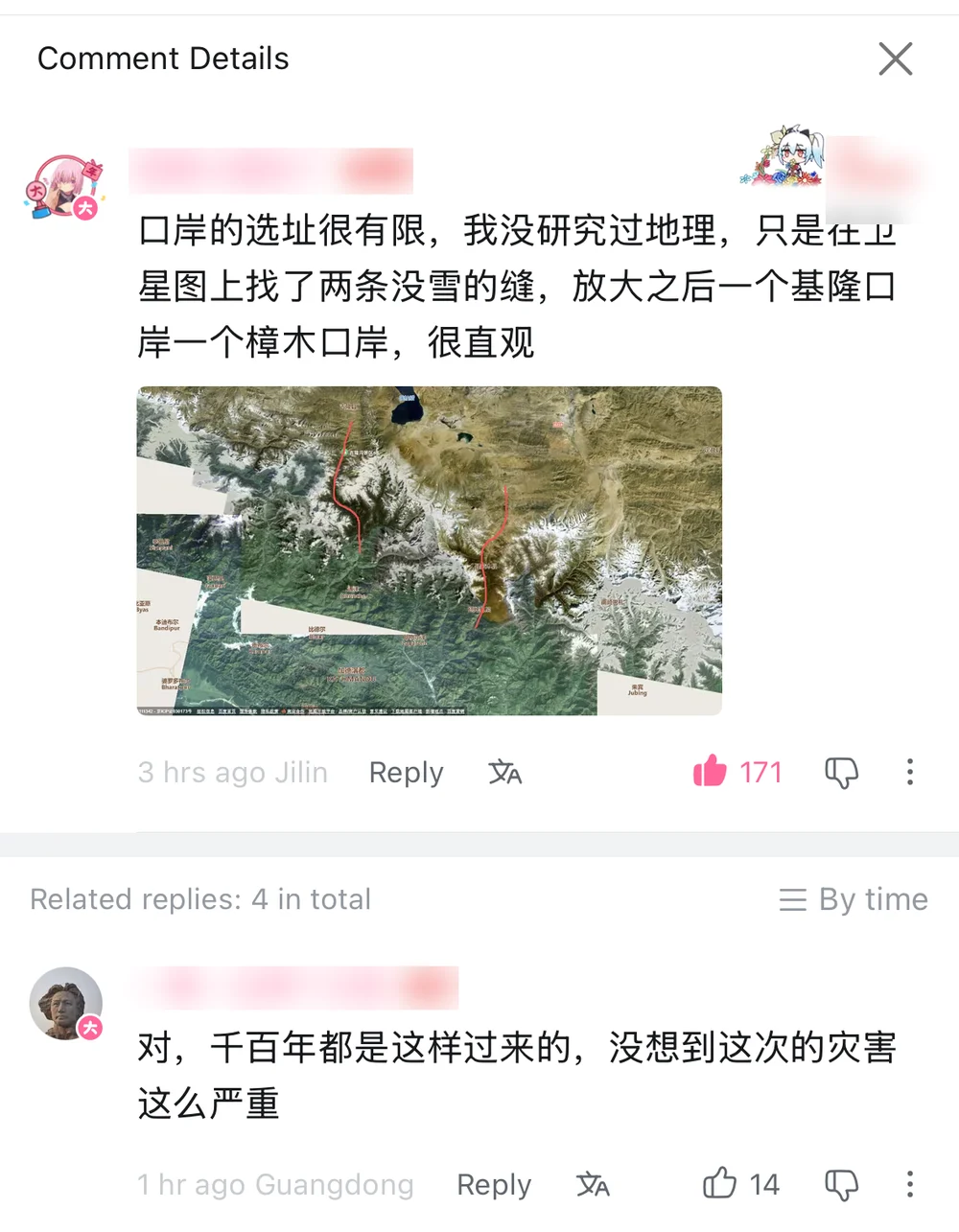
口岸的选址很有限,我没研究过地理,只是在卫星图上找了两条没雪的缝,放大之后一个基隆口岸一个樟木口岸,很直观 “There’s barely anywhere you CAN put a border crossing. I’ve never studied geography — I just looked at the satellite map for gaps with no snow. There are two. Zoom in: one is Gyirong Port [written 基隆 for 吉隆 in the original], the other Zhangmu Port. It’s that stark.” — 171 likes, Jilin
对,千百年都是这样过来的,没想到这次的灾害这么严重 “Right — it’s been this way for a thousand years. Nobody expected this one to be this bad.” — 14 likes, Guangdong
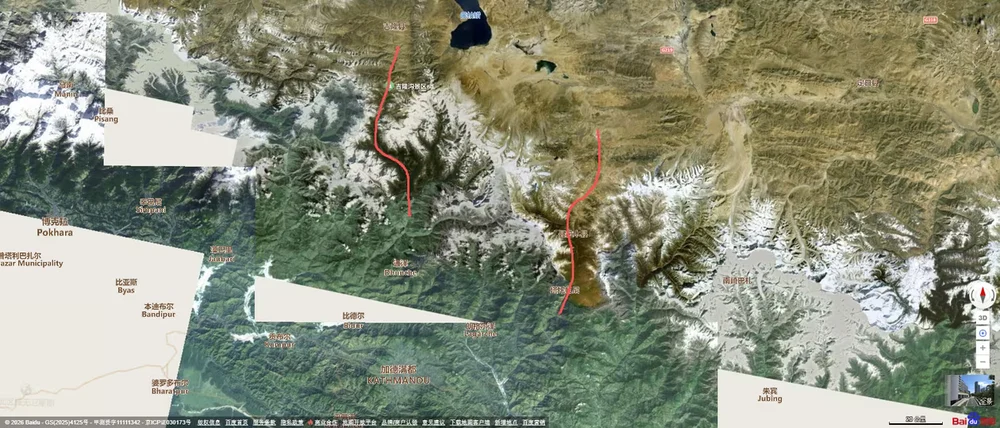
The mountains allow two doors. This was one of them. And once the abstraction had a door, the door had people. The highest-liked personal story of the day:

老爹是工程师在尼泊尔出差,今早看了新闻,发消息没回。前面老妈打来电话说营地全部被冲毁了,老爹就拿了手机出来,笔记本、现金啥都没了,两三百号人转移到上山了,暂时平安🥲 “My dad’s an engineer on assignment in Nepal. Saw the news this morning, messaged him — no reply. Then my mom called: the whole camp was washed away. Dad got out with just his phone — laptop, cash, everything else is gone. Two or three hundred people have moved up the mountain. Safe for now 🥲” — 3,074 likes
人没事就好就好 “He’s okay. That’s all that matters. That’s all that matters.” — 1,102 likes
万幸了 “Thank god. Thank god.” — 280 likes
The screenshot attached to it is the family’s last exchange before the disaster, from August 21. Son: 新手机 你用不? “New phone. Want it?” Father, next morning: 不用 “No need.” Six days later, the phone was the only thing he carried out.
Another commenter had stood at the gate itself, four months earlier:
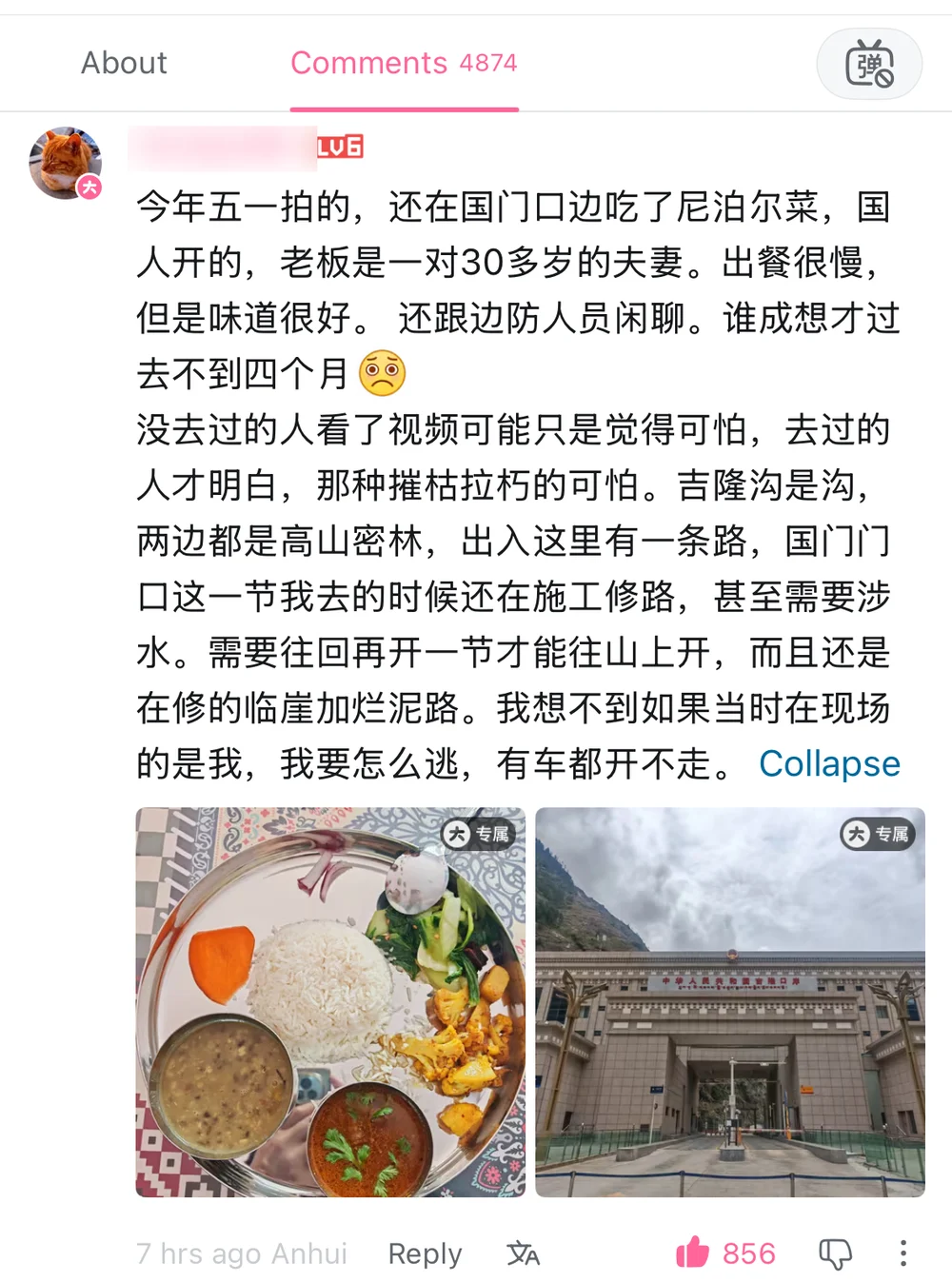
今年五一拍的,还在国门口边吃了尼泊尔菜,国人开的,老板是一对30多岁的夫妻。出餐很慢,但是味道很好。还跟边防人员闲聊。谁成想才过去不到四个月😳 没去过的人看了视频可能只是觉得可怕,去过的人才明白,那种摧枯拉朽的可怕。吉隆沟是沟,两边都是高山密林,出入这里有一条路,国门门口这一节我去的时候还在施工修路,甚至需要涉水。需要往回再开一节才能往山上开,而且还是在修的临崖加烂泥路。我想不到如果当时在现场的是我,我要怎么逃,有车都开不走。 “Took these on May Day this year. Ate Nepali food right by the border gate — a Chinese-run place, the owners a couple in their thirties. Service was slow, food was great. Chatted with the border guards. Who could have guessed — not even four months ago 😳 People who haven’t been there watch the video and just think ‘scary.’ People who HAVE been understand the scale of it. Gyirong Valley is a gorge — high mountains and dense forest on both sides, one single road in and out. The stretch by the border gate was still under construction when I went; you had to ford water. You have to double back a stretch before the road even starts climbing — and that’s a half-built cliff road in mud. I can’t work out how I would have escaped if I’d been there that day. Even with a car, there’s no driving out.” — 856 likes, Anhui

看过视频,感觉都夷为平地了,整个泥流都包裹着口岸大门,人都感觉像蚂蚁一样小 “I’ve seen the video. Everything’s been leveled. The mud wrapped itself around the port gate — people look ant-sized against it.” — 229 likes, Hainan
没了,有卫星对比图,全是泥 “It’s gone. There’s a satellite before-and-after. All mud.” — 39 likes, Shandong
The photos show a steel thali of rice and dal, and the gate inscribed 中华人民共和国吉隆口岸 “Gyirong Port of the People’s Republic of China”. Taken May 2026, four months before the disaster.
Meanwhile the amateur glaciologists finished their homework:

已经比较明确是哪个冰湖垮了 “It’s now fairly clear which glacial lake collapsed.” — 389 likes, Jiangsu
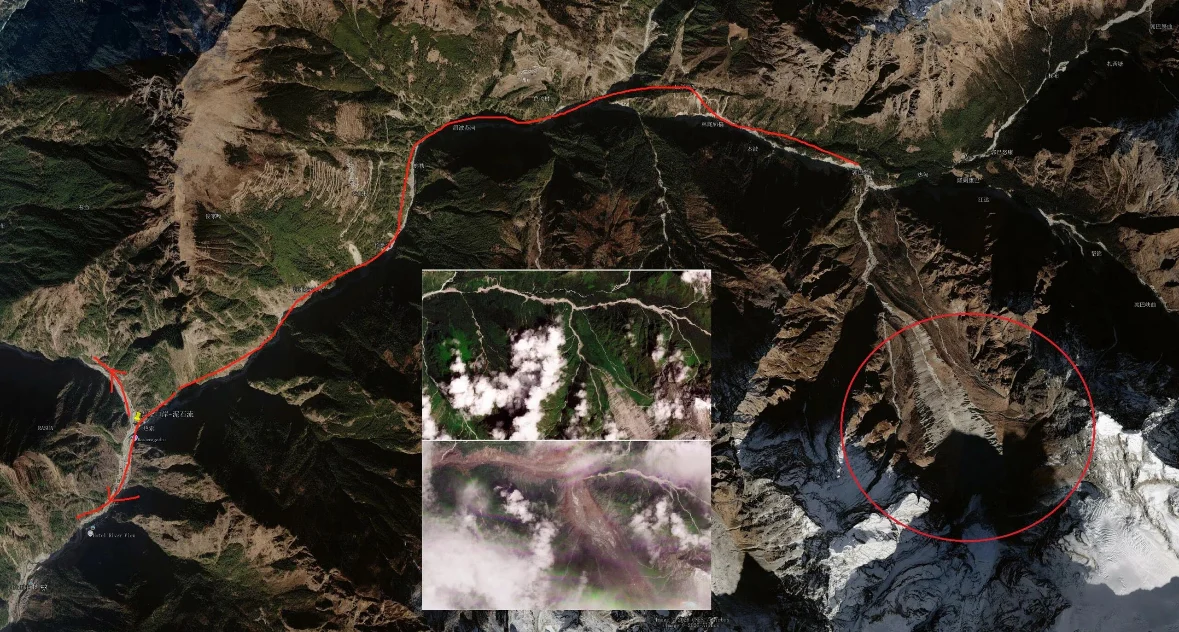
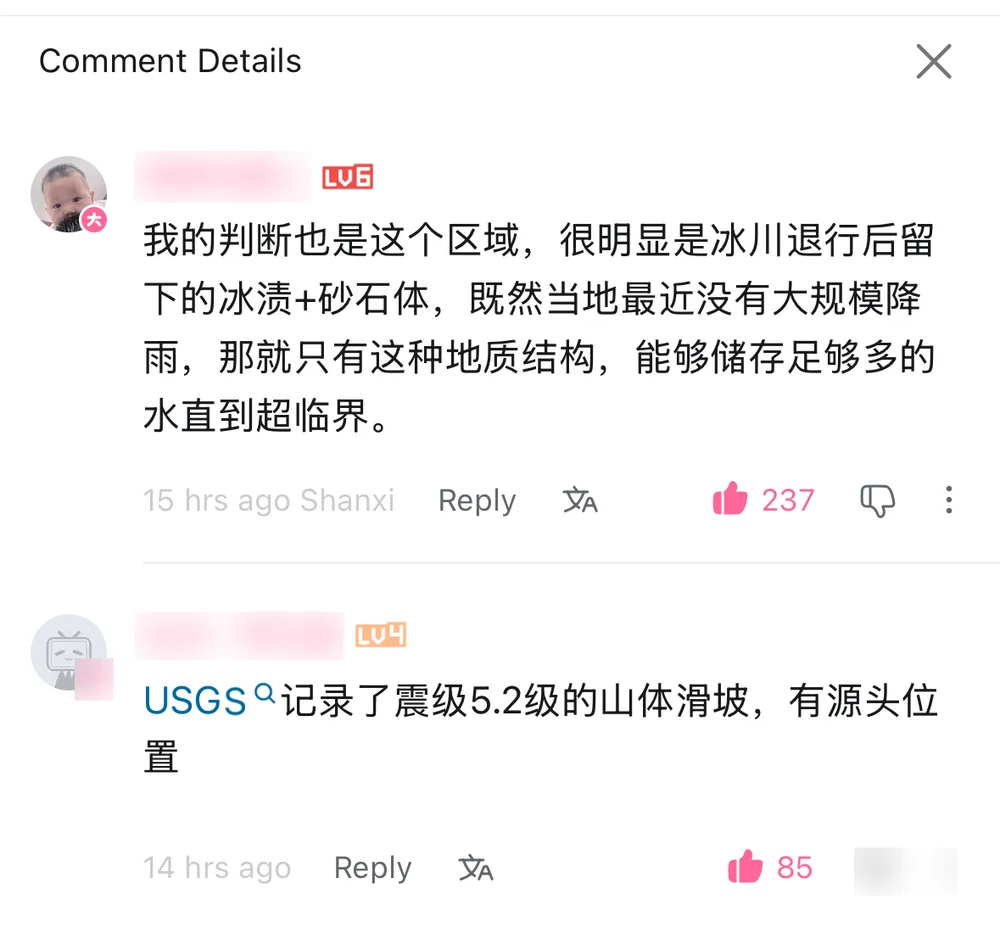
我的判断也是这个区域,很明显是冰川退行后留下的冰渍+砂石体,既然当地最近没有大规模降雨,那就只有这种地质结构,能够储存足够多的水直到超临界。 “My read is the same region. It’s clearly the moraine — ice debris and sediment left behind as the glacier retreated. No major rainfall there recently, so only that kind of geological structure could store enough water to go supercritical.” — 237 likes, Shanxi
USGS记录了震级5.2级的山体滑坡,有源头位置 “USGS recorded the landslide as a magnitude-5.2 event, with a source location.” — 85 likes
A retreating glacier. A moraine holding water it was never meant to hold. The commenters did not have to say the words “climate change” — the diagram said it for them.
What I see
The most-liked comment across all four threads is the one that named the day:

看了事件录像,太恐怖了,简直就像陆地上席卷而来的海啸,人根本逃不掉,躲到车里和楼房里也没用,所到之处无一幸免😭 “I watched the footage. It’s terrifying — a tsunami sweeping across land. People simply cannot outrun it. Hiding in a car is useless, hiding in a building is useless. Nothing in its path was spared 😭” — 4,647 likes, Beijing
看了口岸大楼被瞬间覆盖的监控 只能说太强大了这个泥石流 “I watched the surveillance of the port building being covered in an instant. All I can say is: this debris flow was overwhelming.” — the reply
看过了,被震撼了,辛亏那边人口密度不大,不然后果难以想象,即便这样… “I’ve seen it. I’m shaken. Mercifully the population density there is low, or the consequences would be unimaginable. Even so…” — 790 likes
胆子小的别看原视频 太惨烈了看得我心里不适 “If you’re faint-hearted, don’t watch the original video. It’s brutal. It left me feeling sick.” — 866 likes
难受了几个小时,缓不过来,好绝望啊,人类在大自然面前太渺小了。 “I’ve felt awful for hours and can’t come back from it. The despair. Humans are too small in front of nature.” — the reply

我就这么评价,迄今为止,所有我见过的海啸的视频带来的恐惧,都远远不如这次,印尼海啸,日本抵制海啸,都是有循循渐进的过程,和电影里面扑面而来的完全不一样,扑面和涨水是两回事,这次原视频真的太疯狂了,简直真的和电影里面一样,扑面懂吗?那种完全不给你机会,直接冲过来比房子还高的泥水,只有电影里面见到过,太可怕了,愿逝者安息 “Here’s my verdict: of every tsunami video I have ever seen, none carried fear like this one. The Indonesia tsunami, the Japan tsunami — those built gradually. Completely different from something that comes AT you, like in the movies. A wall coming at you and water rising are two different things. The original footage is insane — it really is like the movies. Do you understand ‘coming at you’? The kind that gives you no chance at all — mud higher than the houses, charging straight in. I’d only ever seen that in films. Terrifying. May the dead rest in peace.” — 3,278 likes, Shanghai

比地震海啸猛烈多了,这次的泥石流,在波及范围内你躲哪里都没用,唯一的可能就是你能飞起来,人在大自然面前实在是太渺小了 “Far more violent than a quake tsunami. With this debris flow, inside its reach, hiding anywhere was useless — your only chance was if you could fly. Humans really are too small in front of nature.” — 711 likes, Shandong
主要是感觉海啸乃至地震都有可能能躲,但是看到相关视频会发现这次根本没地方躲,一切都那么突然,往两边跑都躲不掉,那么大的泥石流和渺小的人类,哎 “What gets me is: a tsunami, even an earthquake, you might dodge. Watch the videos of this and you realize there was nowhere to hide. It was all so sudden — running to either side wouldn’t save you. A debris flow that vast, and humans that small. Ah…” — 190 likes, Zhejiang
二三十米高的黄色洪水携带着各种东西冲击而来,人们下意识地跑开,但是顷刻间,人、车、建筑连带着那片地被冲走卷袭,有的人甚至来不及反应就已经消失在泥石流当中。🙏🙏只能不切实际地祈祷有奇迹会发生,也希望救援人员能安全 “A yellow flood twenty, thirty meters high, carrying everything with it. People instinctively ran. But in an instant — people, cars, buildings, the ground itself — all of it swept up and carried away. Some vanished into the debris flow before they could even react. 🙏🙏 All that’s left is to pray, unrealistically, for a miracle — and to hope the rescuers stay safe.” — 380 likes, Hubei
One sentence recurs across all four threads, typed independently by at least seven different people, in almost the same words every time: 人类在大自然面前太渺小了 rénlèi zài dà zìrán miànqián tài miǎoxiǎo le — “in front of nature, humans are too small.” On an ordinary day, China’s comment sections are the loudest room on the internet — a roast battle with a scoreboard. On August 26 the same rooms turned into something older. People did the physics because the physics was a way of holding it. They counted because someone had to. And when the measuring and the counting ran out, they did the last thing a comment box allows: they typed a prayer where anyone could see it — 愿平安 yuàn píng’ān — “may they be safe” — and pressed send, knowing exactly how small that is, and doing it anyway.
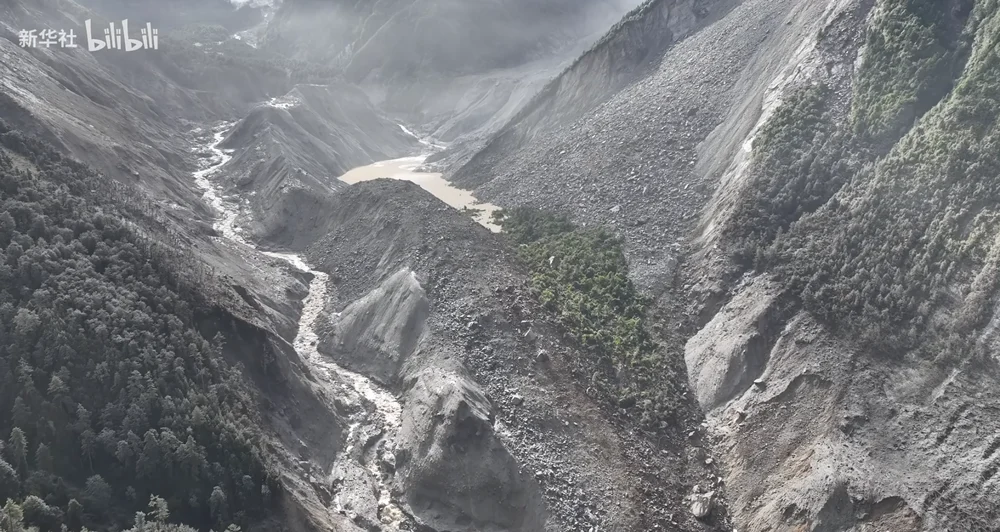
Aerial footage of the landslide valley upstream of Gyirong Port, with the barrier lake formed by the debris, Aug 27, 2026. (Xinhua livestream via bilibili)
下次热搜见 — see you at the next hot search